Where cloth forgets it is cloth, and becomes the breath held between two threads.
The Loom That Learned to Dream
There is a moment in the weaving of jamdani when the fabric appears to contradict itself. The ground weave, so fine it might be measured in moonlight, seems to offer no anchor for the patterns that float above it. And yet the flowers remain. The mango buds hold their position. The geometric tracery stays exactly where the weaver placed it, suspended in the cloth as if by an agreement older than technique.
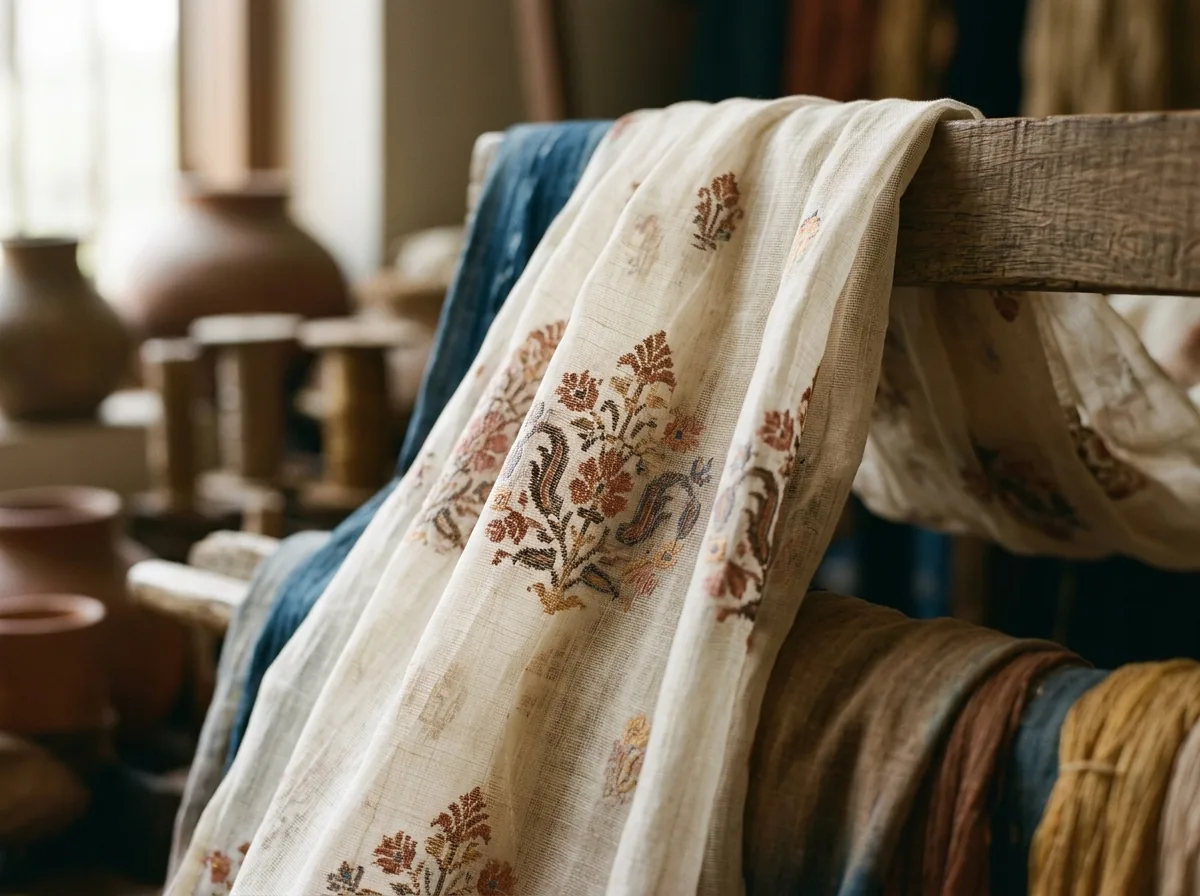
This is the logic of the supplementary weft, the defining principle of jamdani. Unlike woven-in motifs that are trapped within the structure of a fabric, the supplementary threads in jamdani float freely on the surface, interlaced by hand, bamboo needle by bamboo needle, across a ground weave that is itself already extraordinary. The base cloth, traditionally woven from the finest hand-spun cotton grown along the banks of the Meghna and Brahmaputra rivers, is so closely associated with the deltaic soil of Bengal that attempts to replicate it elsewhere have rarely captured the same quality. Water, humidity, and a particular quality of morning air all participate in the weaving.
Jamdani belongs to a tradition that stretches back at least seven centuries, though its lineage in Bengali court culture is likely older still. The word itself is most commonly traced to Persian: jam for flower, dani for vessel or vase. A vessel carrying flowers. The name suits it. Every piece of jamdani is, in some sense, a container for botanical imagination, a length of cloth that holds gardens in a grammar of thread.
Dhaka and Its Diaspora of Thread
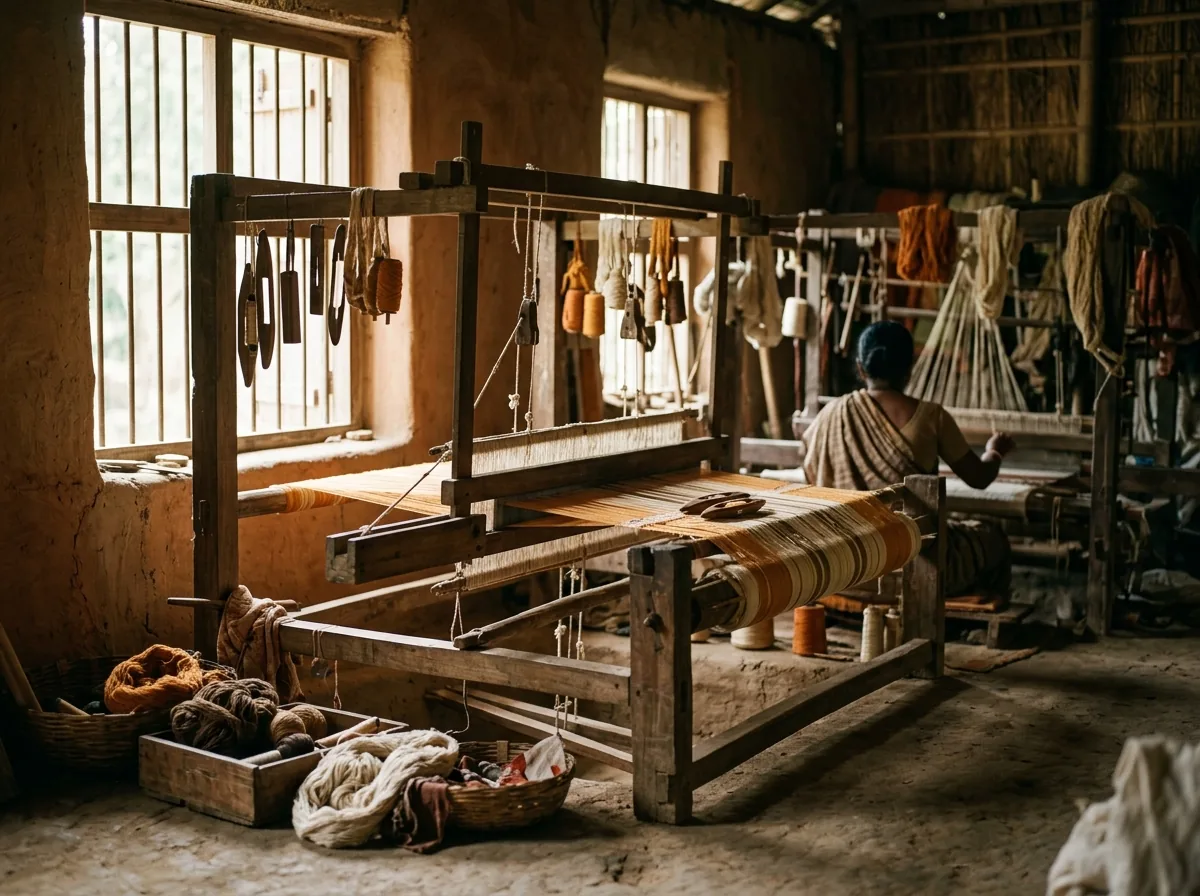
For centuries, the jamdani loom was synonymous with Dhaka, the city on the Buriganga river that served as the capital of Mughal Bengal. The weavers who sustained this tradition belonged primarily to the Muslim weaving communities concentrated in villages to the north and east of the city: Demra, Rupganj, Sonargaon. These were not isolated craftsmen but part of an organised economy, supplying cloth to Mughal nobility, to European trading companies, and to a pan-Asian textile trade that moved fine Bengali cotton from Constantinople to Nagasaki.
The partition of the subcontinent in 1947, and then the liberation of Bangladesh in 1971, reordered the geography of jamdani without entirely severing its roots. Weaving families who migrated to West Bengal carried their patterns and their looms into new settlements. Fulia, a town in Nadia district on the West Bengal side of the border, became one of the most significant of these new centres. Today, Fulia's weavers, many of them descendants of families that crossed the border carrying not much more than the memory of their craft, produce jamdani in a range of styles that bear careful comparison with their Bangladeshi counterparts.
Shantipur, also in Nadia, and the broader Hooghly belt have similarly absorbed the jamdani tradition into their weaving vocabularies. The result is a living craft that carries within it the memory of displacement, of borders drawn through cotton fields, of traditions that survived by travelling. To wear a piece of West Bengal jamdani today is to wear a cloth woven by communities who refused to let their knowledge drown in political geography.
Nur Jahan and the Weight of Lightness
The Mughal court was perhaps the most discerning consumer of fine textiles in the premodern world, and within that court, Nur Jahan, the empress who wielded exceptional political and aesthetic influence during the reign of Jahangir, held particular authority over matters of dress and design. Persian accounts and later Mughal chronicles record the emperors fascination with Bengali muslins. Jahangir himself is said to have requested that the finest grades of Dhaka cloth be brought to the imperial court, where they were assessed with the same seriousness given to gemstones or miniature painting.
Nur Jahans shalwars, according to textile historians who have studied Mughal court records, were reportedly made from cloth so fine that when a full set of garments was folded, they could be held within a closed hand, or passed through a single ring. These grades had their own extraordinary names: woven air, running water. The claims may have grown in the telling, but the grades themselves were real, classified, and traded with precision.
What the Mughal court demanded, the weavers of Dhaka supplied, and in supplying it they refined techniques that remain unreplicated by industrial manufacture. The floating supplementary weft of jamdani was partly a response to this demand: how do you add ornament to a cloth that is already near-invisible? You do it with thread that barely touches the surface. You do it with patterns that seem to arrive from within the cloth rather than being imposed upon it from without. Nur Jahans court did not invent jamdani, but it created the conditions under which the craft reached its most demanding expression.
The Grammar of the Floating Weft
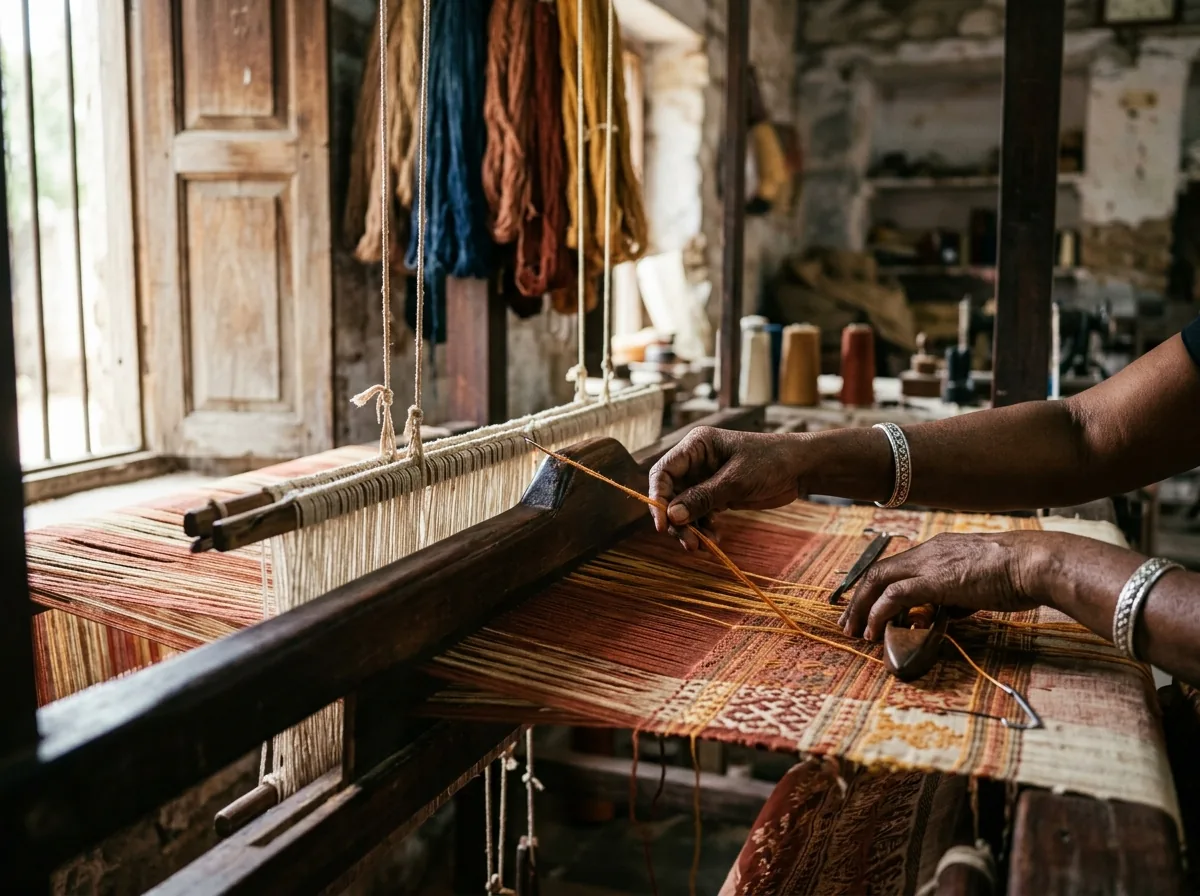
To understand jamdani is to understand the relationship between structure and ornament, and the rare case in which ornament becomes structural. The ground weave of a jamdani fabric is plain cotton, typically a balanced or near-balanced tabby, woven on a pit loom operated by two weavers working in close coordination. On this ground, the supplementary weft patterning is introduced, stitch by stitch, using additional threads that are not part of the functional weave.
The weaver reads the pattern from memory, or from a design held in the mind across years of practice. There are no punched cards, no Jacquard mechanisms, no graph paper placed beneath the threads. The motifs, whether the canonical kalka (mango or paisley), the phool (flower), the tara (star), the lata (vine), or the more geometrically resolved patterns favoured in certain regional styles, are placed by hand and eye alone, supplementary threads laid across the shed and beaten gently into position.
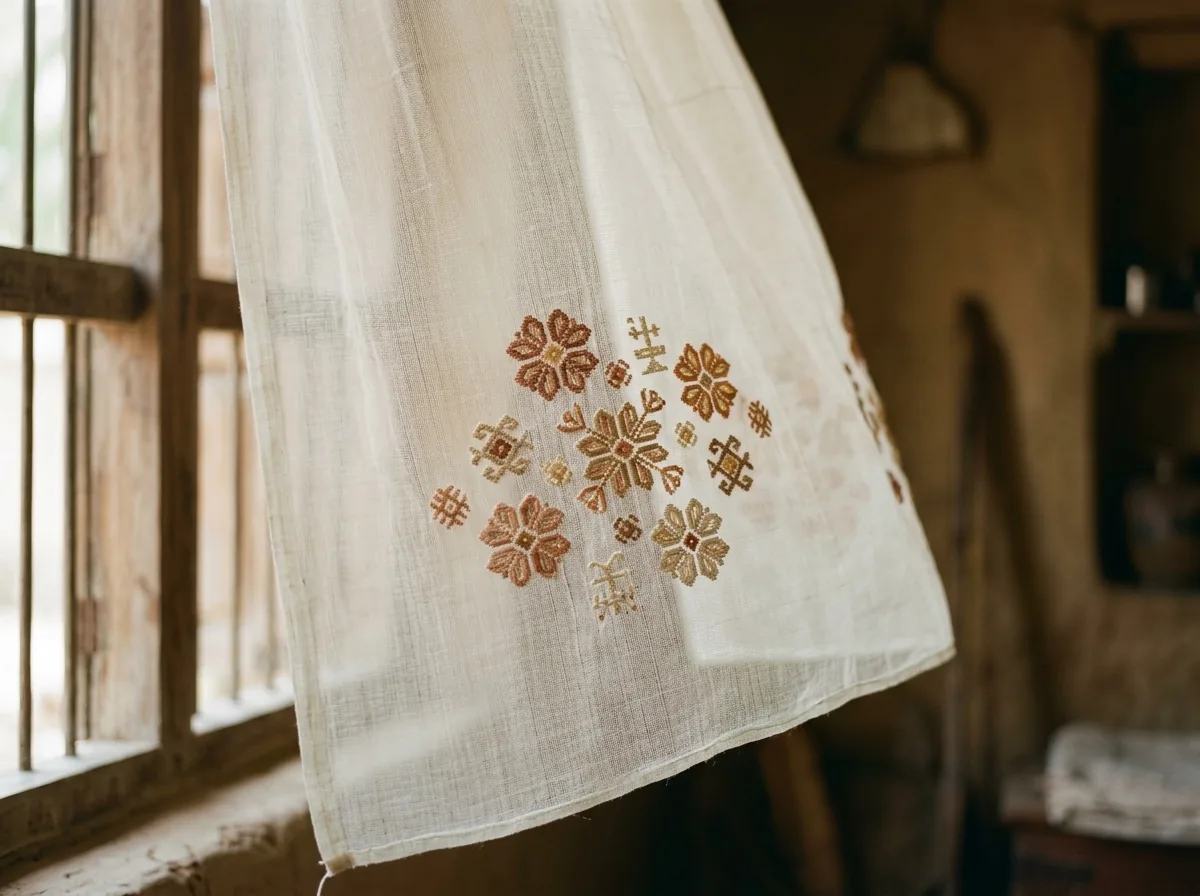
This technique produces the characteristic visual quality that makes jamdani immediately recognisable: a slight three-dimensionality to the patterning, a sense that the motifs are hovering rather than embedded. In strong light, the ground cloth disappears almost entirely, and only the pattern remains visible, as if drawn in thread on air. In softer light, the interplay between ground and motif creates a textural depth that even very fine printed or embroidered fabrics rarely achieve. The craft is time-intensive to a degree that makes it essentially incompatible with commercial-scale production. A single sari may require weeks. A heavily patterned piece, months.
Patterns That Carry Geography
Not all jamdani looks the same, and the regional variations tell a story about how a technique absorbs the aesthetic preferences of its surroundings. The older Dhaka tradition favoured relatively dense, all-over patterning, flowers and vines distributed across the full width of the fabric, with little empty ground visible. The West Bengal tradition, particularly as it evolved in Fulia and Shantipur after partition, developed a somewhat more restrained aesthetic in some lineages, with larger intervals of plain ground between motifs, allowing the sheer quality of the fabric to speak more directly.
There are also distinctions in the choice of supplementary thread. Traditional jamdani uses untwisted or lightly twisted cotton for the supplementary weft, which produces a slightly raised, matte surface to the motif. Some contemporary weavers in West Bengal have incorporated silk supplementary thread into cotton-ground jamdani, a hybridisation that produces different light effects. Purists may argue, but the tradition has always absorbed influence: the Mughal court brought Persian floral vocabulary into a Bengali weaving practice, and the result was more interesting than either source alone.
The motifs themselves constitute a living archive. The kalka pattern, now so naturalised into Bengali textile identity that it seems aboriginal, arrived with Mughal Persian influence. The geometric borders that frame many jamdani saris reference earlier Islamic geometric traditions from West and Central Asia. The small phool scattered across a white ground, however, belongs entirely to the Bengal imagination, and finds no direct equivalent in the textile traditions to the north or west.
A Cloth That Asks to Be Inherited
There is a quality to a well-made jamdani that resists the language of consumption. You do not simply wear it and move on. The fabric has a memory, almost a personality. It softens with washing without losing its structure. The supplementary weft motifs, free from the anxieties of synthetic dye or industrial processing, hold their clarity across decades. Jamdani saris pass between generations not because they have survived but because they deserve to.
In families across Bengal, and in diaspora homes from London to New Jersey to Kuala Lumpur, these pieces are kept in specific ways, wrapped in unbleached cotton, stored away from direct light, brought out for weddings and festivals and the particular occasions that require a cloth equal to the emotion of the day. A grandmother's jamdani, worn to a granddaughter's wedding, is not a sentimental gesture. It is a demonstration that some things are made to outlast the moment that called them into being.
The weavers of Fulia and Shantipur, working now in a global economy that both threatens and occasionally rewards traditional craft, continue to sit at their pit looms in the early morning, two people to a loom, negotiating the impossible task of placing flowers on air. The cloth they make is still, in some irreducible way, the same cloth that was passed through a ring in a Mughal courtyard, the same cloth that made an empress's shalwars feel like wearing nothing but light.