Where the forest breathes, the silk remembers.
A Silk That Was Never Tamed
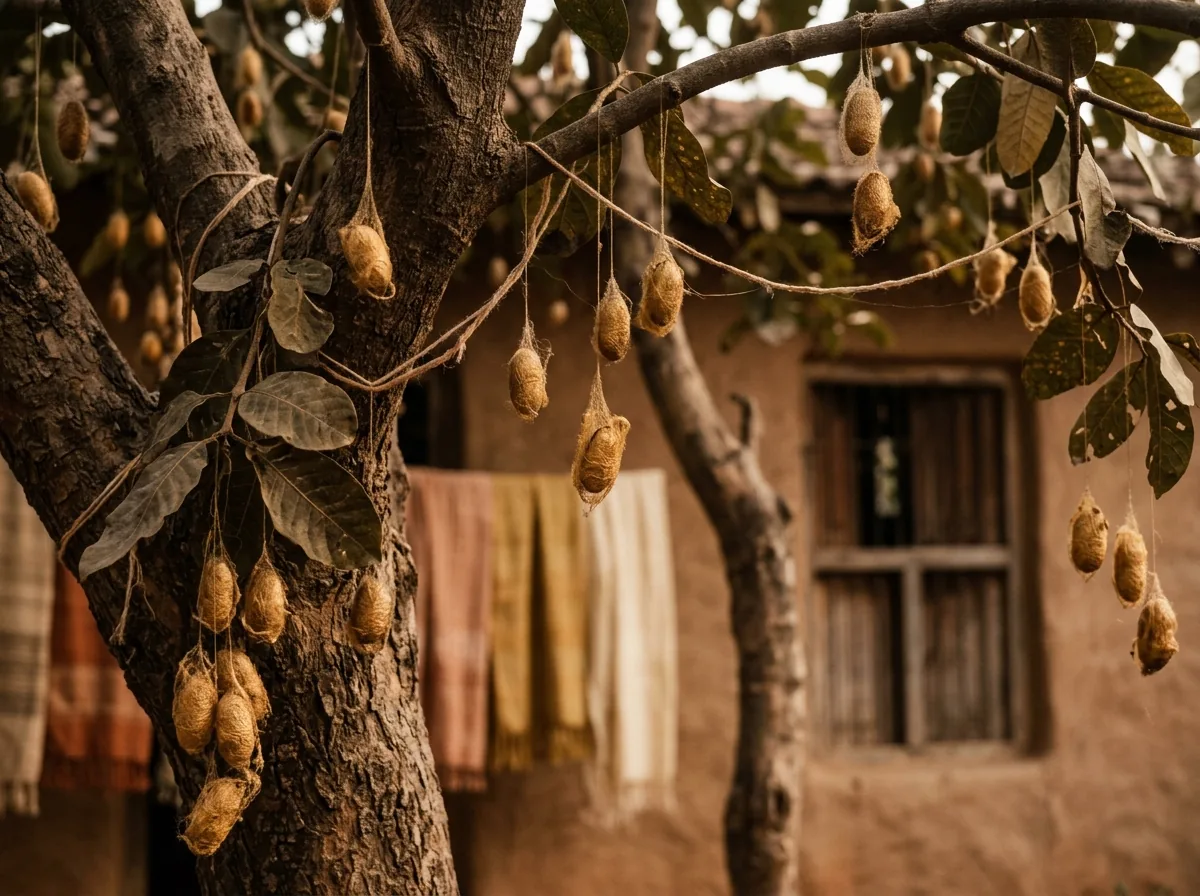
There is a particular quality of light that falls on Jharkhand's sal and arjun forests in the months between monsoon and winter. It is amber and unhurried, the kind of light that seems to belong to an older world. It is in these forests, among the wild canopy rather than on any cultivated farm, that Antheraea mylitta, the tussar silkworm, lives its brief and purposeful life. It feeds on the broad leaves of the arjun tree, the asan, and the sal. It spins a cocoon the colour of raw honey. And from that cocoon, over centuries of patient knowledge, the tribal communities of Jharkhand and Bihar have drawn a silk unlike any other.
Tussar is not the silk of courts and careful commerce. It was never refined into obedience. Its texture carries the memory of bark and forest floor. Its natural colour, a warm, deep ecru that shifts between gold and bronze depending on the hour, cannot be fully replicated by any dye, because it originates not in pigment but in the silkworm's own chemistry, shaped by the tannins of the leaves it consumed. This is a silk that arrives with its biography already written into the thread.
The word "tussar" itself is believed to derive from the Sanskrit "tasara," meaning shuttle, a fitting etymology for a material that has always been defined by the loom's movement and the weaver's hand. It is classified as a vanya silk, a silk of the forest, and that classification carries both ecological and cultural weight. To wear tussar is, in some measure, to carry a small piece of Jharkhand's forest geography against the skin.
The Communities Who Carry the Knowledge
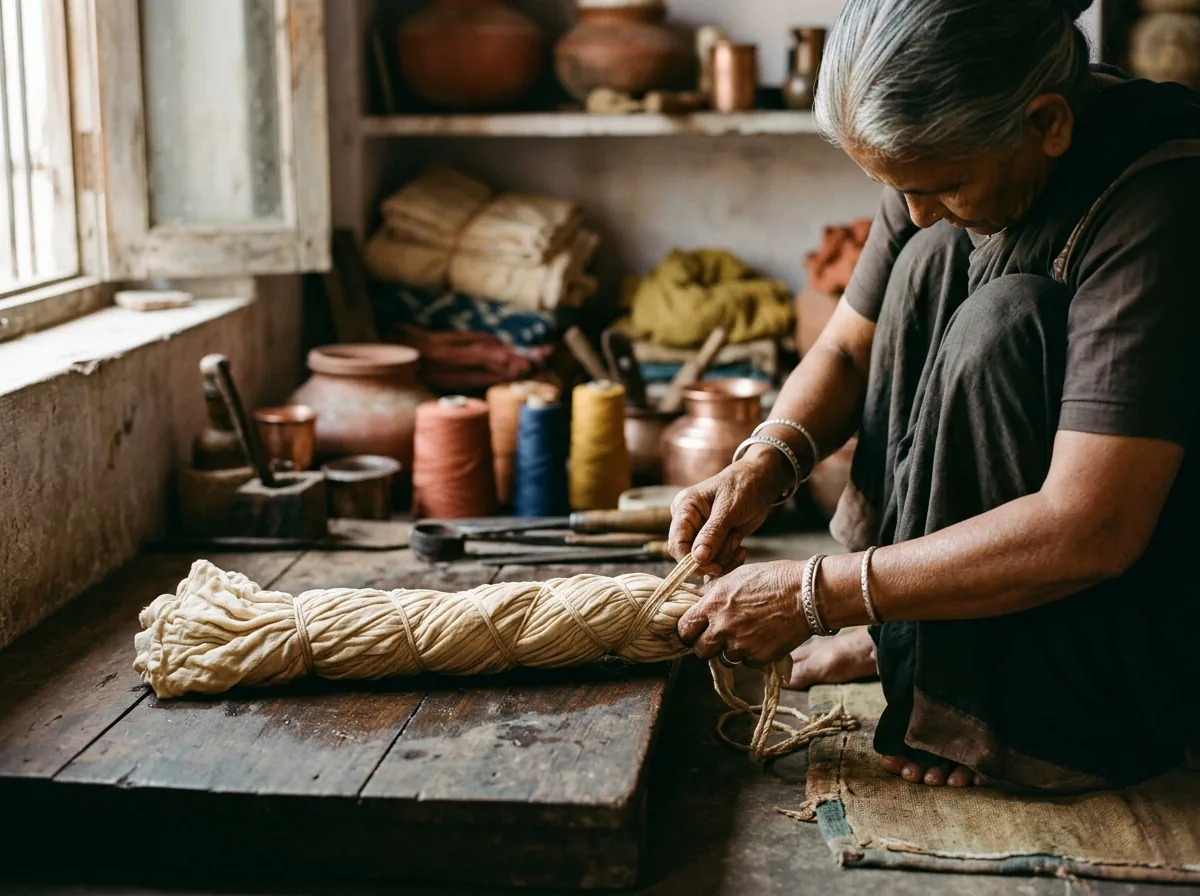
The story of tussar silk cannot be separated from the communities who have stewarded it across generations. In Jharkhand, it is primarily the Kurmi and Panka weaver communities who are associated with tussar weaving, though the cocoon-rearing work has long been conducted by the Gond, Oraon, and other Adivasi communities who live in proximity to the forests where the silkworms thrive. This is a craft geography that encompasses not one skill but many: the forest-dweller who understands the silkworm's seasonal rhythms, the reeler who coaxes the thread from the cocoon without breaking it, the weaver who interprets the thread's natural irregularities as texture rather than flaw.
The towns of Bhagalpur in Bihar and Dumbardih in Jharkhand are perhaps the best-known centres of tussar production, but the craft spreads through a wider network of villages and small towns across the Chotanagpur plateau. Seraikela, in Jharkhand's Singhbhum district, is associated with a particular style of tussar work, while the area around Hazaribagh has its own tradition of hand-painted and printed tussar, where the fabric becomes a surface for the bold geometric forms of the local Kohbar and Sohrai folk-painting traditions.
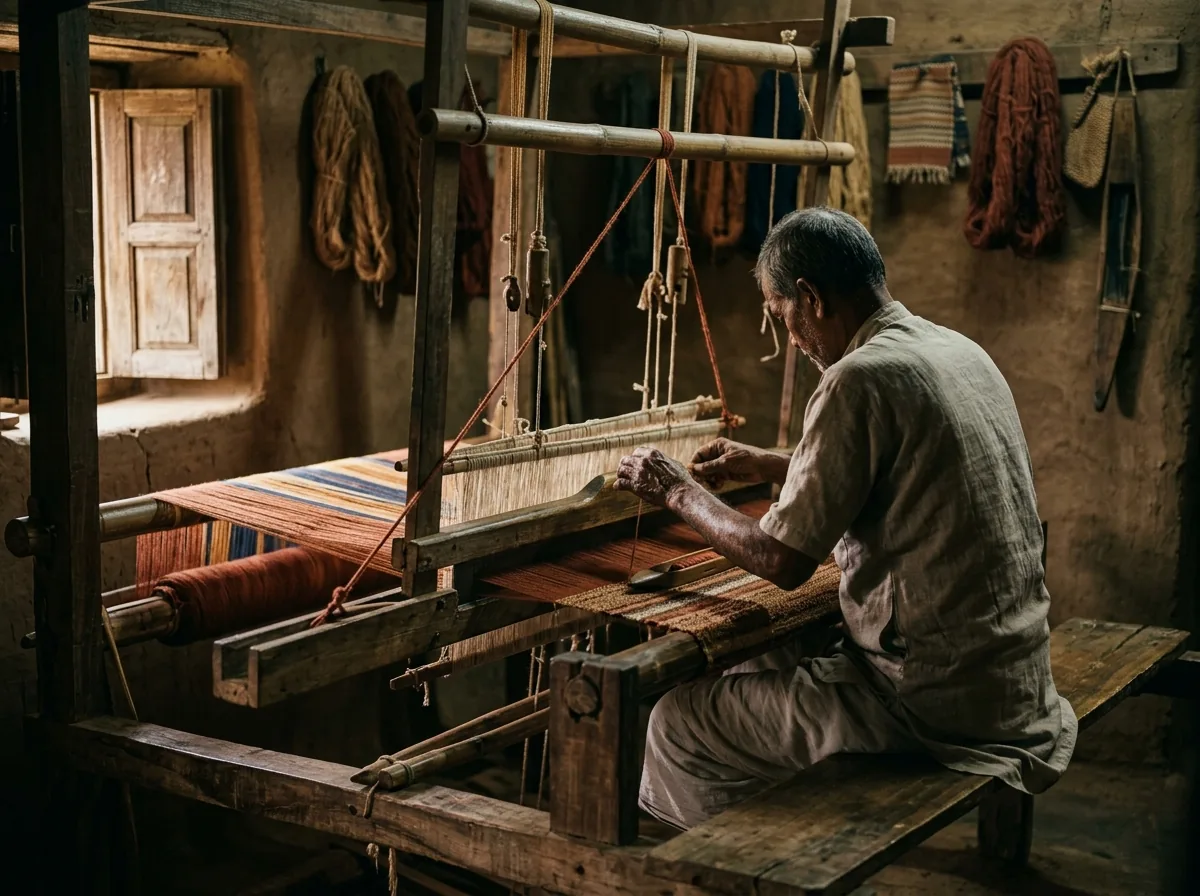
What is remarkable about these communities is the way knowledge has been preserved not through formal institutions but through the household, through the loom set up in the corner of a room, through the grandmother who knows by touch whether the thread has the right tension. It is a transmission that is intimate and unbroken, though not without its pressures from the market forces of the last several decades.
The Character of the Thread
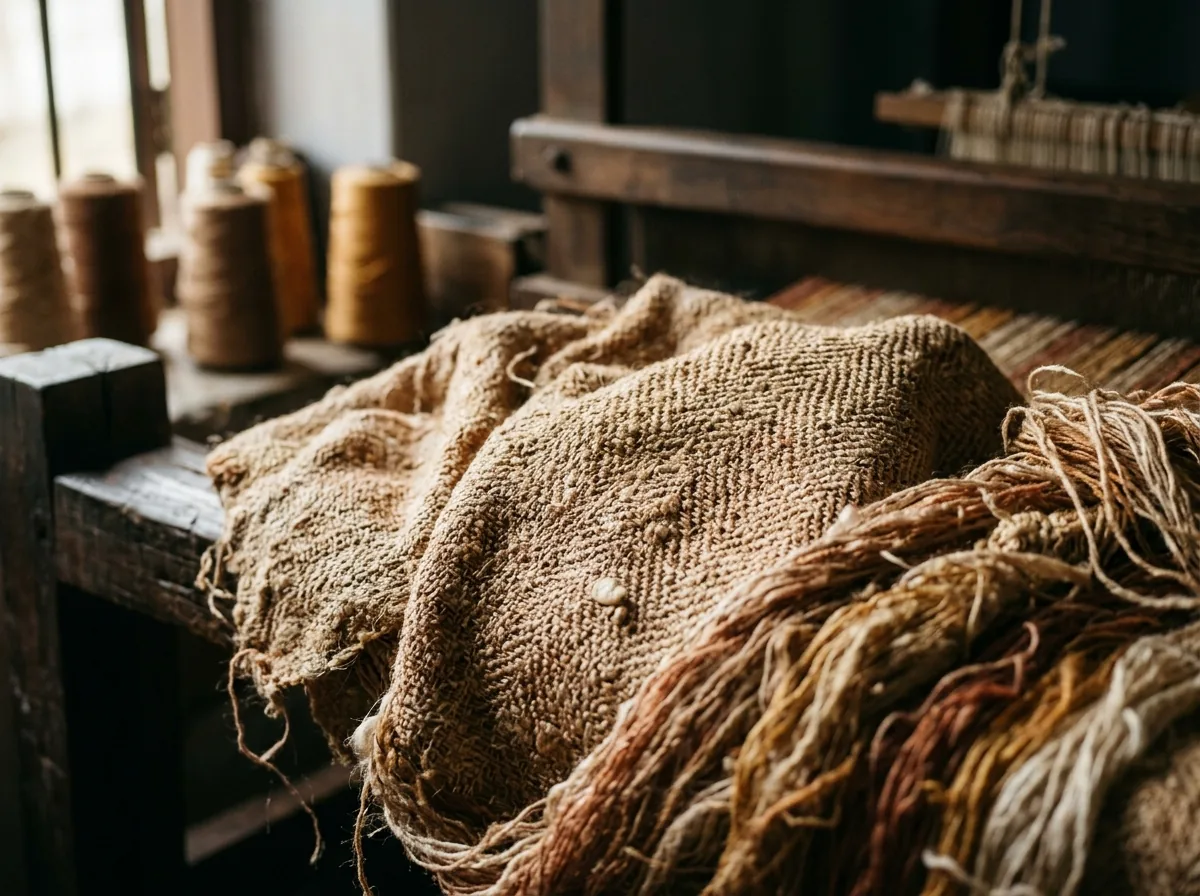
To understand why tussar commands a particular devotion among those who know it, one must begin with the thread itself. Unlike the smooth, uniform filament of mulberry silk, tussar thread is naturally textured. The filament is coarser, and the cocoon's irregular shape means that the reeled thread retains small slubs and variations. These are not imperfections; they are the material's signature. When woven, they create a fabric with a subtly nubbly surface that catches light in ways a smoother silk cannot.
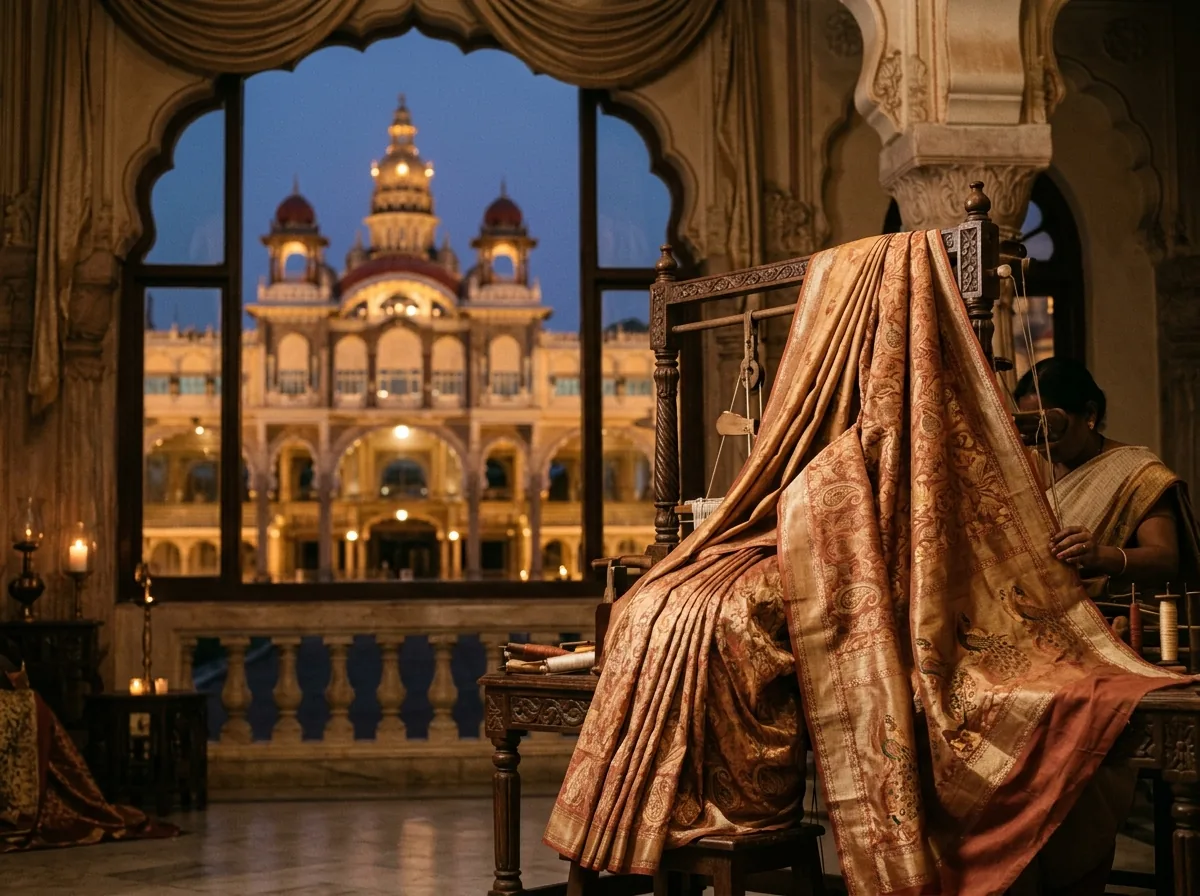
The natural colour of unbleached tussar sits in the range of warm ochre to deep caramel. It takes dye differently from mulberry silk, often rendering colours with a slightly earthy undertone, which many textile connoisseurs regard as desirable. A tussar sari in indigo will carry a depth of tone that is distinct from the same colour applied to a Mysore silk or a Banarasi. The fabric's character is assertive enough to inflect whatever is done to it.
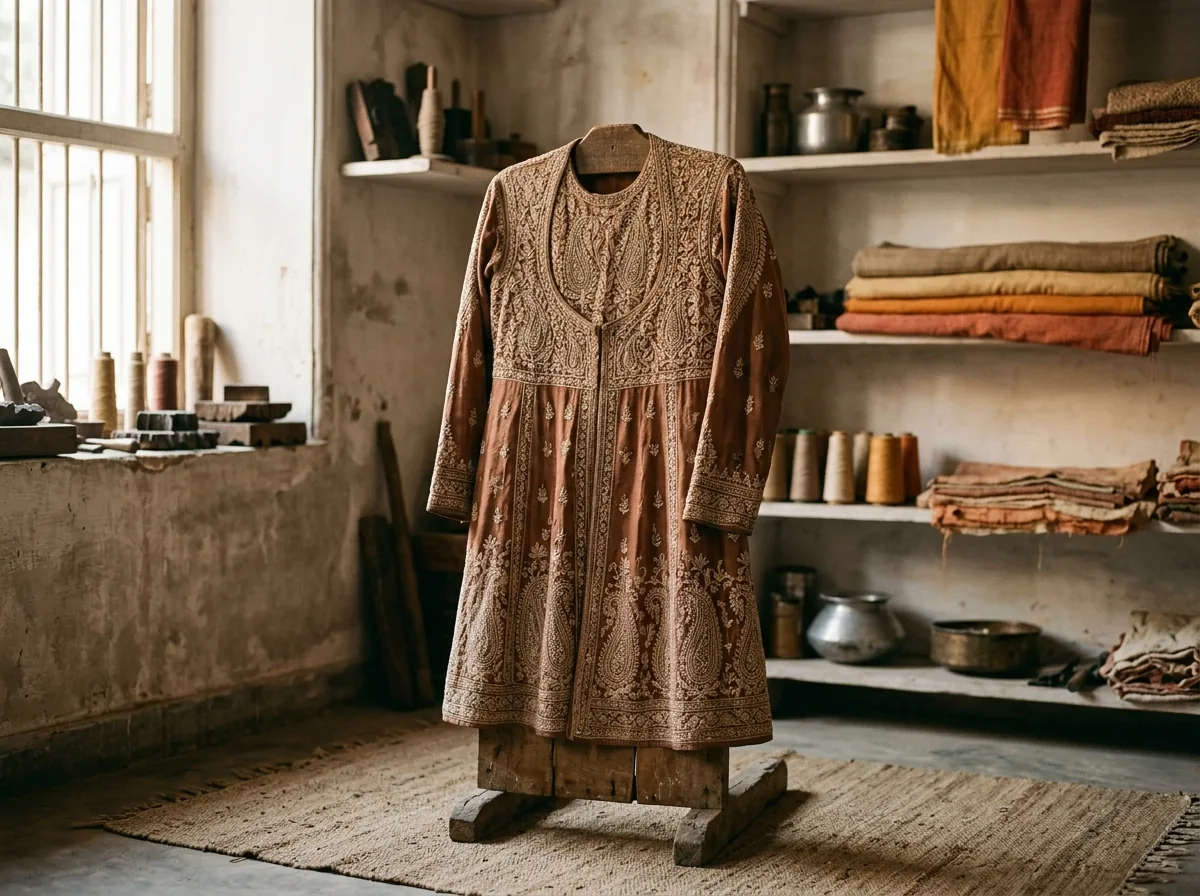
The weave structures used for tussar vary by region. Bhagalpur is known for its plain-weave tussar with zari borders, while Jharkhand's weavers have developed traditions of supplementary-weft work, creating geometric patterns that echo the visual vocabulary of the surrounding Adivasi artistic culture. Some of the finest tussar saris incorporate both hand-woven structure and hand-printed surface decoration, making them layered objects in the most literal sense.
The fabric's drape is different from mulberry silk as well. It is crisper, with a slight body that holds a fold rather than melting into it. It is a silk suited to the upright, the considered, the unhurried gesture.
Bhagalpur and the Silk City's Long History
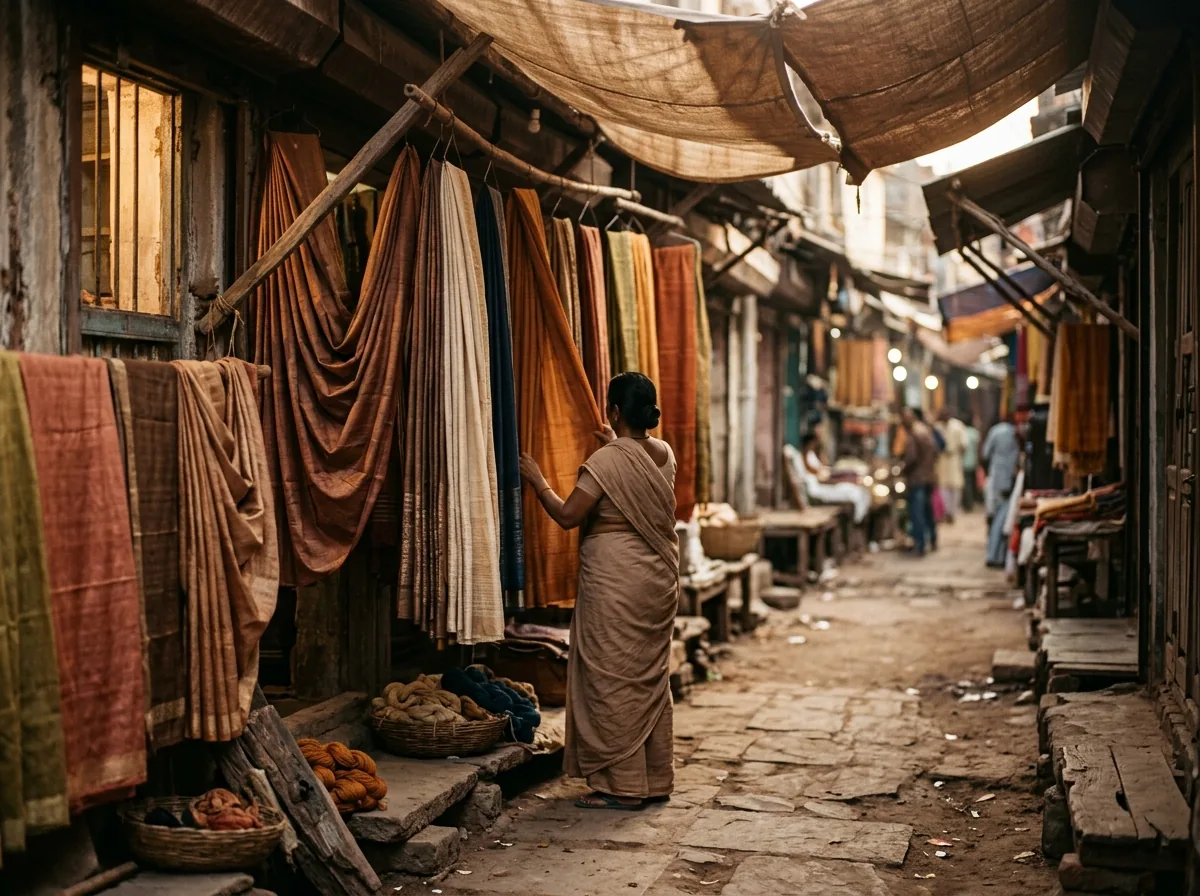
Bhagalpur, situated on the southern bank of the Ganga in eastern Bihar, has been associated with textile production for well over a thousand years. Its silk-weaving tradition is documented in records from the medieval period, and the city came to be known as the Silk City, a designation it still carries, though with more complexity now than in its moment of greatest flourishing. The tussar silk associated with Bhagalpur, often referred to simply as Bhagalpuri silk, is characterised by its relatively light weight and its suitability for a range of garments, from saris to stoles to dress material.
The weaving clusters of Bhagalpur extend into the surrounding villages of Nathnagar and Champa Nagar, where handloom households have operated across generations. The craft went through a period of serious strain in the 1980s and 1990s as power-loom production undercut handloom prices, and many weavers moved away from the trade or shifted to other textiles. The decades since have seen a partial revival, supported partly by the Geographical Indication tag that now protects Bhagalpur silk and partly by renewed consumer interest in handwoven heritage textiles.
What the Bhagalpur weaver has retained, across all of this, is a particular lightness of touch. The finest Bhagalpuri tussar saris have a translucency that surprises, given the fabric's characteristic body. They manage to be both structured and delicate, qualities that seem contradictory until the cloth is in one's hands.
Hazaribagh and the Painted Surface
If Bhagalpur represents the structural tradition of tussar weaving, Hazaribagh in central Jharkhand represents its most visually exuberant extension. Here, the tussar fabric becomes a ground for the Kohbar and Sohrai painting traditions of the region, practised historically by women of the Kurmi and other communities as part of festival and ceremonial life. The motifs are drawn from the natural world: fish, elephants, peacocks, trees, the sun and the moon, rendered in a bold, graphic style that has its own distinct visual language.
What began as wall painting, applied to the mud walls of homes during harvest festivals and wedding ceremonies, has translated onto fabric with remarkable vitality. Artists in and around Hazaribagh, working with natural pigments and earthy commercial colours, apply these designs to tussar with a confidence born of long familiarity. The results are textiles that feel genuinely vernacular rather than decorative, objects in which the surface imagery and the base material are in conversation rather than in competition.
The Geographical Indication tag for Hazaribagh's Kohbar and Sohrai painting traditions has brought some recognition, though the communities of artists who sustain this work remain small. Several women's collectives in the Hazaribagh district have become important points of production, ensuring that the knowledge of both the painting technique and its application to tussar continues to be held within the community rather than replicated externally.
What It Means to Wear the Forest
There is a particular kind of relationship that certain textiles invite, one that goes beyond aesthetics into something closer to attention. Tussar silk belongs to this category. To own a piece of tussar, whether a sari, a stole, or a length of fabric intended for tailoring, is to be in possession of something that carries visible evidence of its origin. The natural slubs in the thread, the warm ground colour that no synthetic can quite match, the slight crispness of the weave: these are not qualities that have been engineered in. They are qualities that arrived with the silkworm, the forest, and the weaver's hands.
The tribal and artisan communities of Jharkhand and Bihar who have sustained this craft across centuries did not do so in pursuit of recognition. They did so because the knowledge was theirs, inherited and practised and passed on within the rhythms of household and season. When we seek out tussar silk with genuine interest, we participate, however distantly, in the continuation of that practice. We become, in a small way, part of the long chain of people for whom this particular silk has mattered.
The forest that gave the silkworm its food, the reeler who drew the thread without breaking it, the weaver who understood the loom's possibilities and the material's limits: these are the presences woven into every length of tussar. The cloth arrives already inhabited.