Where the needle moves slowly, time learns patience.
A Stitch Born in Courtly Shadow
There is a particular kind of elegance that does not announce itself. It arrives quietly, the way a well-cut kurta settles onto the shoulders of a man who has no need to perform confidence. Chikankari is that kind of elegance, and it has always belonged as much to men as to women, though fashion's short memory conspired to forget this for a generation or two.
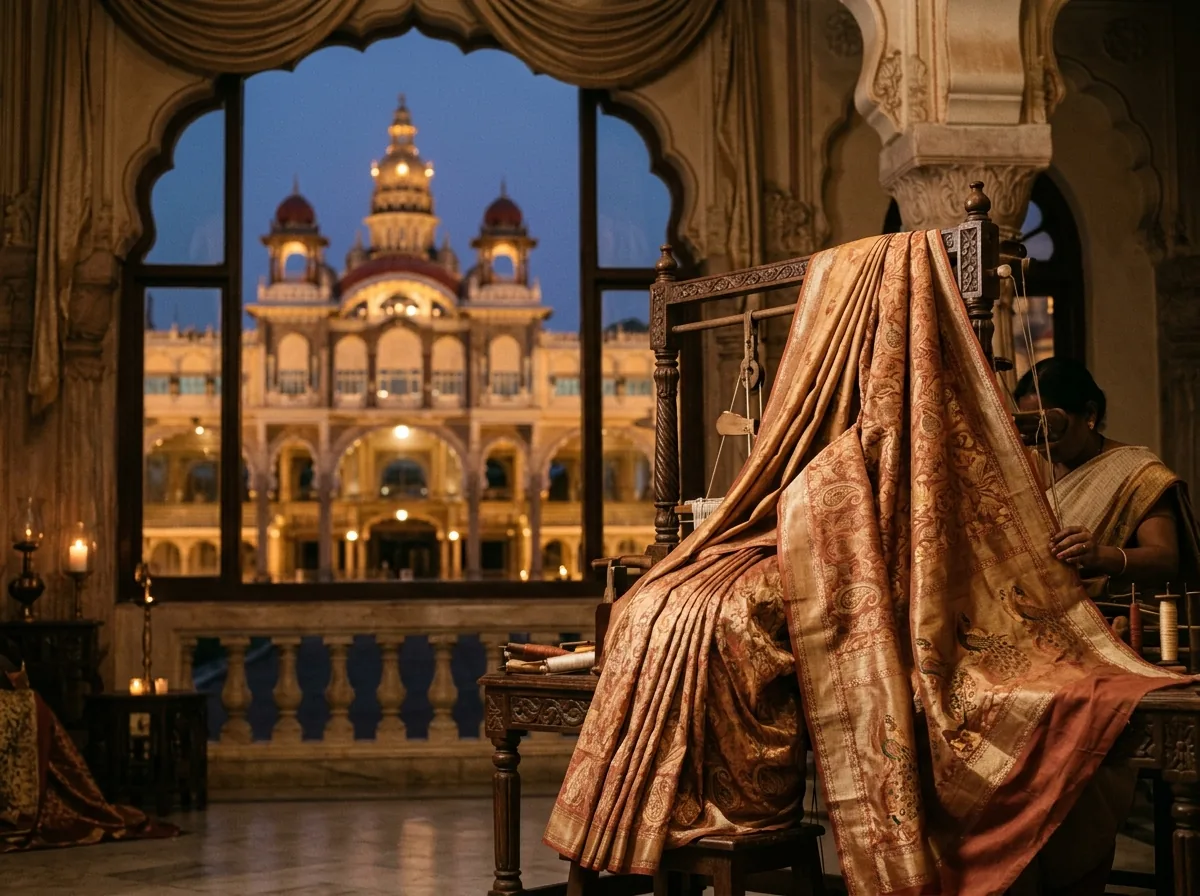
The craft was never a feminine invention. Its earliest recorded patrons were the men of the Nawabi court at Lucknow, the Asaf ud-Dawlah court of the late eighteenth century, where the pursuit of refinement was itself considered a serious occupation. Noblemen commissioned chikan-worked jama coats, angrakhas, and kurtas with the same deliberateness they applied to poetry and music. The white-on-white embroidery was not decoration for decoration's sake. It was a statement of restraint, a visual language that said: I have nothing to prove, and everything to appreciate.
Lucknow's position as the seat of Awadhi culture made it fertile ground for a craft that demands slowness. The city's gharanas of music and dance, its tradition of adab, its layered codes of courtesy, all created a social atmosphere in which fine handiwork was understood and valued. Chikankari grew in that atmosphere like a climbing plant on a old haveli wall. By the nineteenth century, the craft had woven itself into the identity of the city, and Lucknow had become inseparable from the white shadow-work that its artisans produced on muslin so fine it was called woven air.
The Geography of the White Thread
To speak of chikankari as simply a Lucknow craft is accurate but incomplete. The city is the heart, certainly, but the hands that do the work have always lived in the villages and mohallas that ring it. The embroidery clusters around Lucknow in the districts of Barabanki, Hardoi, Unnao, and Raebareli, where women from Muslim artisan families, particularly those who identify as Ansari or Qureshi by community, have carried the needle work across generations.
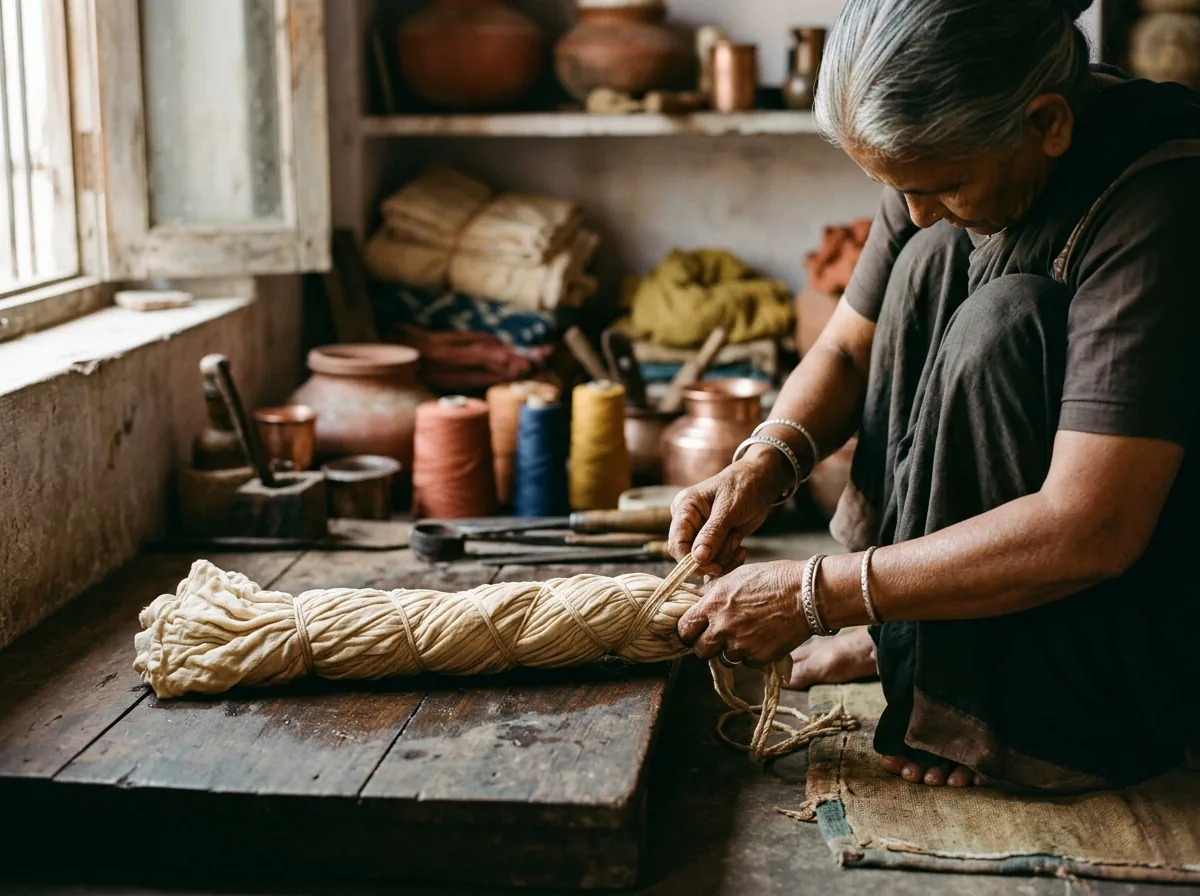
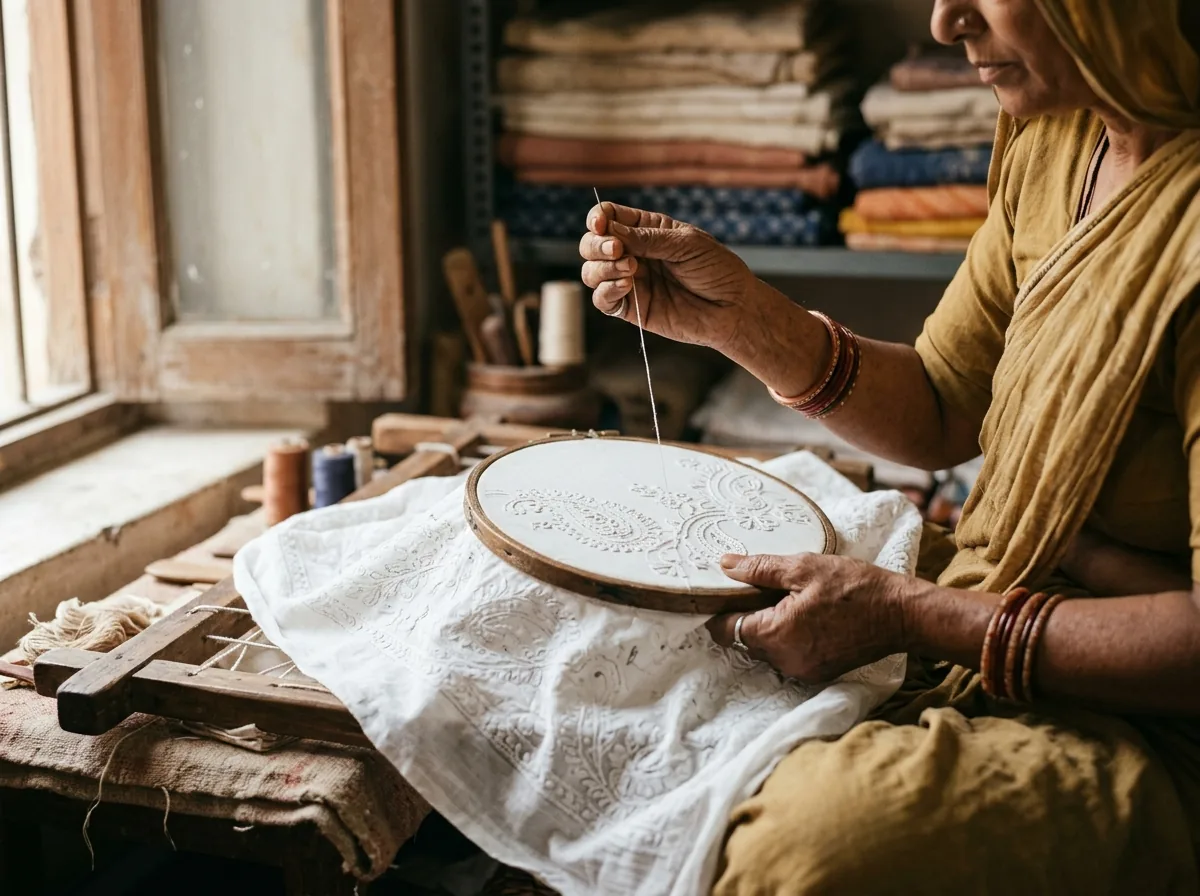
The actual embroidery is traditionally done at home, in natural light, often on cloth that has been block-printed with a pale blue or violet water-soluble dye to mark the pattern. The printer, the embroiderer, and the washer are three distinct figures in the chikankari production chain, and each brings a separate discipline. The block printer may be a craftsman from a kaarigari mohalla near Aminabad or Chowk, those dense commercial arteries of old Lucknow where whole streets have been devoted to a single skill for a century and a half.
The embroidery itself comprises more than thirty distinct stitches. The most commonly recognised are the tepchi, a running stitch that creates shadow from the reverse; the murri, a tiny seed-like knot worked on the fabric surface; and the phanda, a shorter, rounder knot. Then there is the jaali, a pulled-thread technique that creates an open lattice within the cloth, and the bakhiya, a shadow stitch executed on the underside to cast a soft grey silhouette on the face of the fabric. Each stitch has its temperament, its appropriate placement, its own relationship to the weave of the cloth beneath it.
Why Cotton Is Not a Compromise
There is a persistent social anxiety in Indian dressing, particularly among men, that positions cotton as casual, as less-than, as something one wears when one cannot afford better. This is a colonial residue worth discarding. Cotton, specifically the finely woven mul-mul or the slightly sturdier doby-weave cotton favoured for men's chikan kurtas, is not a compromise. In the context of an Indian summer, it is the only logical answer.
The climate argument is straightforward. Between April and September, across the plains of Uttar Pradesh, Rajasthan, Delhi, and Maharashtra, the body needs fabric that breathes, wicks, and does not trap heat against the skin. Silk, however magnificent, does none of these things adequately. Synthetic blends do them not at all. A well-woven cotton kurta in eighty to a hundred thread count, block-printed and hand-embroidered with chikan work, moves with the wearer, softens with each wash, and develops a particular quality of drape over time that no new fabric can replicate.
For men, the chikankari kurta in white, off-white, or the palest ecru is the summer garment that requires least thought and yields most return. It is appropriate for an afternoon meeting, a family lunch, a late evening at an outdoor concert. It does not need ironing to sharp creases to function with dignity; a gentle press is sufficient. Worn with churidar or with straight-cut cotton trousers in a quiet colour, it presents a silhouette that is both distinctly Indian and entirely contemporary.
The fabric is the message. Cotton says: I am at home in this climate, and I dress accordingly.
The Masculine Vocabulary of Chikan
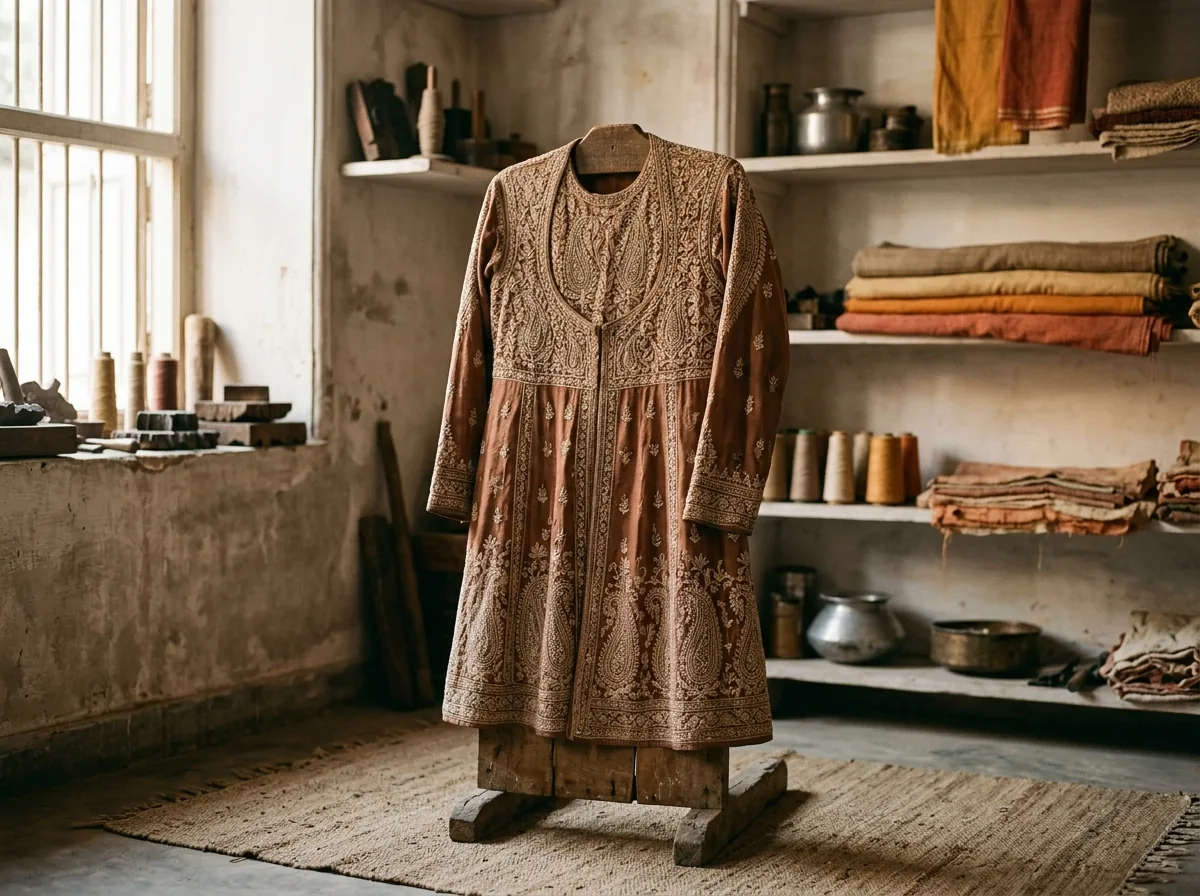
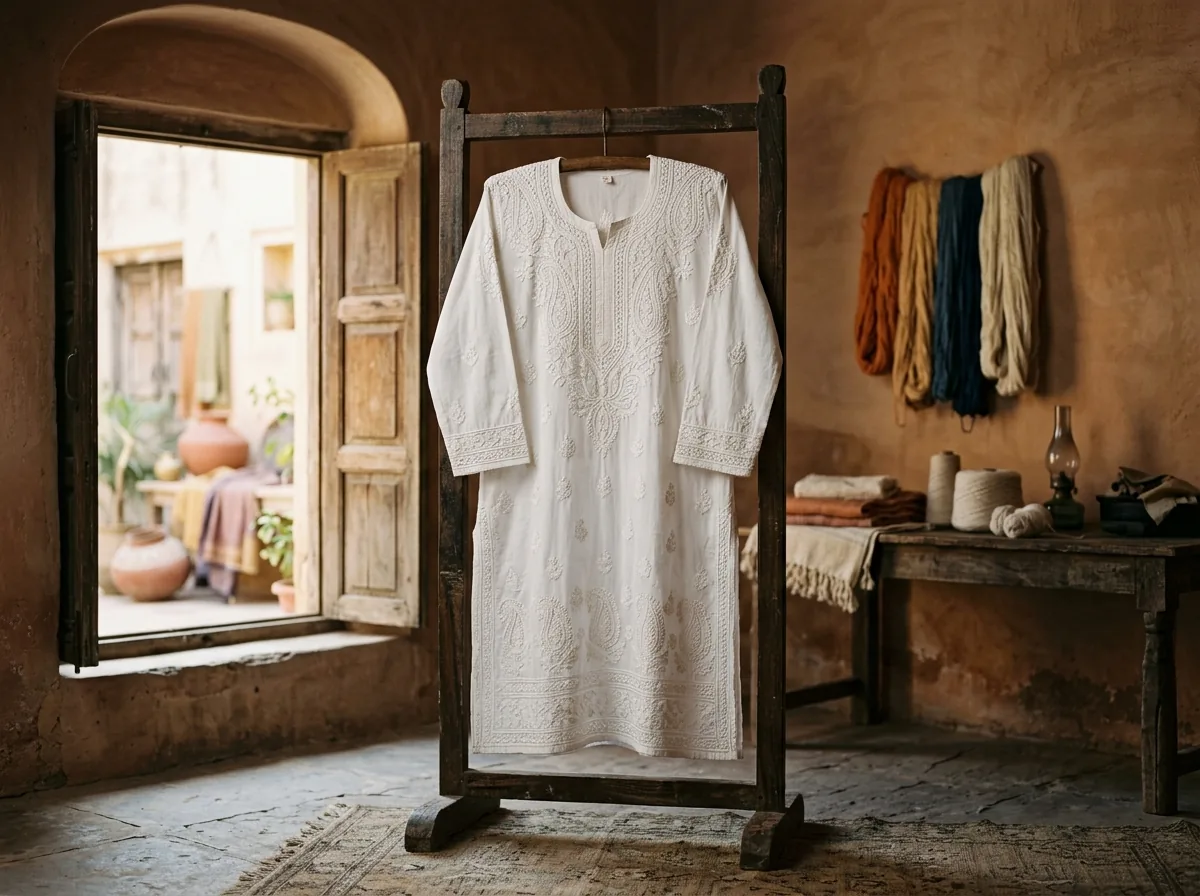
The question of what makes a chikankari kurta specifically suited to men is less about the embroidery itself and more about proportion, placement, and restraint. Women's chikan garments may travel across the entire surface of a garment, dense with motifs. The men's tradition was, and remains, quieter. The embroidery is concentrated at the neckline and placket, at the cuffs, sometimes in a vertical panel that runs from collar to hem on one side. The motifs tend to be architectural: the keri or mango form, the buti, small geometric clusters, occasionally a fine jaali panel at the chest.
The colour story for men's chikan is narrow and purposeful. White on white is the original and remains the most sophisticated. Ivory on ivory follows closely. Some contemporary weavers and designers work with thread colour introduced onto a pale ground, dusty blues on white, soft sage on cream, though these require care in selection to avoid tipping from subtlety into showiness.
Fit matters as much as the embroidery. A chikan kurta that is cut too loosely loses its quiet authority; the embroidery becomes shapeless. One that is cut close to a shirt-pattern loses the necessary ease that allows cotton to breathe. The ideal length for a man's chikan kurta sits between mid-thigh and just above the knee, with sleeves that reach to the wrist without binding. The collar may be a simple mandarin, a small Nehru band, or a placket without collar at all, each producing a slightly different register of formality.
Caring for Something Made Slowly
A chikankari kurta is not a garment to be treated carelessly, though the care it requires is less complicated than the reverence it deserves might suggest. The primary rule is simple: cold water, gentle motion, no machine agitation. The embroidery stitches, particularly the jaali and the phanda, can distort under the mechanical stress of a washing machine drum. Hand-washing in cool water with a mild soap, or the kind of soft detergent traditionally used for delicate Indian fabrics, preserves both the cloth and the thread.
The kurta should be dried flat or hung from the shoulders, not from a single corner where gravity will stretch the weave unevenly. Ironing is done on the reverse, with a cloth between the iron and the embroidery, so that the raised stitches keep their dimension. A flat murri or phanda is a lost murri or phanda; the texture is the point.
Storing a chikankari kurta correctly matters too. Cotton breathes, which means it should be stored where air can circulate, not sealed in plastic. A muslin bag or a clean cotton pillow slip serves well. Cedar or neem leaves are preferable to synthetic moth deterrents, which can leave a residue on fine cotton. Treat the garment as you would a piece of correspondence written by hand: with the understanding that the effort invested in its making is not easily replicated, and deserves to be met with at least a little equivalent attention.
The Quiet Return
There is something quietly significant about the revival of men's interest in chikankari, in the choice to wear something that carries the cumulative knowledge of embroiderers in Barabanki and Chowk, the design memory of a court that has been gone for a century and a half, and the logic of a fabric perfectly suited to where and how we live.
The chikankari kurta asks nothing spectacular of the man who wears it. It does not require a particular build, a particular occasion, or a particular kind of confidence. It requires only that the wearer pay enough attention to appreciate what he has chosen: that the white thread tracing its patient way across white cotton was placed there by a hand that learned from another hand, in a house somewhere beyond the Lucknow ring road, in the kind of quiet that good work requires.