Where the desert drinks the sky, cloth becomes the first language of rain.
The Wave Before the Storm
There is a moment in the Rajasthani summer, just before the monsoon breaks, when the air thickens with anticipation and the horizon turns the colour of bruised indigo. It is precisely this moment that lehariya has always tried to hold inside a length of cloth. The word itself arrives from lehar, meaning wave, and every stripe that runs in a clean diagonal across a fine cotton or silk dupatta carries within it the memory of water moving across sand.
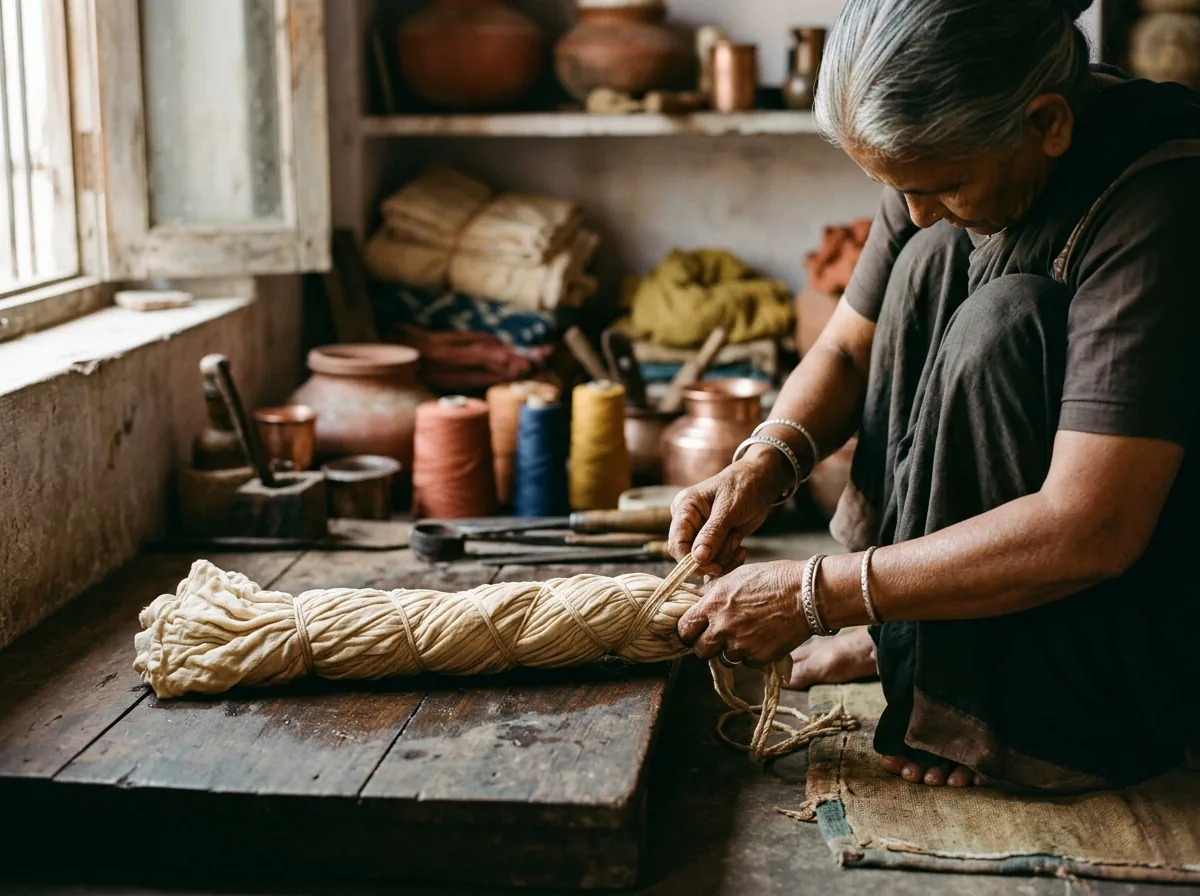
Lehariya is, at its heart, a resist-dyeing tradition, practised with uncommon discipline in and around Jaipur and Jodhpur, where the craft is woven so tightly into the social fabric that it functions almost as a seasonal calendar. The technique demands that the cloth be rolled on the diagonal, bound tightly with thread at regular intervals, and then submerged in a dye bath. Each unbinding reveals a stripe, and a second round of binding and dyeing produces the intersecting wave pattern known as mothda, a double lehariya in which two sets of diagonal lines cross to form a net of colour. The geometry is strict, the palette is instinctive, and the result is a textile that somehow manages to feel simultaneously disciplined and joyful.
What makes lehariya unusual among India's resist traditions is that the binding is never random. The craftsperson must anticipate the finished design before a single thread is tied, holding the completed cloth in the mind's eye while working with wet fingers on undyed fabric. It is a form of spatial memory that is passed between generations without notation, sustained entirely by practice.
Jaipur, Jodhpur and the Geography of the Wave
The two cities that anchor the lehariya tradition sit roughly 340 kilometres apart, and yet they have developed the craft along parallel lines that occasionally diverge in revealing ways. In Jaipur, the production has historically been concentrated in the older weaving and dyeing quarters of the walled city, where communities of rangrez dyers have maintained their vats and their knowledge across generations. The Chhipa community, responsible for much of Rajasthan's resist-print and dye heritage, has contributed significantly to the refinement of lehariya technique in this region, though the craft is not exclusive to any single group.
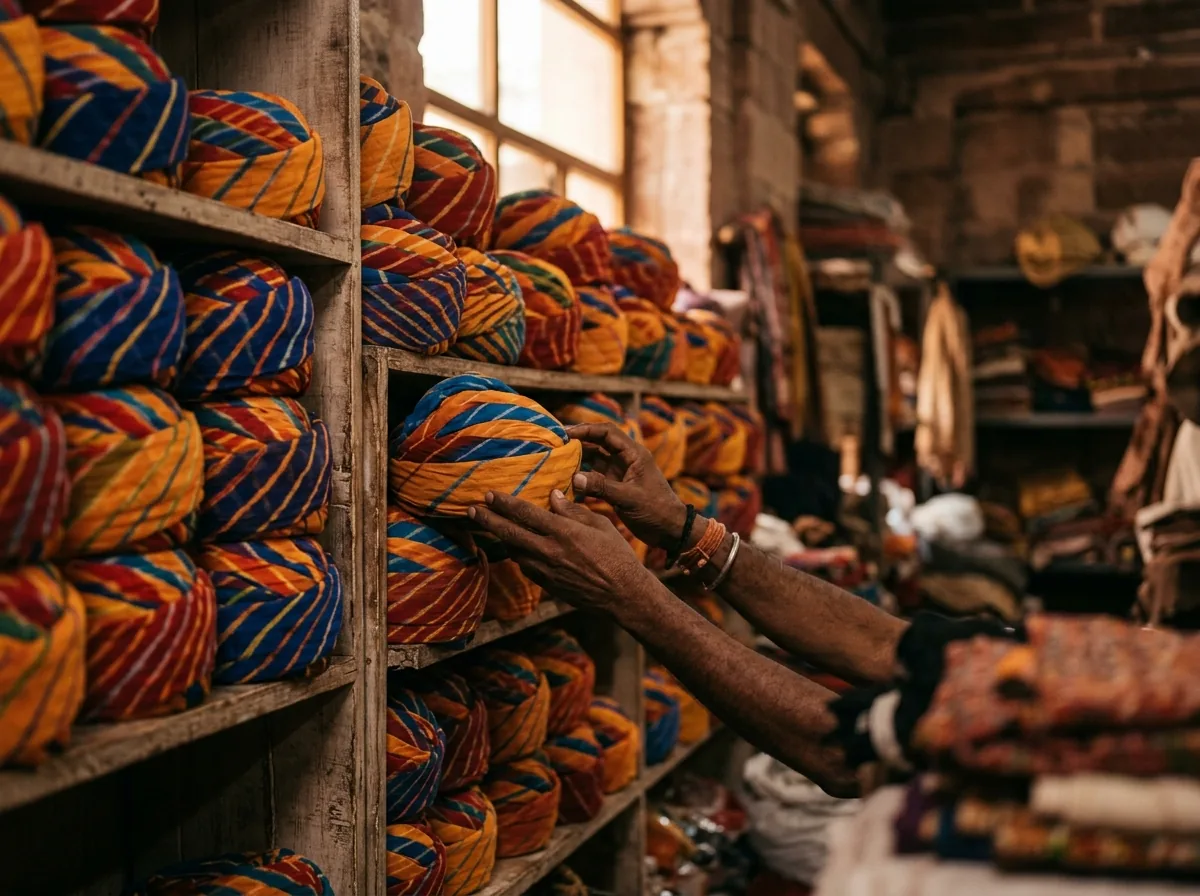
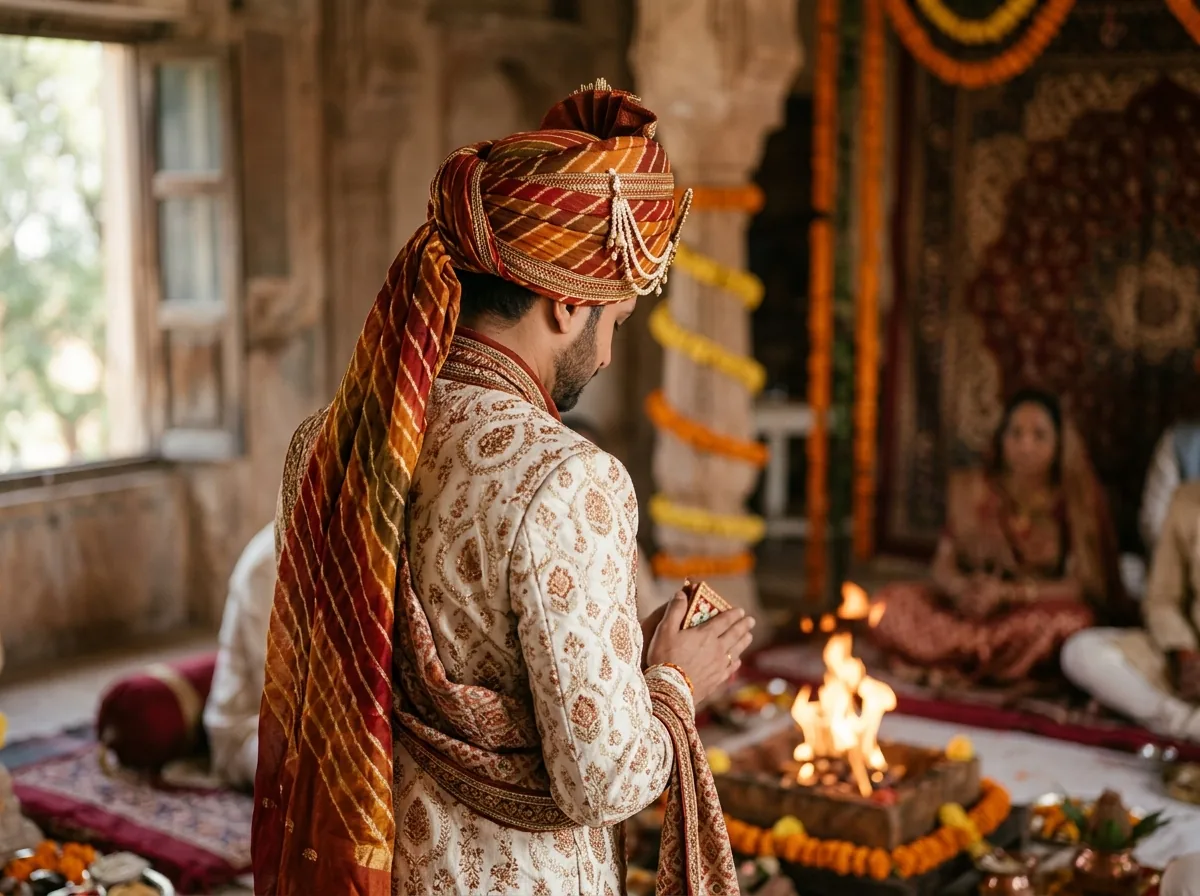
Jodhpur's relationship with lehariya runs through its markets and its domestic rituals in a slightly different register. Here the cloth is associated particularly with the pagdi, the turban, and with the long lengths of fine fabric that men of various communities wind around their heads as a daily act of self-presentation. The lehariya pagdi in Jodhpur is not a decorative accessory so much as a statement of belonging, of season, and of occasion. A groom arrives at his wedding in a particular shade of pink-and-saffron lehariya; a man participates in a festival with a different palette entirely.
Beyond these two cities, smaller centres of production exist in towns such as Sanganer and Bagru, both of which sit on the outskirts of Jaipur and are better known for block printing but maintain quiet lehariya traditions of their own. The dye chemistry varies by location; Bagru's well water has its own mineral character, which affects the quality of the natural dyes that older craftspeople still prefer to use alongside the synthetic colours that now dominate much of the market.
Monsoon as Muse, Festival as Occasion
The monsoon is not merely a meteorological event in Rajasthan; it is a cultural one, and lehariya is its cloth. Teej, the festival that celebrates the arrival of the rains and the reunion of Parvati and Shiva, arrives in the months of Shravan and Bhadrapada, and it arrives wrapped in lehariya. Women in Jaipur and across the Shekhawati region wear lehariya sarees, lehariya odhnis and lehariya bangles of lacquered glass that echo the diagonal stripe in a different medium. The whole of the season seems to take on the character of the textile.
There is a logic to this that goes deeper than fashion. The wave pattern is an act of longing, a desert people's vision of water made permanent in silk. To wear lehariya during Teej is to dress in rain, to call the monsoon close with the colours of the sky at the moment of its arrival: deep green for new leaves, saffron and yellow for the marigolds that bloom in courtyard pots, strong pink for the women who swing in gardens and sing the songs of Teej recorded in poetry stretching back several centuries.
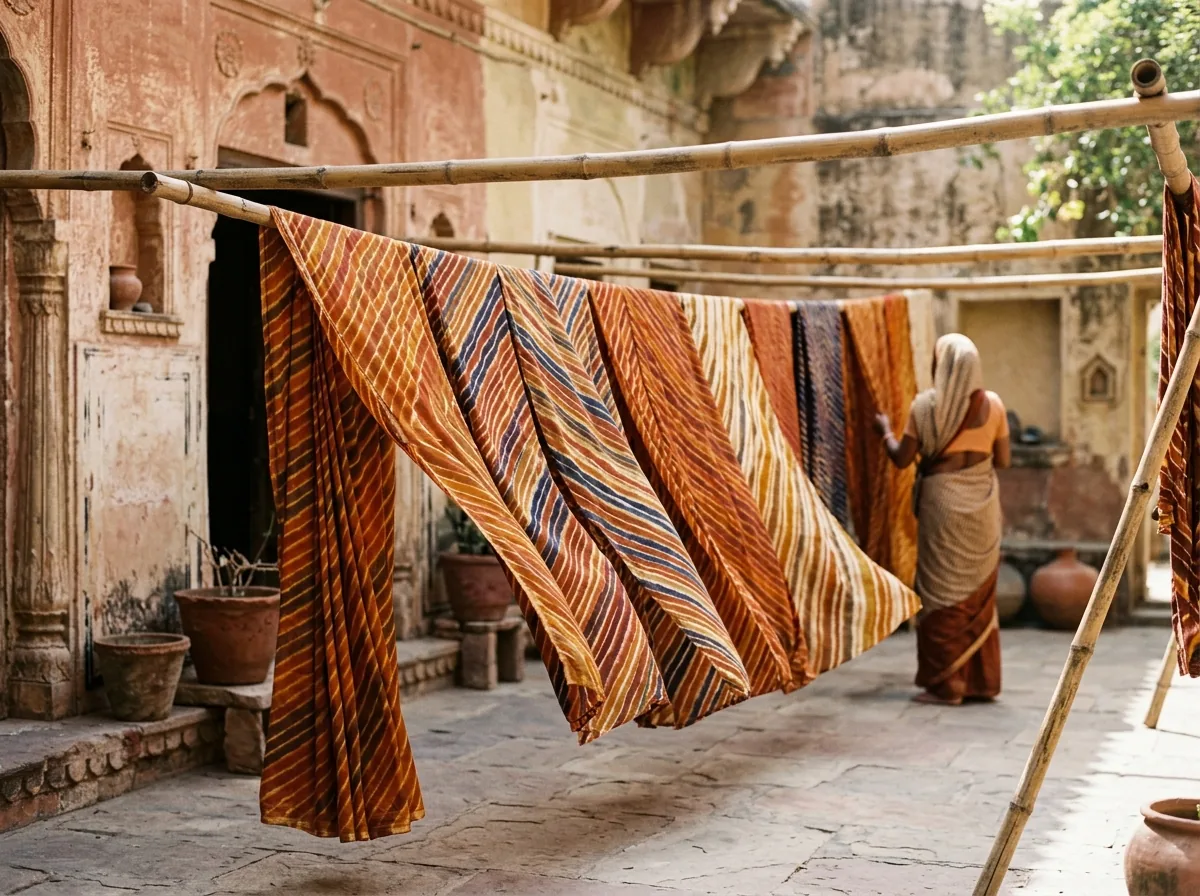
Gangaur, another festival calibrated to the agricultural and emotional rhythms of the Rajasthani year, similarly draws on lehariya's palette. Here the imagery of the goddess Gauri, celebrated for her devotion, aligns naturally with the festive cloth tradition. The craftspeople in the city quarters of Jaipur note that the weeks before these festivals represent their most intense period of production; the dye vats run continuously, and the streets outside the workshops fill with lengths of wet, brightly coloured fabric drying on bamboo poles.
The Pagdi, Wound in Waves
To understand lehariya fully, one must spend time with the turban. The Rajasthani pagdi is not a single garment but a language, and lehariya is one of its most expressive dialects. Depending on how the cloth is wound, what colours have been chosen, and at what angle the diagonal stripes fall across the forehead and brow, a pagdi communicates caste, community, region, occasion, and season with a precision that no other garment quite matches.
For the rangrez craftsperson preparing a wedding order, the client's requirements will specify not only colour but the exact width of the lehariya stripe, the number of dye baths, and whether the cloth should be single or double lehariya. A bridegroom's family may request a specific combination of colours that has been used in their community for generations, so that the cloth connects the present celebration to a long chain of prior ones. In this sense the pagdi is archival as much as it is ceremonial.
The length of cloth required for a single pagdi varies by style and community, running from several metres for a modest wrap to over twenty for the elaborate safa styles worn at aristocratic Rajput weddings. The craft of winding is itself a skill; in some communities an elder relative is responsible for winding the groom's turban, and the act of doing so is considered a form of blessing. Lehariya enters this ritual not as decoration but as the medium through which affection, tradition, and identity are physically transferred from one generation to the next.
Colour, Chemistry and the Hand in the Vat
The palette of lehariya is immediately recognisable even to those who cannot name the craft. Bright yellows that carry the warmth of haldi, pinks that edge towards the vermillion of sindoor, deep greens that recall the first growth after rain, and the occasional blue that speaks of sky rather than sea: these are colours of intention, not accident. They are also colours of chemistry.
Traditional lehariya relied on natural dye sources that the rangrez communities of Rajasthan sourced, traded, and prepared with considerable expertise. Turmeric yielded yellows, pomegranate rind contributed tannins essential for fixing, and indigo was traded across long routes that connected the dye gardens of Gujarat and Bihar to the workshops of Jaipur. Resist-dyeing with natural pigments requires careful mordanting, and the knowledge of which metals to use with which fibres and which dye plants was guarded and transmitted within families.
Contemporary lehariya production uses a mixture of natural and chemical dyes, and the quality of output varies considerably. The finest work still comes from craftspeople who understand dye behaviour intuitively and who can read a length of cloth emerging from the vat and know instantly whether the resist has held or bled. This is knowledge that cannot be taught in a single season. It accumulates slowly, through years of wet fingers and ruined lengths and gradual mastery, and it is this accumulation that separates a lehariya worth wearing for twenty years from one that fades in the first monsoon it was made to celebrate.
A Living Grammar of Colour
What endures about lehariya, beyond its beauty, is its function as a living grammar of social and seasonal life in Rajasthan. It has not been preserved in a museum vitrine; it is still wound around heads, still pinned at shoulders, still purchased in the weeks before Teej by women who know precisely which palette their family expects and which shop in the old city will produce it without compromise.
The craft survives because it remains useful, not as a relic of heritage discourse but as an active participant in the ceremonies that mark a life: birth, marriage, festival, mourning, reunion. The diagonal wave that the rangrez craftsperson imposes on cloth through patient binding is the same wave that rolls across sand when the desert finally receives its rain, and to wear it is to participate, however briefly, in that ancient conversation between a dry land and the sky it depends upon.