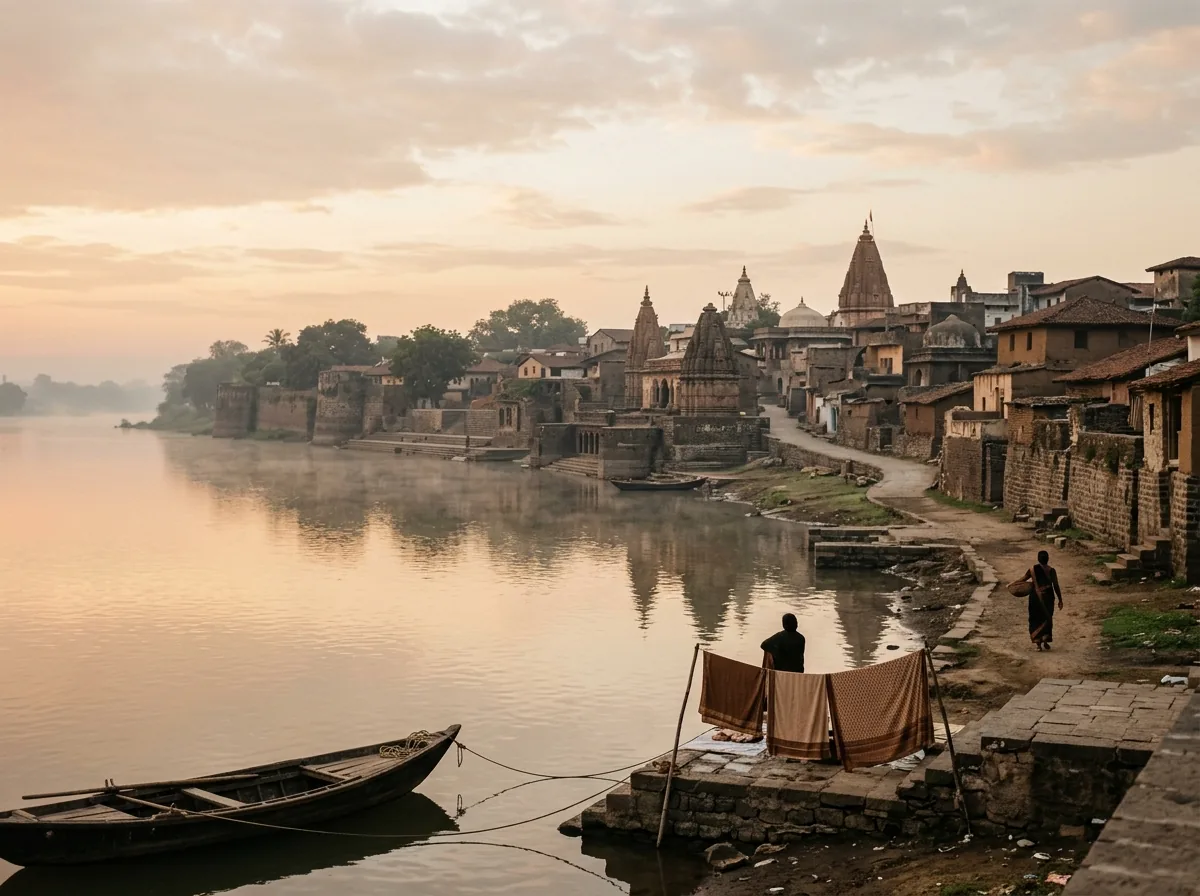
Where the loom holds time still, and silk remembers the river.
A Silk Born of the Deccan Plateau
There are textiles that clothe the body, and there are textiles that carry a civilisation. Paithani belongs to the second kind. Woven in the ancient city of Paithan, on the banks of the Godavari in Maharashtra's Aurangabad district, this silk has been in continuous conversation with Indian courtly life for over two thousand years. The Satavahana rulers are said to have prized it. Medieval travellers wrote of it. Today, it remains one of the most coveted handwoven silks on the subcontinent, and yet its making has barely changed in its essential character.
Paithan itself is a quiet town, its lanes shaded by neem and tamarind, its pace unhurried. It does not announce itself. But step into any of the weaving households clustered along its older quarters and you enter a different order of time entirely. The air carries the soft percussion of pit looms at work, a rhythm as old as the settlement itself. The Godavari, wide and brown in the monsoon season and contemplative in summer, runs at the edge of the town like a slow punctuation mark in an ancient sentence.
It is from this geography, from the particular quality of light that falls across the Deccan plateau, from the mineral-rich waters of the Godavari once used to wash and prepare the silk, that Paithani draws its character. Not romantic mythology, but a genuine relationship between place and craft. The silk here does not merely exist. It belongs.
The Grammar of the Peacock and the Parrot
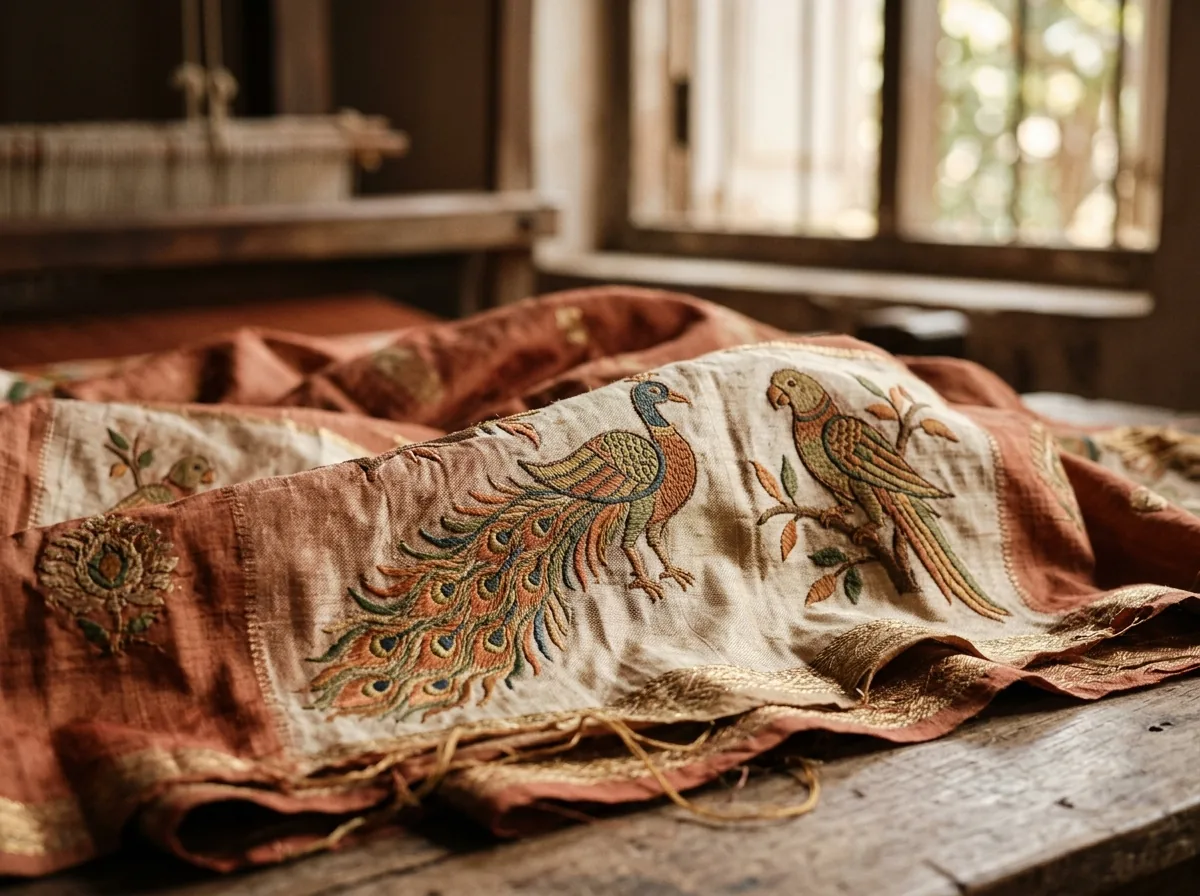
Ask a Paithani weaver to name the two souls of his craft and he will tell you without hesitation: the mor and the tota. The peacock and the parrot. These two motifs have presided over the Paithani tradition for centuries, not as decorative novelties but as a visual grammar, a shared language between weaver and wearer that requires no translation.
The mor, or peacock, appears most gloriously in the pallu, the broad decorated end of the sari that drapes across the shoulder. In classical compositions, peacocks face each other across a central axis, their tail feathers fanning into elaborate arches, their bodies worked in the supplementary weft technique that gives Paithani its signature tapestry-like richness. Each peacock is built colour by colour, shuttle by shuttle, across a ground of pure mulberry silk. The feathers are not printed or embroidered after weaving. They are woven in, thread by thread, during the act of creation itself.
The tota, the parrot, is equally beloved, and typically occupies the body of the sari, appearing within the characteristic karvati, or saw-toothed border, or nestled among flowering vines in the field. In older pieces, the parrot was rendered in a green so vivid it seemed to hold light within the weave. Weavers today still speak of achieving that particular green as a mark of mastery.
Beyond these two presiding motifs, the Paithani vocabulary includes the lotus, the mango, the asawali or flowering creeper, and the narali or coconut. Each motif carries regional and familial associations. Certain families in Yeola, the town in Nashik district that became a secondary centre of Paithani production in the nineteenth century, developed their own signature interpretations of these classical forms, and those distinctions persist quietly today.
The Two-Generation Loom
The phrase most often heard in Paithani weaving households is this: one generation learns, the next generation weaves. It is not a lament. It is a statement of how the craft understands itself.
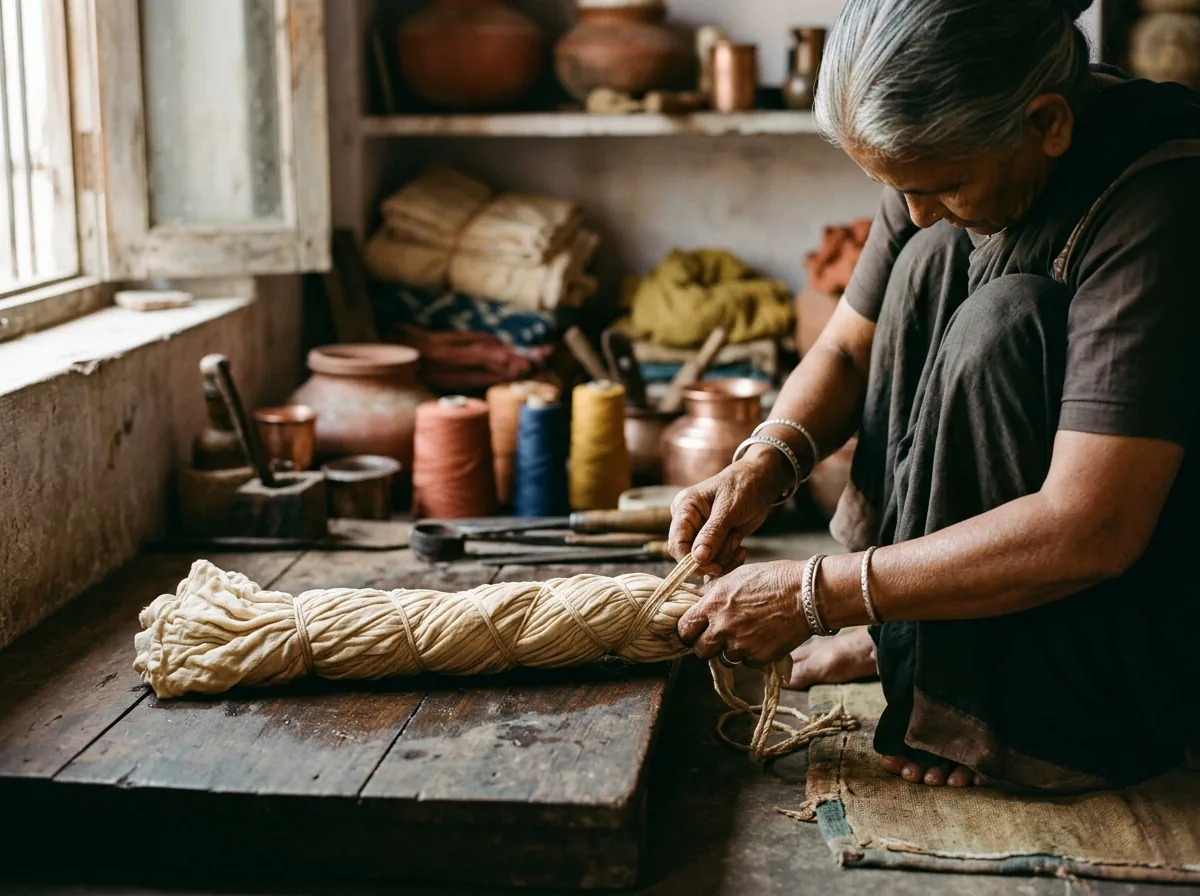
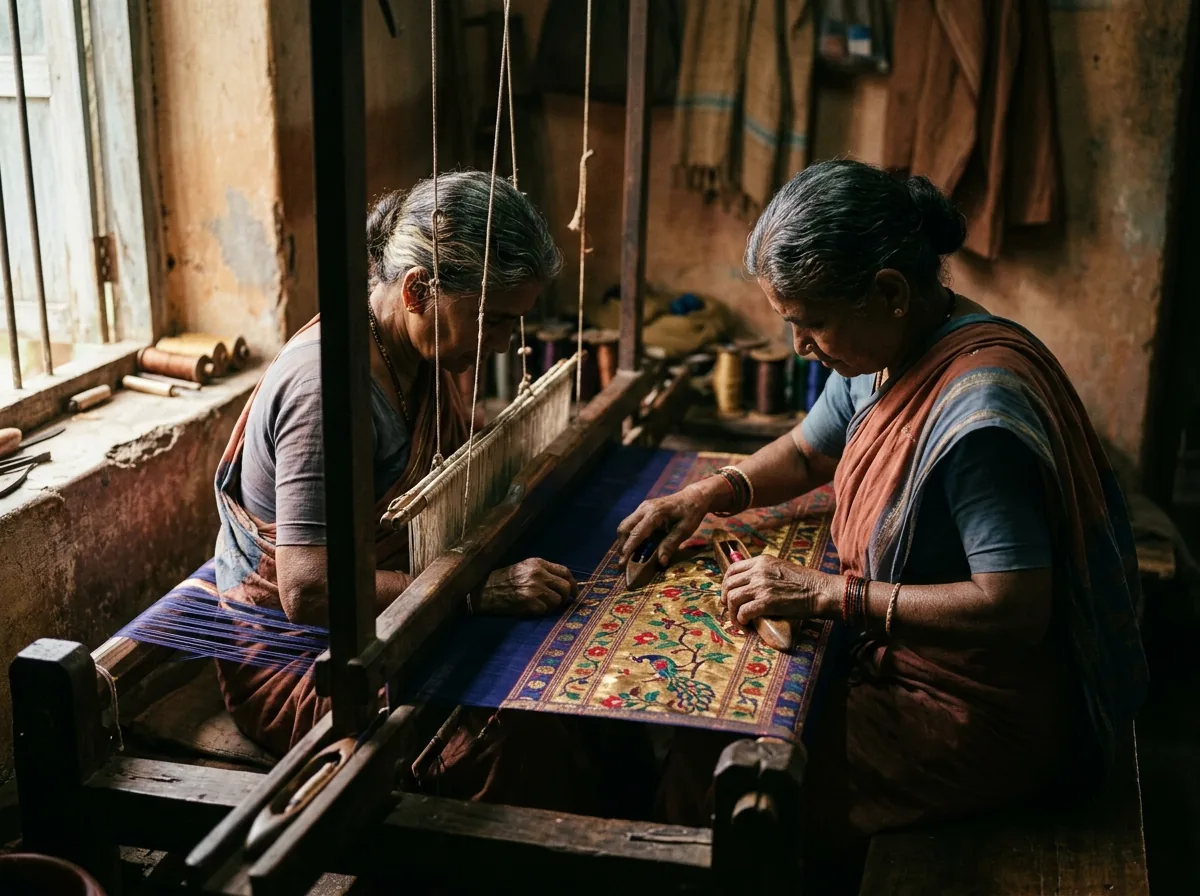
A young person who comes to the loom in a traditional Paithani family does not begin by weaving. He or she begins by watching. Then by winding bobbins. Then by learning to read the graph paper designs, the naksha, that translate a motif into a counted sequence of wefts. The loom itself, a handpit loom with no mechanical automation, demands that the weaver hold the entire structure of a design in mind before a single shuttle is passed. For a complex pallu with interlocked peacock forms and multiple supplementary colours, this preparation alone can take days.
The actual weaving of a single Paithani sari, depending on the complexity of its design, takes anywhere from two months to two years. This is not an approximation or a figure of speech. A sari with a densely worked pallu and an elaborate woven border may genuinely require eighteen months of sustained work at the loom, with two weavers often sitting together to manage the supplementary weft sequences. When it is finally cut from the loom and held up to the light, the silk ripples with a phenomenon unique to Paithani: the colours shift as the fabric moves, because the warp and weft are in deliberately contrasting hues. A green silk warp crossed with a gold zari weft produces a fabric that appears almost bronzed in one light and emerges green again in another.
This optical character is not a technique applied to the surface. It is structural. It lives inside the weave. And it takes two generations to fully understand why.
Yeola and the Expansion of a Tradition
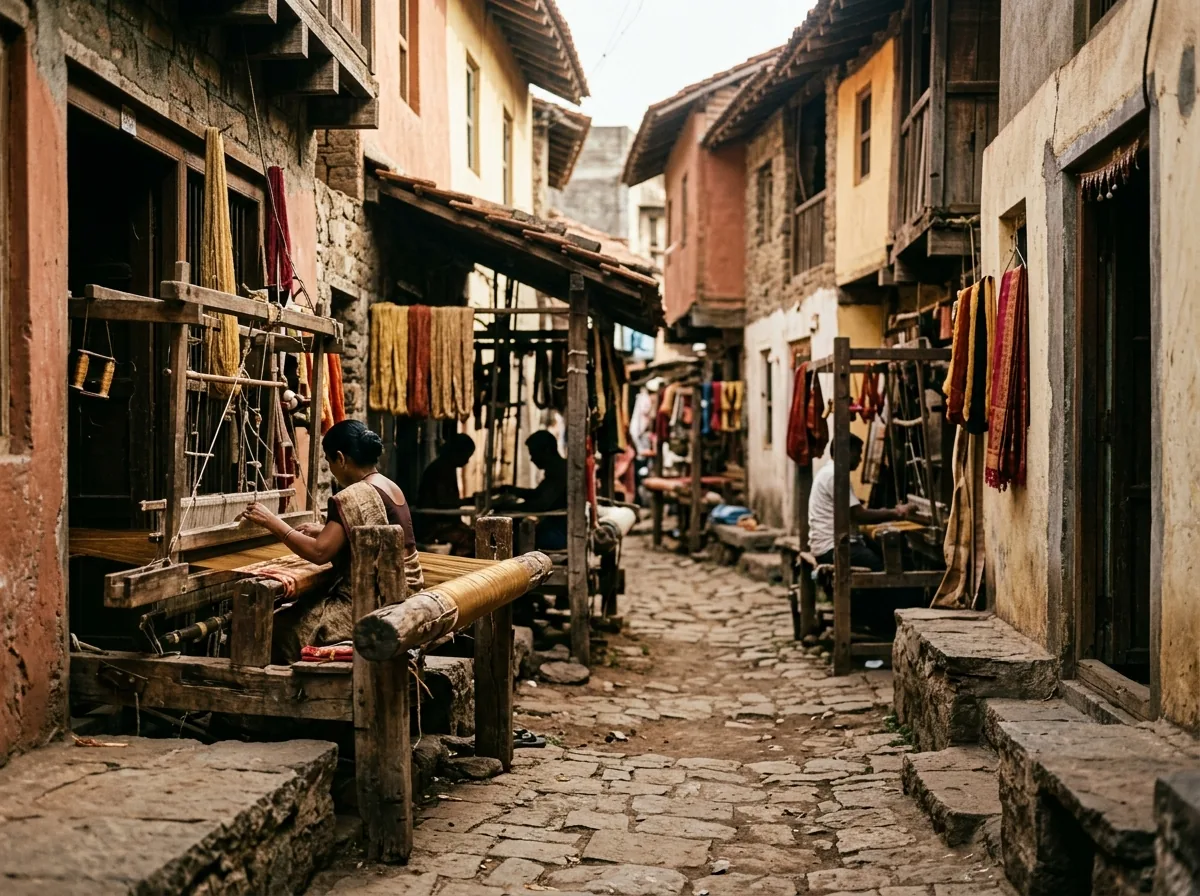
While Paithan remains the spiritual home of the weave, the town of Yeola in Nashik district became, over the course of the nineteenth and early twentieth centuries, the commercial and creative engine of Paithani production. If Paithan gave the silk its name and its origins, Yeola gave it scale, and in doing so preserved it through periods when court patronage collapsed and demand faltered.
The weaving community in Yeola is predominantly from the Sali and Padmasali communities, hereditary silk weavers who brought considerable technical knowledge with them as the craft expanded geographically. In Yeola, the concentration of loom households is remarkable. Entire streets are given over to the craft. The sound of pit looms overlaps from house to house, creating a kind of woven soundscape that is particular to the town.
Yeola weavers developed variations in colour palette and motif density that distinguish their work from Paithan pieces in subtle but recognisable ways. Collectors and connoisseurs learn to read these distinctions: the slightly warmer gold of the Yeola zari border, the particular way the asawali vine curves through the field in certain family lineages, the preference for deeper, more saturated body colours that Yeola became known for.
The Geographical Indication tag granted to Paithani in 2009 covers both centres and acknowledges the tradition as a whole, but within that broad recognition, the two towns maintain a gentle and productive sense of distinct identity. This is not rivalry. It is the natural differentiation that occurs when a living craft is practised by human beings with particular histories and particular hands.
Colour as Conversation
One of the least discussed and most remarkable aspects of Paithani is its historical relationship with colour. Before synthetic dyes reached the subcontinent in the late nineteenth century, Paithani weavers worked with natural dyestuffs that required considerable knowledge to extract, fix, and sustain. Indigo for blue. Pomegranate rind and turmeric for yellow. Madder for the range of reds that appear in older pieces. Combinations of these produced the secondary palette that gave classical Paithani its warm, deep tonality.
The shift to synthetic dyes brought both loss and possibility. Loss because certain colours that natural dyes produced, a particular quality of faded warmth that deepens with age, cannot be exactly replicated by chemical means. Possibility because the range of colours available expanded dramatically, and weavers could respond to changing tastes in ways that earlier generations could not.
Today, the best Paithani work navigates this history with care. Some weavers, particularly those working with organisations focused on craft revival, have returned to natural dye processes, not as a nostalgic exercise but as a genuine creative choice. The resulting saris have a restraint and depth that reads very differently from the saturated jewel tones of the commercial market. Neither approach is more authentic than the other. They are different conversations that the craft is having with different moments in time.
The zari, the metallic thread that runs through the borders and pallus of every Paithani, is traditionally real gold or silver, alloyed and drawn into thread around a silk core. The quality of the zari is another distinguishing factor in assessing a piece, and experienced buyers learn to assess it by touch and weight as much as by sight.
What the Loom Does Not Forget
A Paithani sari does not arrive at the wearer lightly. It carries in its every thread the accumulated knowledge of a community that has returned to the same loom, generation after generation, to practice a form of beauty that is also a form of devotion.
When a woman wears a Paithani at a wedding or a festival, at a daughter's ceremony or a moment of personal significance, she is participating in an unbroken continuity that stretches back to the Godavari riverbank in the first centuries of the common era. She may not know the name of the weaver. She may not know whether her sari came from a loom in Paithan's older quarter or from a workshop street in Yeola. But the silk knows. The peacock in the pallu knows. The particular shimmer that moves across the fabric as she walks, that quality of light held within structure, that is not a feature or a selling point. It is the signature of a tradition that has never needed to announce itself, because it has always been, quietly and entirely, itself.