Ten thousand knots, and in each one, a name the cloth remembers.
The Geography of a Gesture
There is a particular quality of light in the Rann of Kutch in the weeks before the monsoon. The salt flats hold the heat like fired earthenware, and the air carries the fine mineral dust of a landscape that has been, for centuries, both demanding and generous. It is here, and across the wide pastoral expanse of Saurashtra to the south, that bandhani has been practised for longer than most written records care to acknowledge. The craft appears in references as early as the seventh century, and fragments of tied cloth have been excavated from sites along the Sindh corridor, suggesting a continuity that outlasts dynasties.
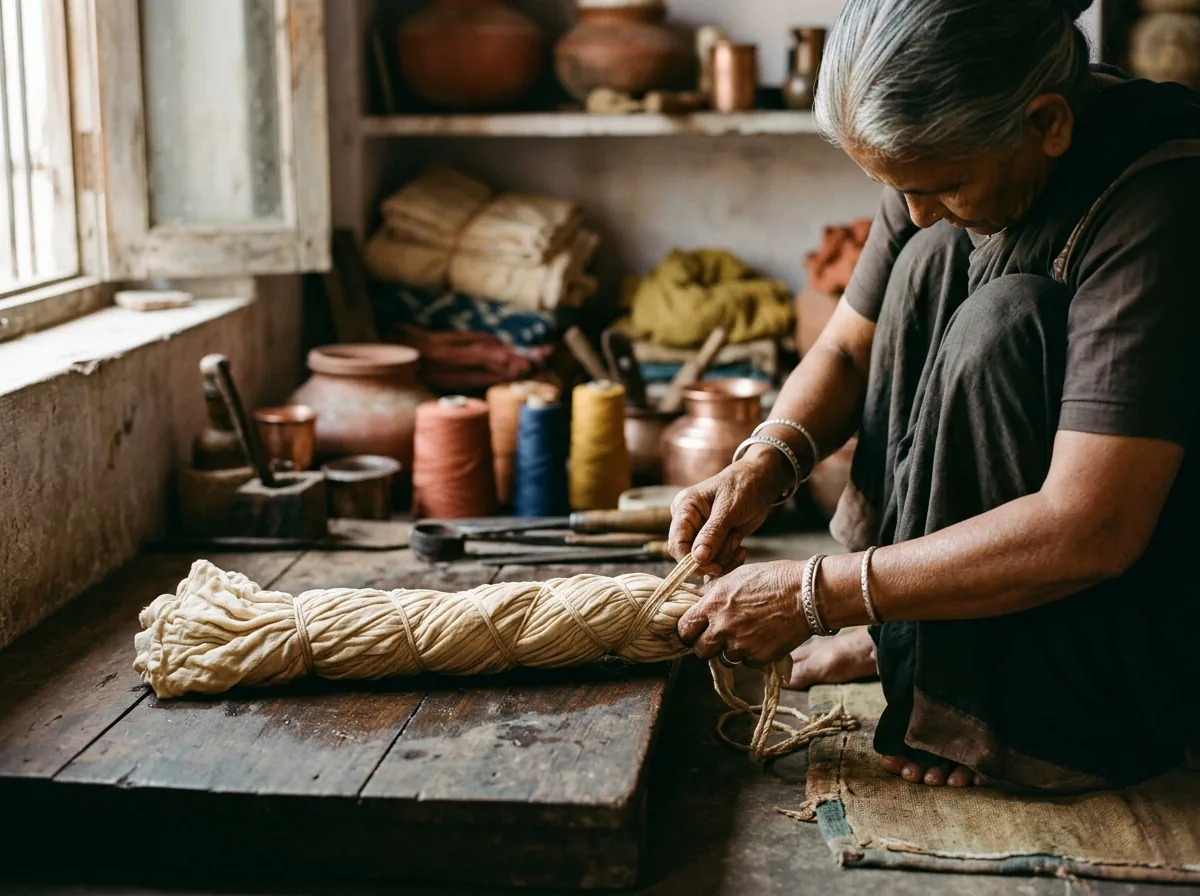
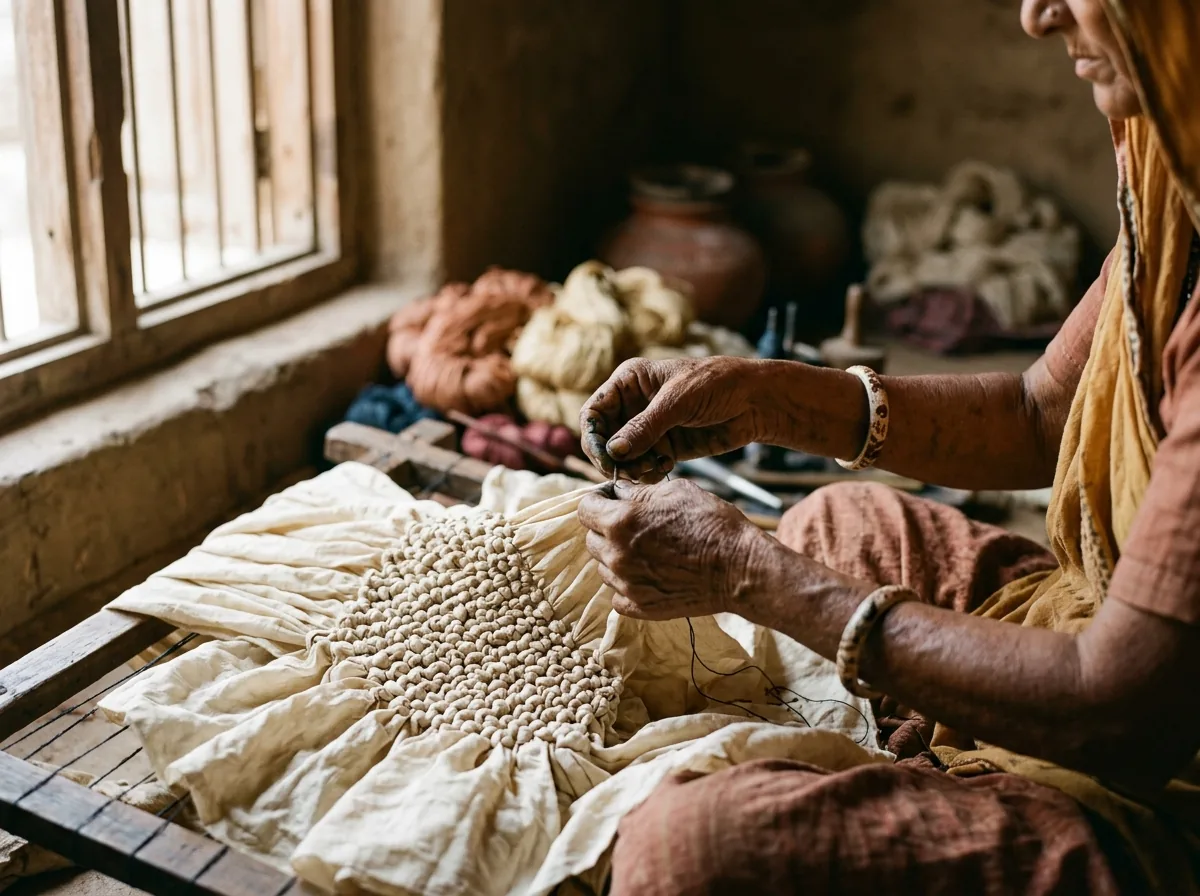
The word bandhani derives from the Sanskrit bandhan, meaning to bind. But the gesture itself is older than any word for it. A woman takes a length of fine cotton or silk, gathers a pinch of cloth between thumb and forefinger, binds it tightly with thread, and in doing so, protects that tiny point from the dye that will flood the rest of the fabric. Multiply that gesture ten thousand times, or twenty thousand, and you begin to understand why bandhani is not merely a textile technique. It is a form of sustained intention, a meditation carried out in the domestic interior, across seasons, across generations.
The primary centres today are Bhuj and Anjar in Kutch, and the towns of Jamnagar, Rajkot, and Morbi in Saurashtra. Each locality carries its own signature, its own density of pattern, its own preference for ground colour. Jamnagar, long associated with the finest silks, has given bandhani its most luminous register. Bhuj, rebuilt after the 2001 earthquake with quiet tenacity, continues to produce work of extraordinary refinement.
The Khatri Communities and the Thread of Continuity
Bandhani in Gujarat is overwhelmingly the work of the Khatri community, a Muslim artisan group whose presence in Kutch and Saurashtra predates several waves of regional migration. The Khatris identify themselves as specialist dyers and printers, and their knowledge of natural mordants, resist techniques, and colour sequencing constitutes a body of expertise that has been transmitted within families for generations, not through written manuals but through proximity, observation, and the slow accumulation of practice.
Within the broader Khatri identity, there are distinctions. Some families specialise in the tying alone, a task that falls largely to women working at home. Others manage the dyeing, which involves precise knowledge of how a colour will behave when it meets wet cloth, how turmeric and indigo and pomegranate rind interact with different fibres, and how the sequence of immersions determines the final palette. The knowledge is collaborative and distributed, which means it is also resilient. No single person holds all of it.
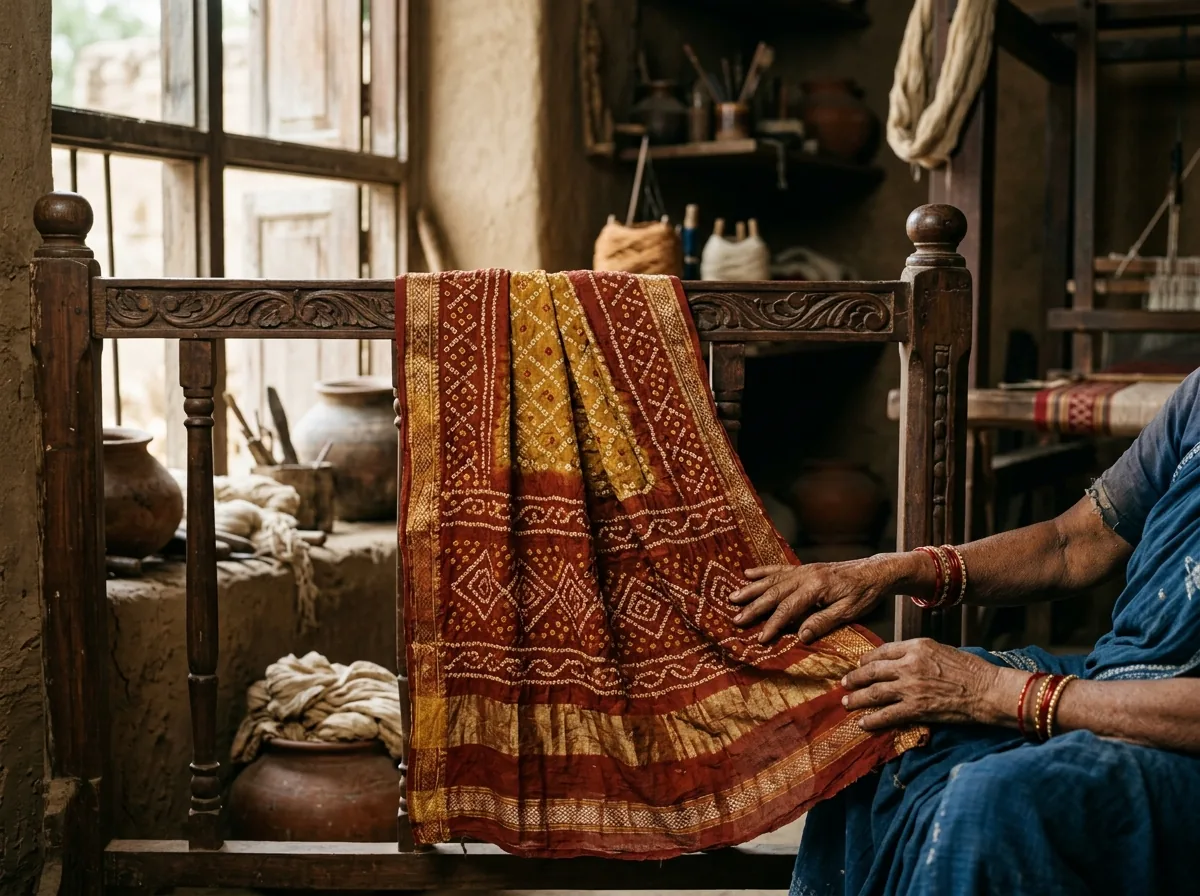
The Hindu Nayak community in certain parts of Saurashtra also practises bandhani, and their work tends toward the bold geometric dotwork associated with the odhani and gharchola cloths used in wedding ceremonies. The gharchola, traditionally a wedding gift presented to a bride, is woven with a distinctive grid of woven-in checks and then tied and dyed, so that the bandhani pattern appears within each square of the lattice. The result is a cloth of such visual complexity that it seems almost architectural, a structure built from absence and colour simultaneously.
What the Knot Withholds
The logic of bandhani is the logic of resistance. What the thread withholds from the dye becomes, ultimately, the pattern. The undyed points appear as small circles of the ground cloth, and it is their arrangement, their density, their scale, and their relationship to the surrounding colour that constitutes the design. This is a fundamentally different way of thinking about image-making. The pattern is not added to the surface; it is preserved within it.
Experienced tyers in Bhuj can work entirely from memory, their fingers finding each successive point in a sequence so internalised that it requires no visible guide. For more complex compositions, a woodblock printed outline may be applied to the cloth beforehand, giving the tyer a faint map to follow. But even then, the translation from printed line to tied knot involves countless small decisions, adjustments of tension and placement that no outline can fully prescribe.
The dots themselves are not uniform. A chikna bandhani, smooth and fine, uses knots so small that a single saree may contain upward of seventy-five thousand individual ties. A bolder work, intended for the heavier cotton used in Rabari or Bharwad pastoral communities, may use larger knots that produce a different visual texture entirely, coarser, more emphatic, more suited to the outdoor light of a pastoral landscape. The Rabari community of Kutch has traditionally used bandhani odhanis in deep reds and blacks as markers of life events, their patterns understood within the community as a kind of textile literacy.
Colour as Chronicle
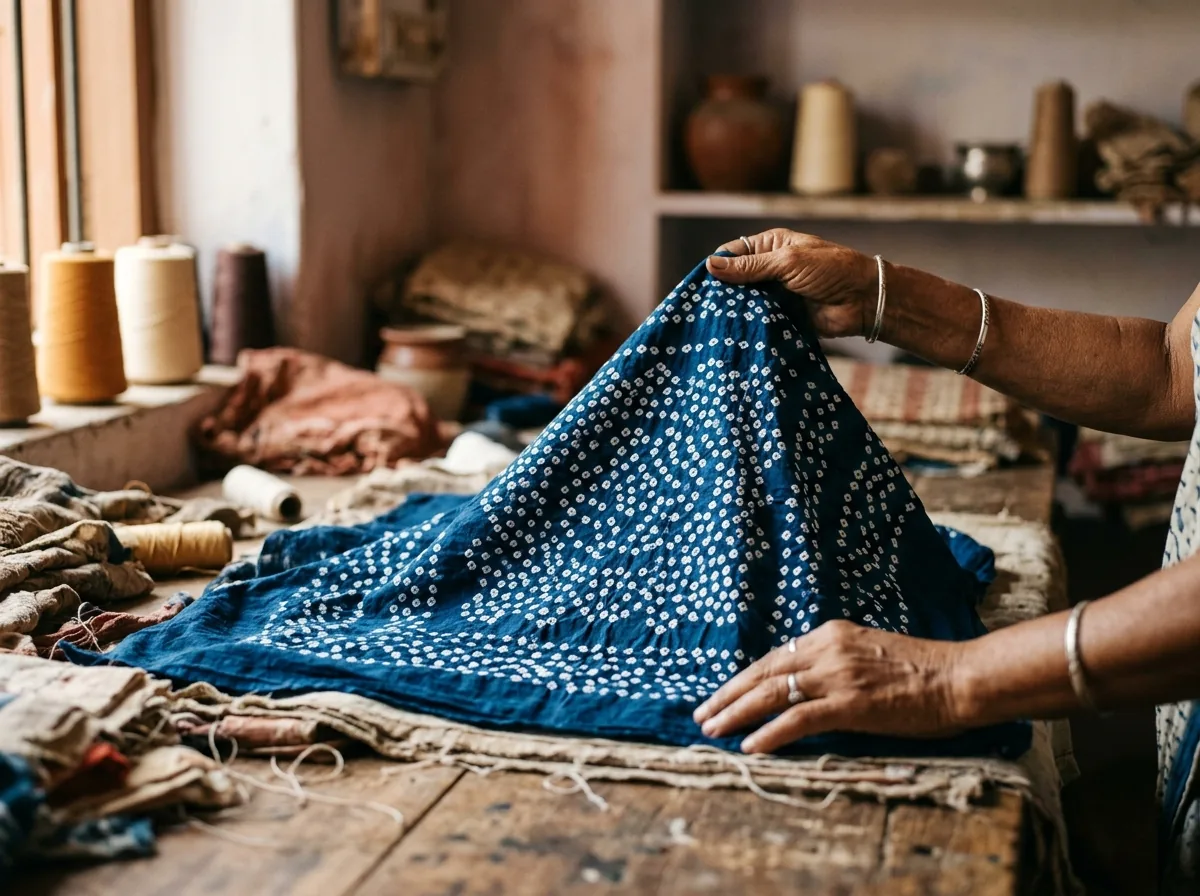
The colours of bandhani are not decorative choices alone. They carry social and ceremonial weight that shifts across communities and occasions. Red and yellow together, particularly on the gharchola, are auspicious for weddings. A widow in certain communities would not wear the crimson ground that marks a married woman. The deep indigo associated with certain Kutchi work has its own regional identity, distinct from the brighter chemical blues that entered the palette in the late nineteenth century.
Natural dyeing in bandhani has a demanding logic. Because the cloth is tied before it is dyed, and because the ties must be removed without damaging the fine silk or cotton beneath, the dye baths must be chosen carefully for their temperature and their chemistry. Pomegranate rind yields a warm yellow that also acts as a mordant, preparing the cloth to receive other colours. Indigo requires its own fermented vat, its own patience. The alizarin reds derived from madder root produce a depth that synthetic alternatives have not convincingly replicated.
The shift toward synthetic dyes in the mid-twentieth century was a matter of economics and availability, not preference. Many Khatri families who work with synthetic dyes today speak with considerable precision about what was lost, not in abstract terms, but in the specific quality of how a colour ages, how it softens over decades of wear, how the cloth and the dye become, over time, the same thing. A natural-dyed bandhani saree worn for thirty years develops a surface that is, in the truest sense, unrepeatable.
The Occasions That Call for Knots
Bandhani enters life at its most significant thresholds. In communities across Kutch and Saurashtra, a young woman's trousseau would include bandhani odhanis in colours specified by family tradition. A newborn would be wrapped in a yellow-ground bandhani cloth. A newly married woman crossing the threshold of her husband's home for the first time might wear a gharchola whose every woven square contained a tiny field of tied dots, each one bound by the hands of women from her community.
The craft's presence in ceremony is not incidental. The act of tying and the act of binding in ritual share a common grammar. The knot that protects the cloth from dye is, in the same symbolic register, the knot that marks the transition from one state of life to another. Bandhani scholars have noted this convergence without reducing it to simple metaphor. The cloth participates in the ceremony not as costume but as object with its own memory, its own record of the labour that produced it.
In the festivals of Navratri, bandhani chaniya cholis in layered reds, greens, and oranges appear across the Kathiawar region in such abundance that the colours of the craft seem to become the colours of the season itself. This is not nostalgia. These garments are being newly made, newly tied, newly worn. The tradition is not a museum exhibit; it is a living calendar.
A Cloth That Holds Its Breath
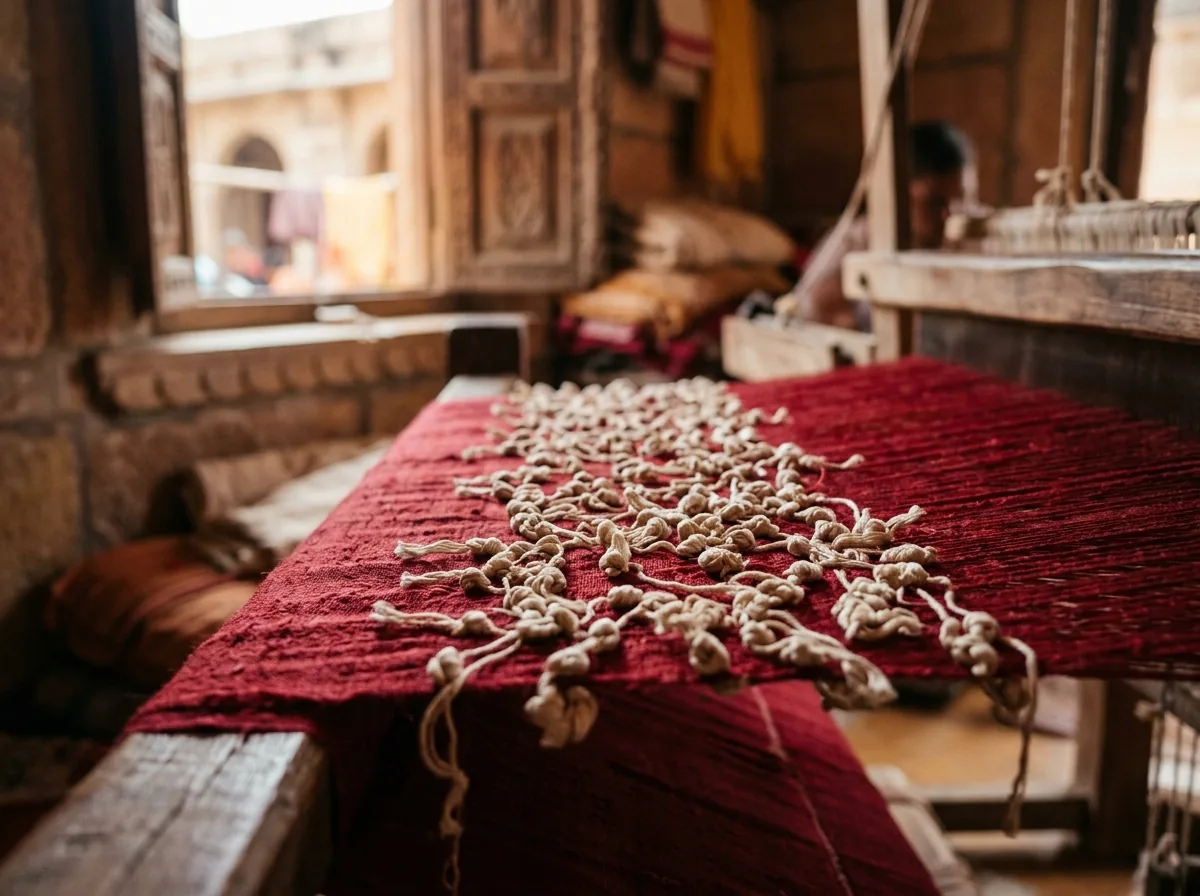
There is a moment, known to anyone who has watched a bandhani being untied after its final dye bath, when the cloth is still damp and the threads are being snipped free one by one. The pattern is not yet fully visible. The tiny bound points have spent hours compressed, withheld from colour, held in a kind of suspension. As the threads fall away, each dot opens, releases, reveals. The cloth, in a sense, exhales.
It is a quiet and unhurried process, and it resists the pace of contemporary production almost entirely. This is not a craft that can be meaningfully accelerated without changing what it is. The tying is slow. The dyeing is slow. The untying is slow. And in that slowness, which is sometimes read as inefficiency and sometimes, more accurately, as a different relationship with time, lies the character of every piece that survives it.
What reaches us, the cloth folded in its tissue, carried across distances, is not simply a textile. It is the accumulated patience of hands that worked without hurry, in the knowledge that the knot would eventually open into something worth the waiting. Bandhani asks its wearer to hold that same unhurried attention, to look closely enough to see, in the constellation of small circles, something that ten thousand separate gestures made possible.