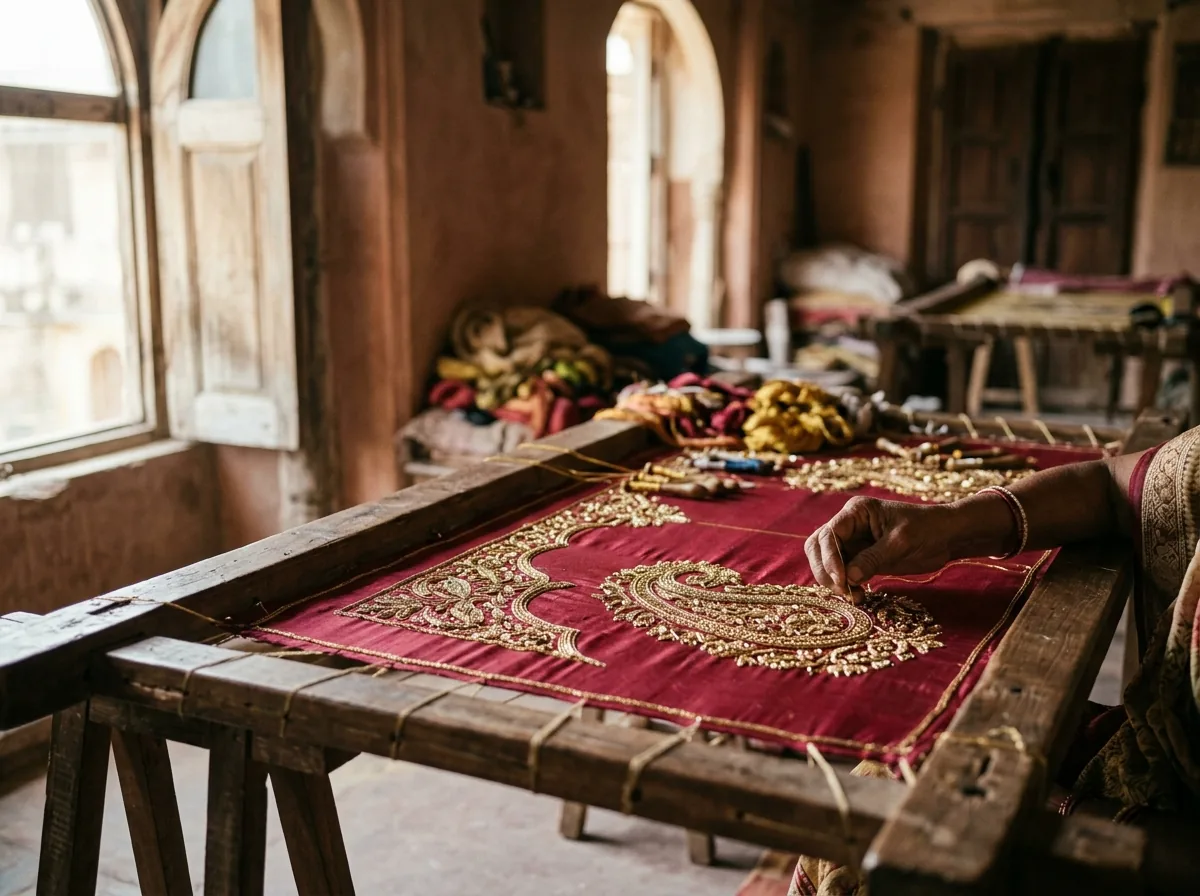
Gold does not shout. It accumulates, stitch by stitch, until the fabric remembers light.
The Weight of an Old Inheritance
There is a particular quality of silence in a Lucknow karkhana in the late afternoon. The light comes in low and lateral, catching the metallic threads stretched across a wooden karchob frame, and for a moment the cloth seems to breathe. The craftsmen seated cross-legged on the floor do not look up. They have been here since morning, and the work requires a stillness that is almost devotional.
Zardozi, from the Persian zar (gold) and dozi (embroidery), is one of the most demanding textile arts practised on the subcontinent. Its roots travel deep into Mughal court culture, where it adorned the robes of emperors, the caparisons of elephants, and the tent canopies of campaign encampments. It was not decorative in the way we use that word loosely today. It was political. It communicated sovereignty, patronage, and the astonishing capacity of a court to transform raw material into refined beauty.
The craft arrived in India through Persia, carried westward along trade corridors and then eastward again through the cultural ambitions of the Mughal nobility. By the sixteenth century, the ateliers of Agra and Lahore had established karkhanas where hundreds of craftsmen worked under court supervision. When Awadh rose to prominence in the eighteenth century and Lucknow became its glittering capital, zardozi followed the patrons, taking root in the narrow mohallas that still bear the names of old craft families. Chowk, Aminabad, the lanes radiating outward from the Rumi Darwaza, these neighbourhoods became the quiet engines of an embroidery tradition that would last three centuries and longer.
Thread by Thread: What the Work Involves
To understand zardozi is to understand patience as a material. The foundation cloth is typically silk, velvet, or heavy organza, stretched taut across the karchob so that it resists the needle's pressure without distorting. The embroiderer works from the front, though some preparatory work requires turning the frame. The threads themselves are not simply gold-coloured. In the finest traditional work, real gold wire, called badla, was beaten into thin strips and wound around a silk or cotton core. Silver wire received a similar treatment and was used for what is called chandi ka kaam, or silver embroidery.
Today, the materials have largely shifted. Real gold and silver wire are reserved for heirloom commissions and certain ceremonial orders. Most contemporary zardozi uses copper wire coated in gold or silver finish, known as kalabattu, along with a vocabulary of supplementary elements. Salma refers to the fine coiled wire that lies flat against the cloth, creating texture and lustre simultaneously. Sitara are small punched metal sequins, quite different from the plastic variety. Dabka is a rough, springy coiled wire that catches the light at an angle distinct from salma. Kora is a stiffer thread, nankha a finer one. Each element has a specific application, and a skilled karigaar knows them by touch.
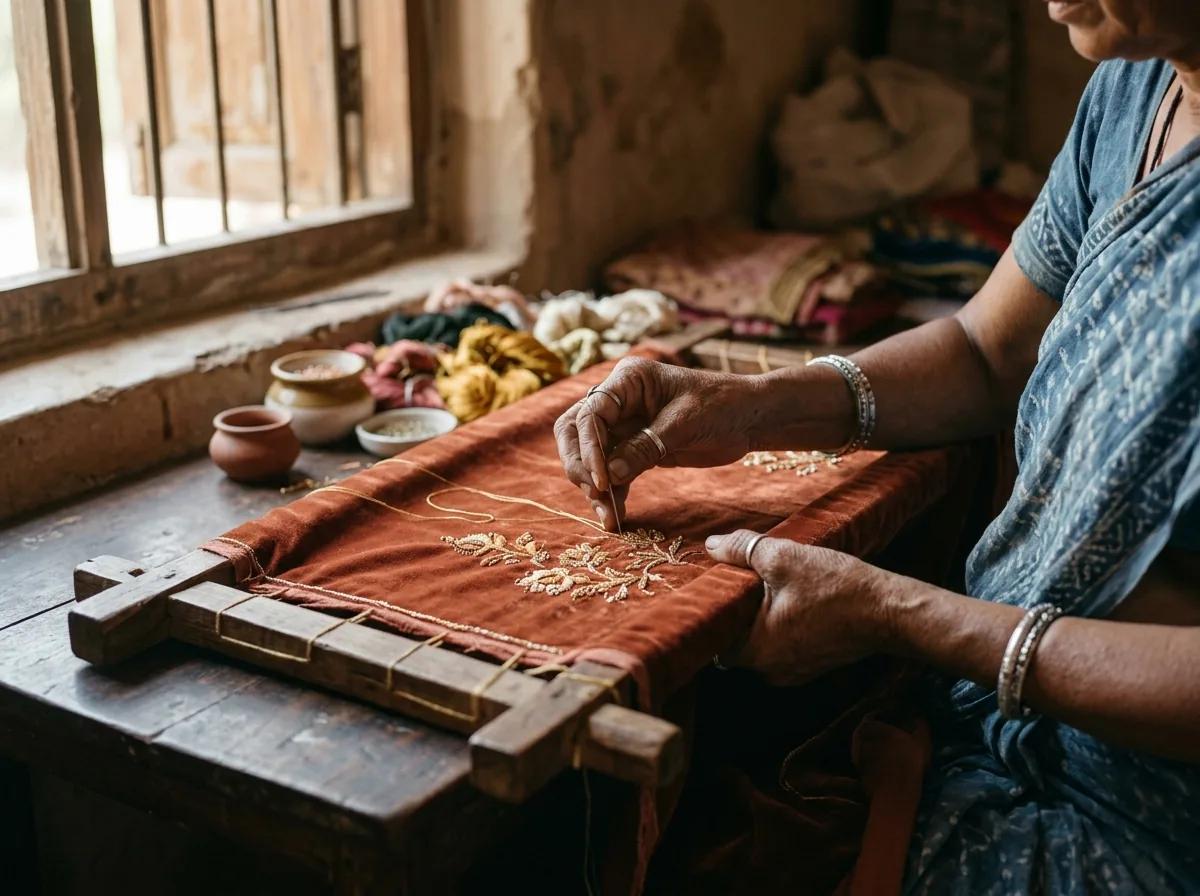
Ari work, practised alongside zardozi in Lucknow and parts of Delhi, uses a hooked needle resembling a fine crochet hook to pull thread loops up from beneath the fabric. The resulting chain-stitch texture creates a different surface than the flat couching of classic zardozi, and the two techniques are often combined within a single piece. Distinguishing which passages are ari and which are laid-thread work is part of the pleasure of looking closely.
Lucknow and Delhi: Two Schools of the Same Gold
Both cities claim zardozi as their own, and both are correct. The distinction between them is real, though it resists easy summary.
Lucknow zardozi, as it developed through the Nawabi courts of the Asaf-ud-Daula period and beyond, tends toward a certain refinement. The motifs are Persian in origin but have absorbed something gentler over generations: mango or keri forms that curve rather than point, flowering sprays that seem to lean rather than stand upright, a preference for negative space that gives the embroidery room to be seen. The Lucknow tradition is associated above all with the karkhana system, the organised atelier in which a master karigar, or ustad, oversaw a hierarchy of embroiderers at various stages of skill. This system survives, in altered form, in workshops in the Chowk area and in the surrounding districts of Barabanki, where many craftsmen now work from home.
Delhi zardozi carries a different weight. The capital's tradition is older in some respects and was shaped by the direct demands of the Mughal imperial workshops. The motifs are fuller, the density of work often higher, and the colour palette more willing to mix gold with bold ground fabrics. In certain Delhi pieces, particularly those made for bridal markets, the embroidery achieves an almost architectural quality: reliefs of metal thread built up through multiple passes until the fabric beneath is almost entirely concealed.
Neither tradition is purer or better. They are cousins who grew up in different households, each carrying a family resemblance and a private manner.
The Karkhana and Its Custodians
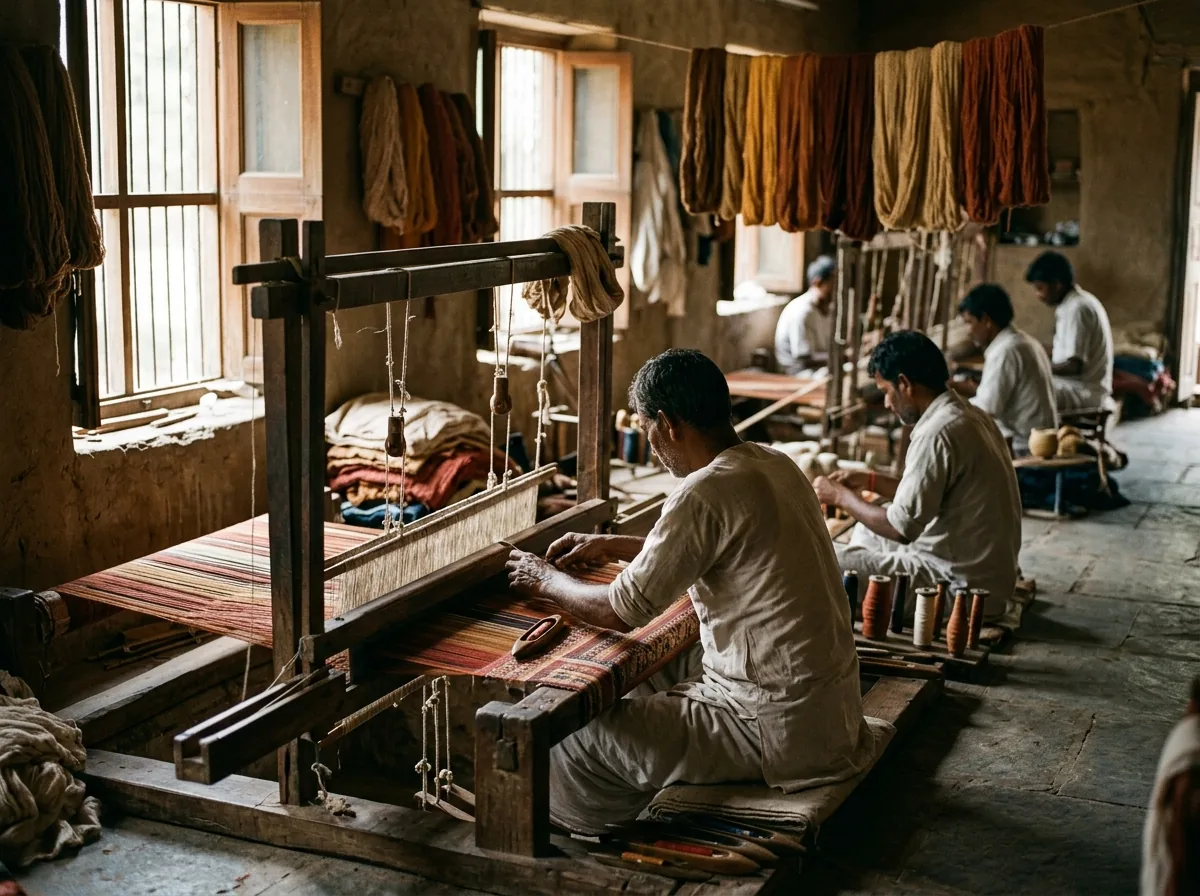
The word karkhana means, simply, a workshop or factory. In the context of Awadhi craft, it carries far more. The karkhana was a social institution as much as a productive one, a place where skills were transmitted not through formal instruction but through proximity. A young apprentice sat beside an ustad for years before touching the karchob frame. He learned by watching the angle of the needle, the tension of the thread, the weight of the hand. There was no curriculum.
This system created extraordinary depth of skill and also a certain vulnerability. The knowledge lived in people, not in documents. When patronage collapsed, as it did catastrophically after 1857 and again during the trade disruptions of the twentieth century, whole lineages of technique could disappear within a generation. Certain very fine forms of zardozi, including work that incorporated real zari alongside ari embroidery in multi-layered compositions, are now seen only in museum collections and old heirloom pieces.
What remains is still impressive. In the gallis of Lucknow's older quarters, family workshops continue, often now operating as subcontractors for fashion export houses or boutique labels. The ustad may be training his son or a nephew. The karchob frames are the same. The vocabulary of salma, sitara, dabka, kora, nankha endures.
There are also efforts to sustain the tradition through documentation and design collaboration. Craft organisations working in Uttar Pradesh have, over the past two decades, attempted to record techniques and connect karigar communities directly with designers who can offer more thoughtful commissions than the bulk export market typically allows. Progress is uneven. The finest craftsmen remain underpaid for work that requires years of accumulated skill. This is the quiet difficulty at the heart of a tradition that the world considers luxurious.
Motif and Meaning: Reading the Surface
Zardozi is not merely decorative. It is a language with a grammar, and like any language it rewards those who take the trouble to learn it.
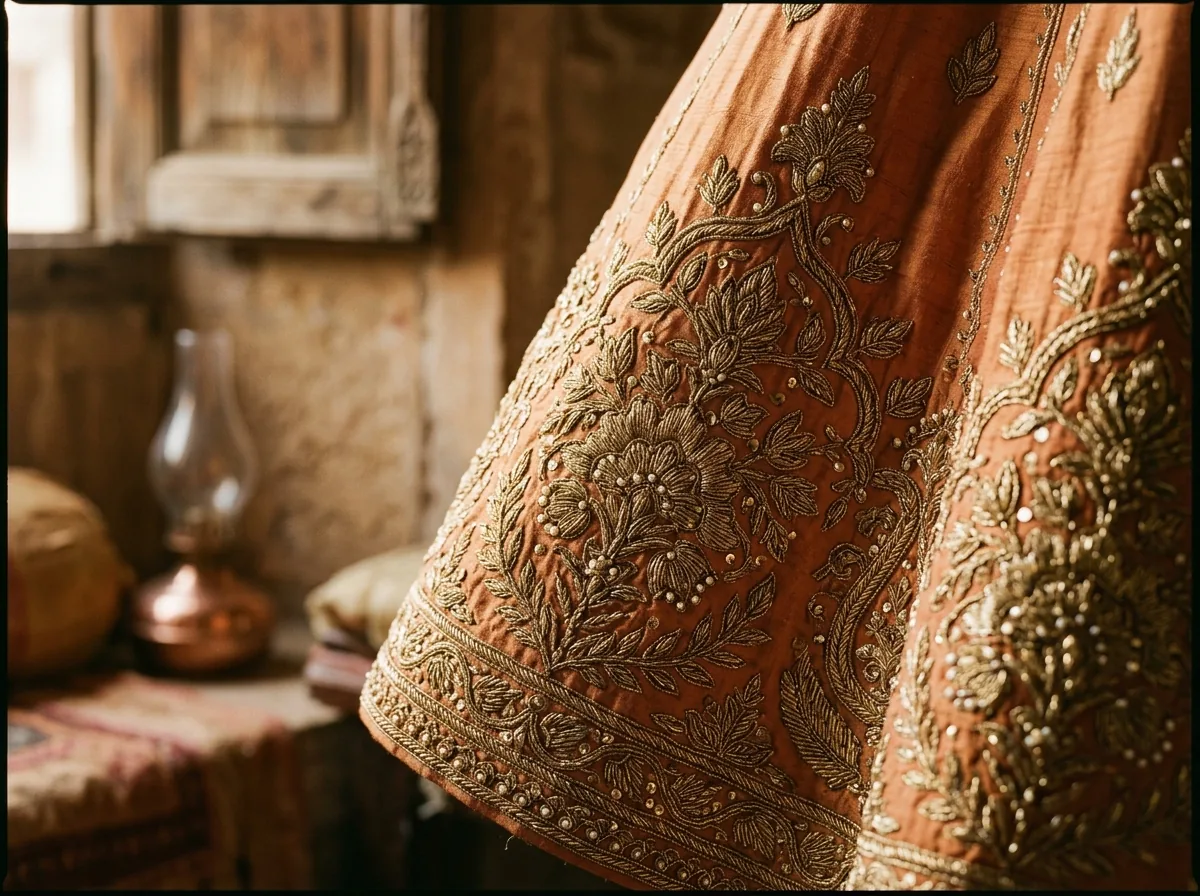
The mango or paisley form, so ubiquitous that it has become a cliche in casual usage, carries a specific meaning within the zardozi vocabulary. In Awadhi work, it almost always points inward, curving toward the body's centre, and its internal filling follows a hierarchy of motifs: flowers within flowers, leaves held inside petals, miniature landscapes compressed into the space of a thumbnail. To read one of these motifs fully is to read an entire decorative tradition.
Kairi forms are set alongside jali patterns, lattice structures worked in fine thread that create the impression of a net thrown over the cloth. Buti, the scattered single motif, appears in both formal arrangements (the symmetrical field of a shawl or a dupatta) and informal ones (the improvised placement that a skilled craftsman might choose to balance a garment's overall visual weight). Larger compositions, called boota, anchor the design and provide its focal points. On a full bridal lehenga, a master craftsman will design the relationship between buti, boota, and border so that the eye moves across the fabric as it might move through a formal garden, always finding a point of rest and then a reason to continue.
The palette of ground fabrics matters too. Deep red velvet asks for gold in a particular density. Ivory silk requires restraint. Black requires the most confidence of all, because every thread is visible against it and there is nowhere to hide an imprecise stitch.
When the Gold Settles
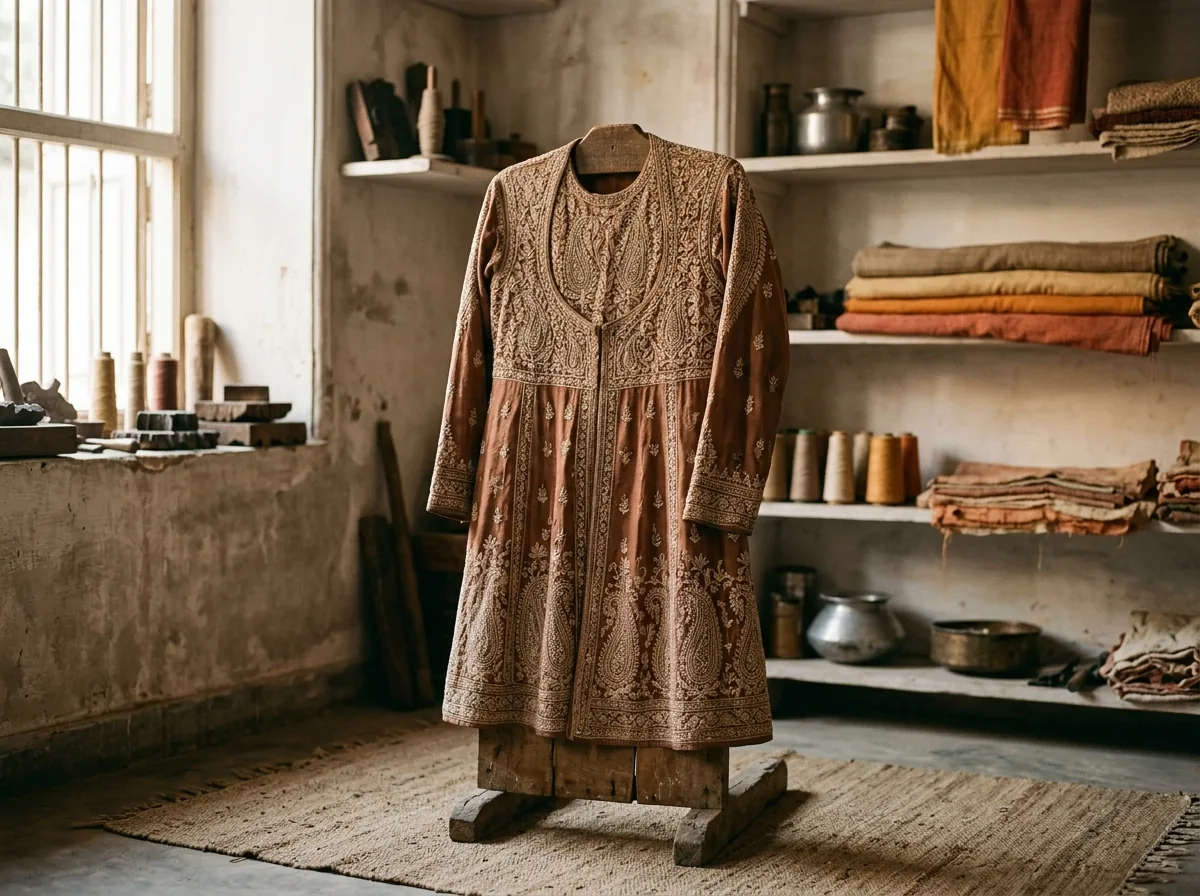
A finished zardozi piece does not announce itself. It requires the right light, the right movement, the right occasion. This is part of its character. It is an embroidery made for candlelight and ceremony, for the moment when a bride crosses a threshold or a dancer turns under a lamp. In flat daylight it can seem almost quiet. In motion it is entirely otherwise.
This quality of waiting, of holding its brilliance until the moment is right, is perhaps what distinguishes true zardozi from its many imitations. Mass-produced embroidery can approximate the visual effect in a photograph. It cannot approximate the weight of the cloth as the wearer lifts it, the way a salma-worked border falls differently from a printed one, the faint sound that sitara make against each other when the fabric moves.
There is something worth preserving in that difference, not as museum piece or nationalist symbol, but as a living measure of what human attention can do with wire and needle and time. The craftsmen of Lucknow and Delhi are still sitting at their frames. The work continues, stitch by stitch, accumulating its quiet weight.