Where the mulberry leaf becomes silk, and silk becomes ceremony.
A Kingdom That Wore Its Identity
Long before the phrase "luxury textile" entered the vocabulary of global fashion, the court of Mysore had already perfected the idea. The Wadiyar dynasty, which governed the Kingdom of Mysore through centuries of extraordinary cultural ambition, understood cloth the way other rulers understood stone: as a language of permanence. Silk was not merely worn in Mysore. It was curated, commissioned, and consecrated.
The relationship between the palace and the loom was not incidental. It was policy. The Mysore court actively patronised the Devangas and the Sale communities, traditional silk-weaving families who had settled across the Mysore region and its surrounding districts, bringing with them a grammar of interlocked motifs, zari construction, and a particular instinct for restrained opulence. These weavers did not make cloth for markets. They made cloth for occasions, for the durbar hall, for the processional elephant's ceremonial covering, for the body of a queen on an auspicious morning.
What distinguished Mysore's silk from the brocaded magnificence of Varanasi or the geometric precision of Kanchipuram was its texture: a smooth, almost liquid surface that caught the light without demanding it. The weave was tight but the hand was yielding. If Kanchipuram silk announces itself, Mysore silk converses. It has the confidence of something that does not need to raise its voice.
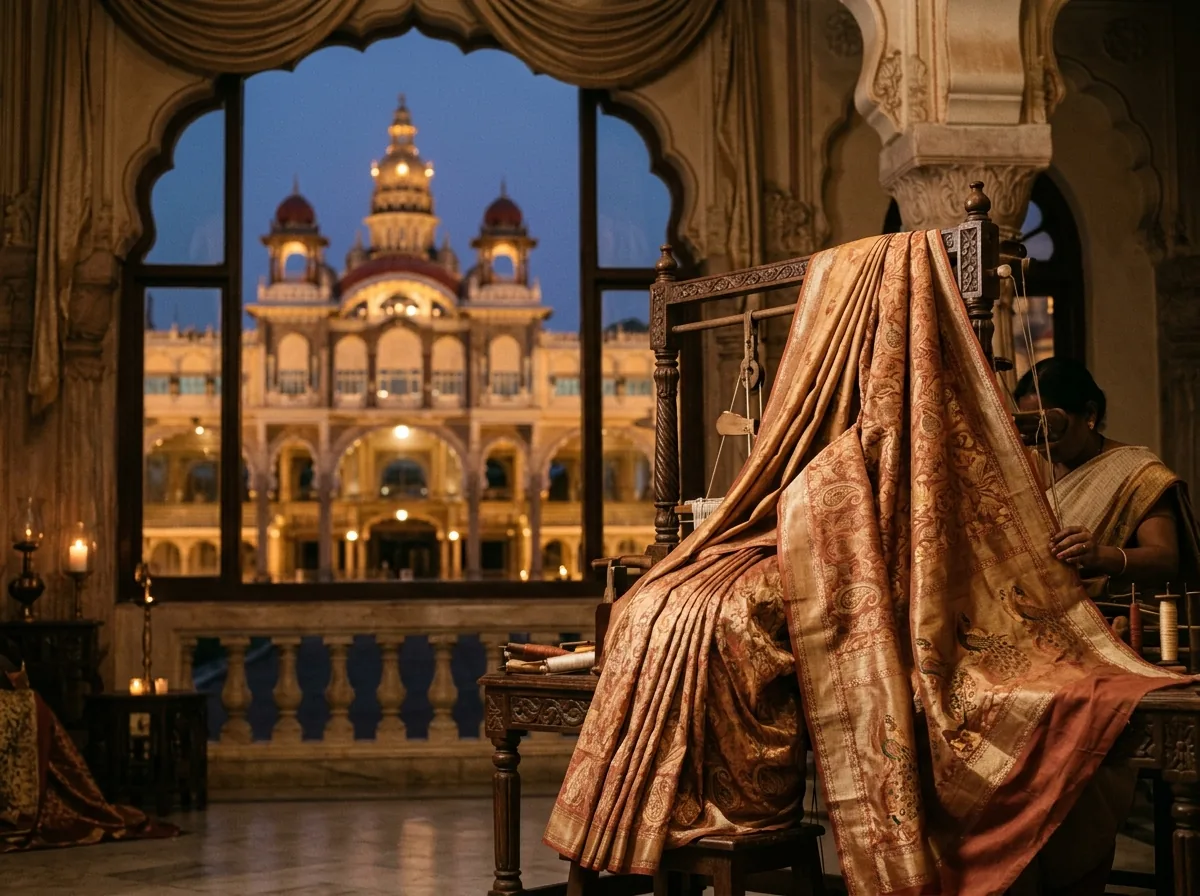
The city of Mysore, at the foot of the Chamundi Hills, remains inseparable from this inheritance. The palace there is not only an architectural monument. It is, in a very real sense, a primary source for understanding what these textiles were always meant to express.
The Corporation and the Craft
The Karnataka Silk Industries Corporation, established in 1912 under the reformist administration of Dewan Sir M. Visvesvaraya during the reign of Krishnaraja Wadiyar IV, was one of the earliest state-backed interventions in textile production in South Asia. Its founding premise was unusual for the era: that a traditional craft could be both industrially supported and artistically preserved, without one ambition cancelling the other.
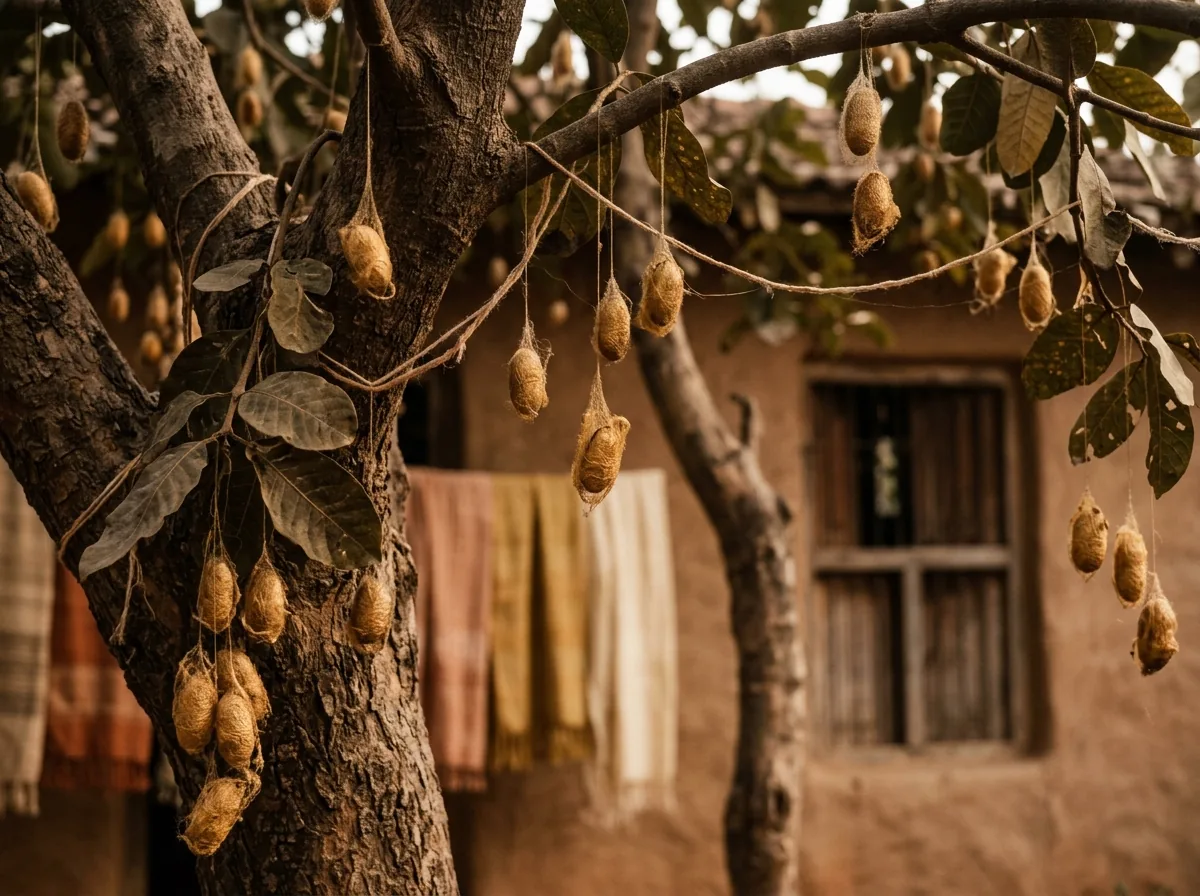
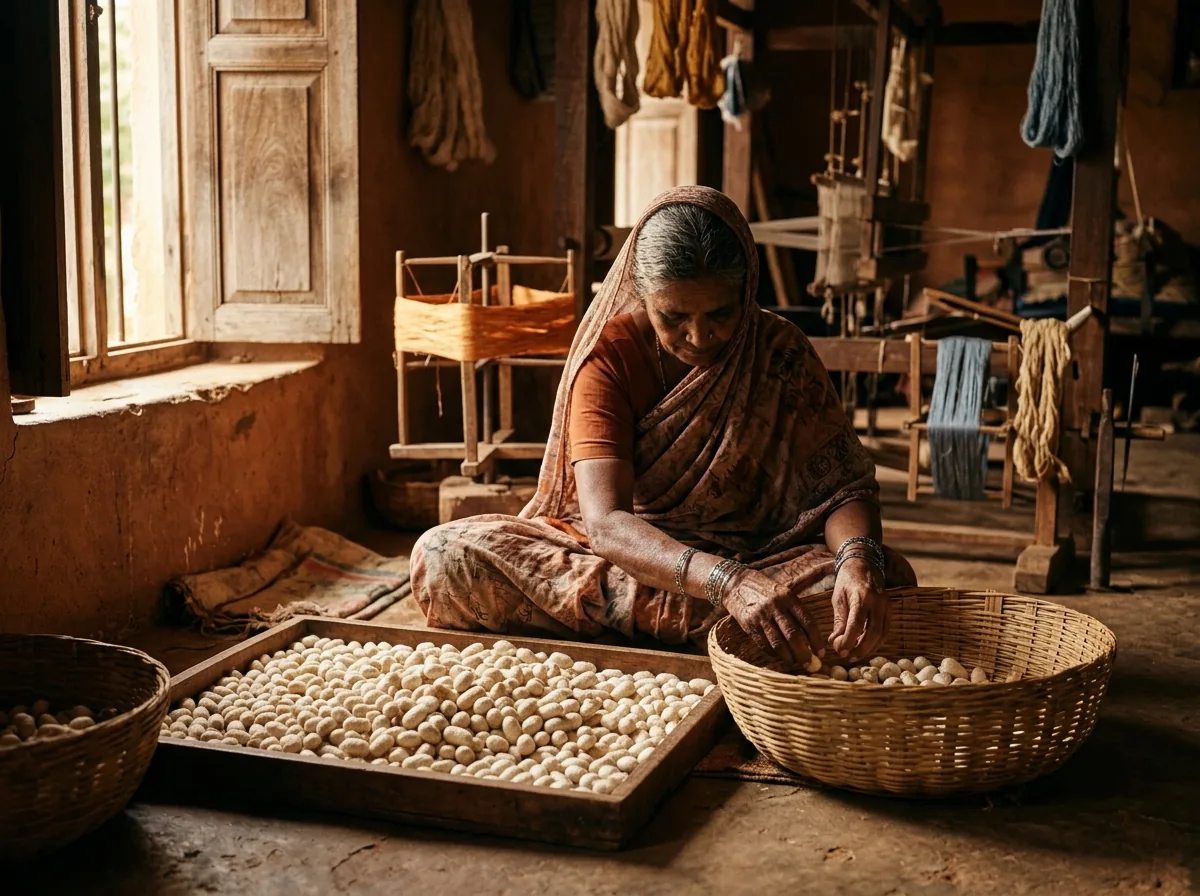
The KSIC, as it came to be known, operates its primary weaving facility in Mysuru, with ancillary production networks extending into the sericulture belts of Ramanagara, Channapatna, and the villages clustered along the Cauvery basin in Mandya district. Ramanagara, often called the silk city of Karnataka, is where the raw cocoon arrives first. The district's mulberry farms, tended across generations by farming families who understand the precise humidity and leaf-quality a silkworm requires, supply the thread that the corporation's looms then transform.
What the KSIC did, and continues to do, is codify. It maintained the specific count of threads per inch that defines Mysore crepe silk's characteristic drape. It regulated the use of pure zari, the gold and silver thread woven into borders and pallus. It created an institutional memory that protected the cloth from the drift of market imitation.
This is not to suggest the organisation has been without its contradictions. The tension between handloom and power-loom production has been a live debate within Karnataka's textile ecosystem for decades. But within the scope of what it set out to preserve, the KSIC remains a significant custodian of a very specific and very beautiful standard.
The Crepe-Silk Saree: A Study in Restraint
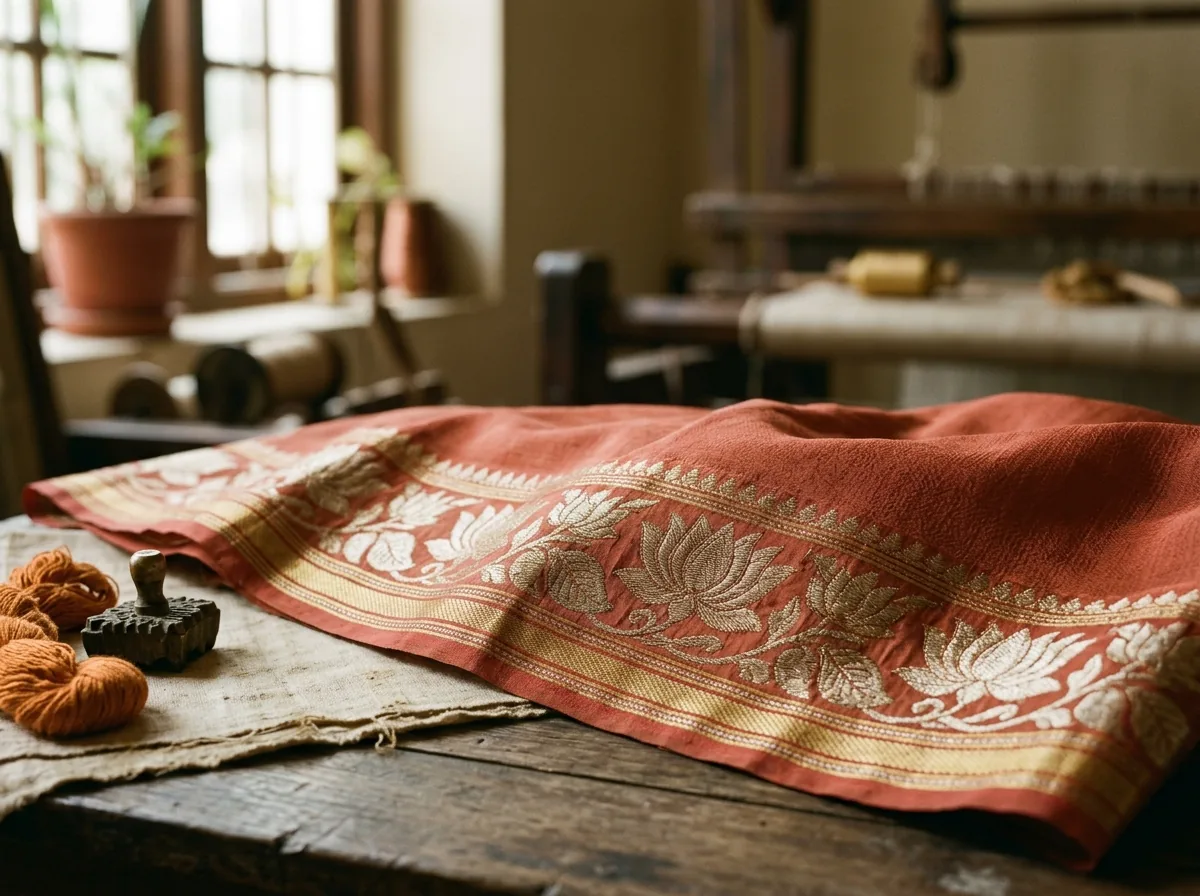
Among all the forms that Mysore silk takes, the crepe-silk saree is the most quietly extraordinary. The crepe weave is achieved through a particular tension in the yarn during production. The silk threads are twisted at a higher rate than in a plain weave, and when the fabric is released from the loom, this tension resolves into a subtly crinkled, elastic surface. The result is a fabric that moves with the body rather than around it.
A Mysore crepe-silk saree does not hold its shape in the rigid, architectural manner of a Kanchipuram kanjeevaram. It softens. It settles. It responds to warmth and movement. This quality made it particularly suited to the climate of the Deccan Plateau, where the Mysore court held its ceremonies through seasons that were warm even in winter. A saree that breathes and bends is not a small comfort in that context.
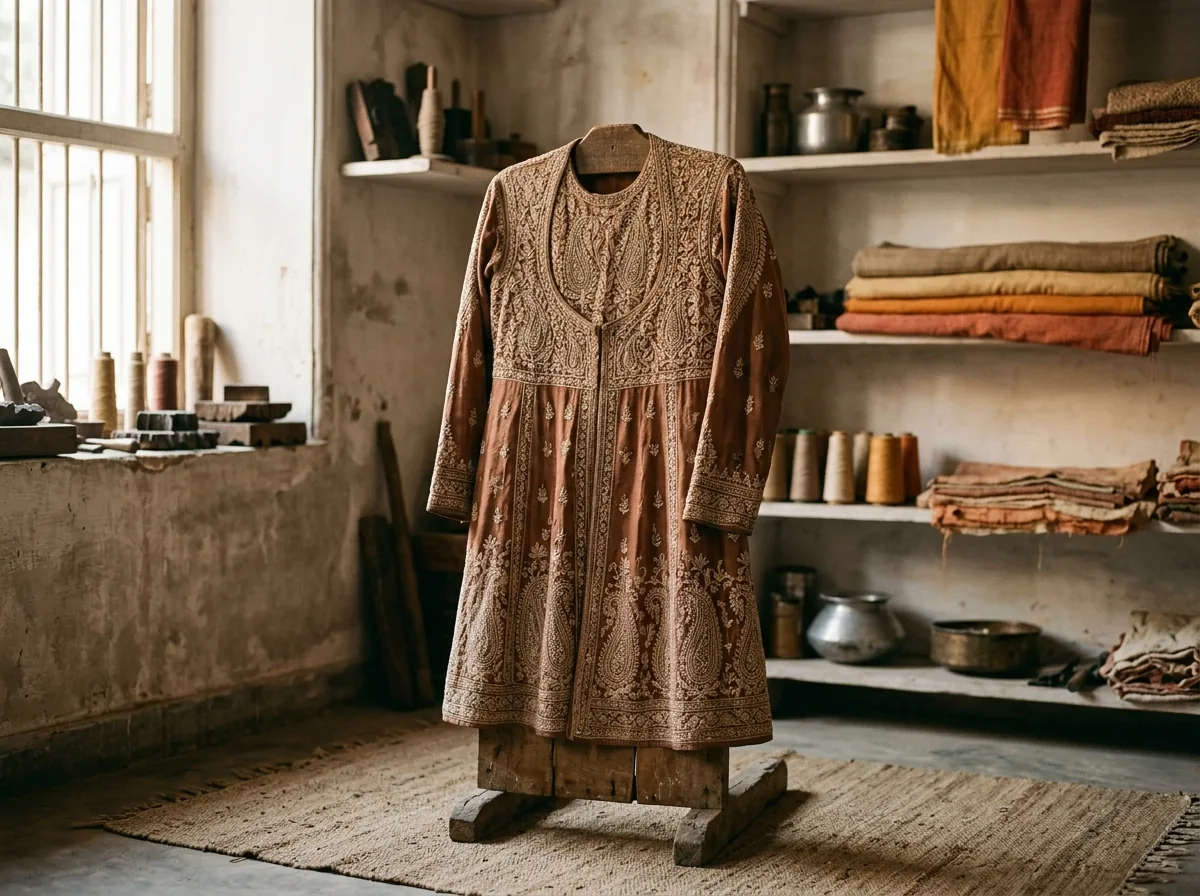
The colour palette of Mysore crepe silk reflects the natural world of its region. Deep forest greens named for the Nagarhole reserve. The warm ivory of aged turmeric. A particular shade of rose-gold that appears in the Karnataka sky just after the monsoon. These are not merely poetic descriptions. The KSIC's own archival records and traditional dye practices have long drawn on the district's botanical vocabulary, even as synthetic dyes gradually replaced natural ones through the mid-twentieth century.
The border of a Mysore crepe-silk saree is typically narrower than its Kanchipuram counterpart, and the zari design within it tends toward single-motif repetition: the hamsa (swan), the lotus bud, or the temple gopuram reduced to its essential geometric signature.
Threads of the Durbar
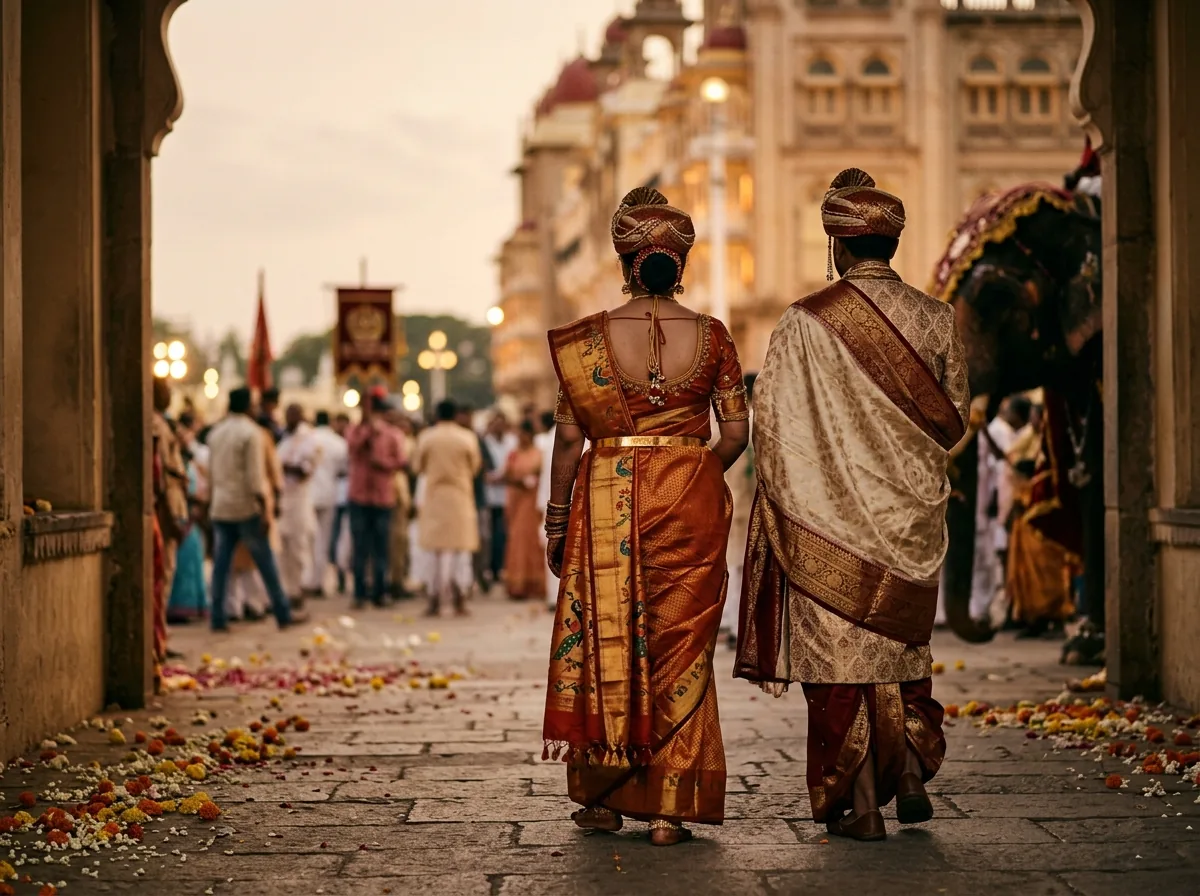
To understand Mysore silk fully, one must spend some time with the Dasara. The ten-day festival, celebrated at Mysore Palace with a pageantry that draws visitors from across the country and the world, has historically been among the most important occasions in the textile calendar of South India. The royal family commissioned specific sarees for specific days of the festival. Weavers received instructions not merely about colour but about the narrative content of the pallu, the specific deity to be referenced in the border motif, and the precise weight of gold in the zari.
This level of specificity created a category of saree that existed entirely outside commercial circulation. These were objects made for a single occasion, for a single wearer, in a single moment of ceremonial time. Some remain in the palace collection. Some passed into family inheritance. A small number have entered museum collections in Mysuru and Bengaluru, where they can be studied as primary documents of court aesthetics.
The connection between Dasara and silk production also had a practical dimension. The festival brought wealth into Mysore city, and a portion of that wealth circulated back to the weaving communities of the Devangas and the Sale families in the surrounding taluks. Patronage was not abstract in Mysore. It had a very specific economic geography: the palace at the centre, and the weaving villages in a radius around it, each one receiving commissions, producing cloth, and sustaining a skill that required years to acquire.
This arrangement was disrupted, though never entirely severed, by the political transformations of 1947 and the subsequent integration of the princely states into the Indian Union. The KSIC in many ways became the institutional successor to the durbar's commissioning function, attempting to sustain demand through state initiative where royal patronage had once provided it.
What the Handloom Holds
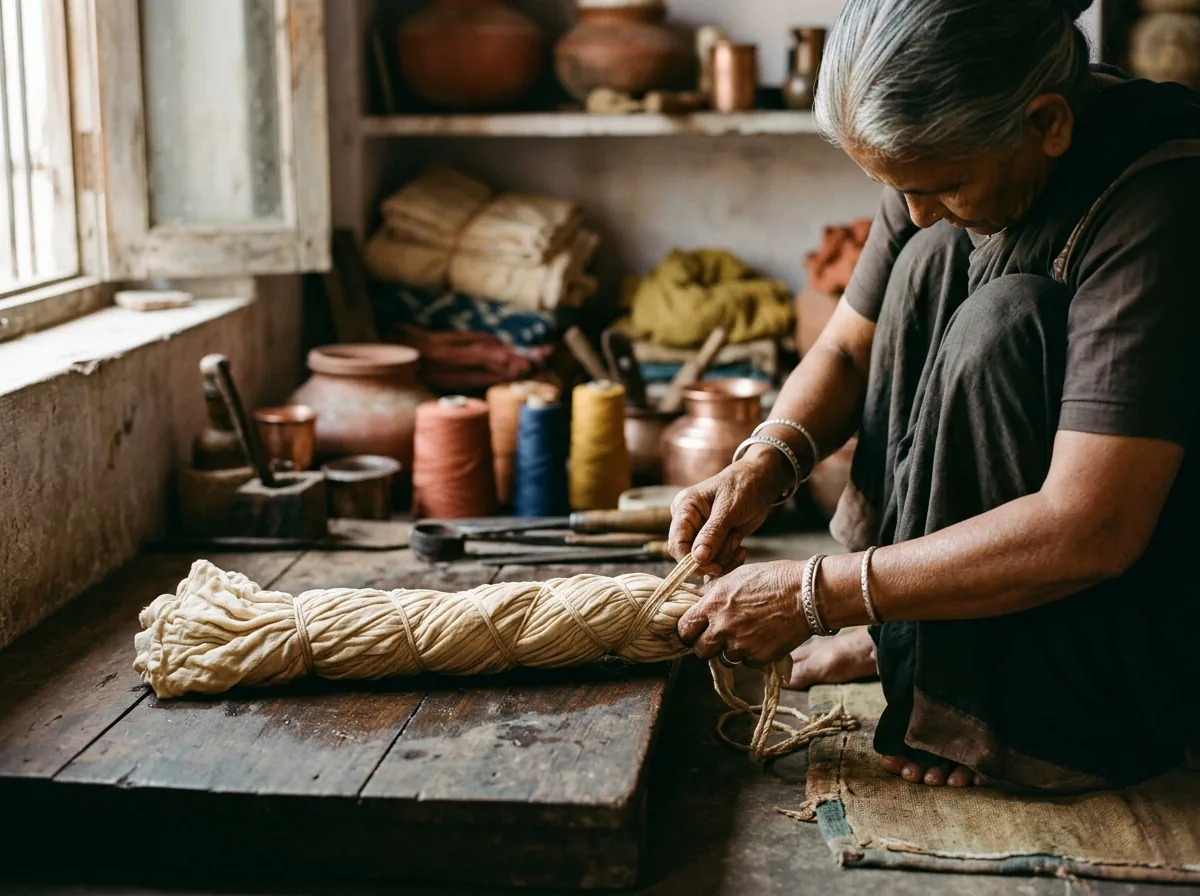
There is a meaningful difference between a Mysore silk saree produced on a power-loom and one completed by a weaver working a pit loom in a home workshop in one of the villages around Mysuru. The thread count and the fibre may be identical. The colour may be the same. But the handloom cloth carries within it a quality of attention that cannot be replicated by mechanical repetition.
This is not sentimentality. It is a material observation. A handloom weaver adjusts tension in real time, responding to the resistance of the thread, the humidity of the morning, the particular elasticity of a specific silk consignment. Each adjustment is a micro-decision. Accumulated across six yards of cloth, these decisions produce a surface that is subtly alive, slightly irregular in the way that all living things are irregular. The irregularity is not a flaw. It is the signature.
In the villages of T. Narasipur and Srirangapatna, on the banks of the Cauvery, handloom weavers from the Devanga community continue this work. Their numbers are smaller than they were a generation ago. The economics of handloom production in competition with power-loom alternatives place real pressure on the choice to continue. But the cloth they produce remains distinct, and discerning buyers, both within India and among the diaspora, have become increasingly precise in their ability to recognise and value that distinction.
Organisations like the Handloom Mark and state-level certification schemes attempt to create transparency in this space. The conversation around authenticity is ongoing, and it is healthy. It means that the craft is still considered worth arguing about.
The Saree as Inheritance
There is a particular kind of knowledge that lives in a folded saree stored in a cedar chest. It is the knowledge of who wore it and when, the occasion it was made for, the hands that constructed it, and the tradition from which those hands learned. A Mysore silk saree of genuine quality is the kind of object that carries this knowledge quietly and without demand.
The crepe-silk saree, with its extraordinary drape and its palette drawn from the land around the Chamundi Hills, has passed through the wardrobes of Mysore's court ladies, through the Dasara pageantry of decades, through the afternoon ceremonies of South Indian weddings, and into the jewellery boxes and occasion trunks of the Indian diaspora in London, Toronto, and Singapore, where it is unfolded on certain mornings with a specific kind of care.
That unfolding is its own form of continuity. The palace may now be a heritage site open to tourists on Sunday mornings. The durbar may be a memory preserved in photographs and archival silk. But the cloth itself, when it settles around the body of someone who understands what she is wearing, remains exactly what it always was: the distillation of a place, a community, a history of attention, and the quiet, unargued dignity of extraordinary making.