Where the needle moves, the silence speaks.
A Court That Taught Cloth to Dream
There is a story told in the old quarters of Lucknow, in the neighbourhoods of Chowk and Yahiyaganj, about a craft that arrived not on merchant ships but in the memory of a culture. Chikankari, the whitework embroidery that has defined the aesthetic of Awadh for centuries, carries within its stitches the unmistakable fragrance of Persian sensibility. Some historians trace its formal cultivation to the court of Nawab Asaf-ud-Daula in the late eighteenth century, when the city itself was being reimagined as a capital of refinement. Others point to Noor Jehan, the Mughal empress of Persian origin, crediting her with introducing the delicate pulled-thread techniques she had known from her homeland. What is certain is this: Awadh provided Chikankari with the conditions it needed to flourish. A court that understood leisure. Patrons who could distinguish between forty kinds of white. An economy of time that allowed a single kurta to travel through twenty pairs of hands before it was considered complete.
The word itself is thought to derive from the Persian "chikan," meaning embroidery worked with a needle. That etymology is telling. This is not a craft that announces itself. It does not arrive in gold zari or the blaze of mirror work. It arrives quietly, in the play of shadow on a surface that appears, at first glance, to be plain. The genius of Chikankari is that its depth reveals itself slowly, the way a poem must be read more than once to be understood. In this sense, it was always the ideal language for a court that prized subtlety above spectacle.
Thirty-Six Stitches and the Grammar of Restraint
To speak of Chikankari without speaking of its stitches is to describe a raga without naming its notes. The craft encompasses thirty-six distinct embroidery techniques, each with its own name, its own hand position, its own appropriate context. They fall broadly into two families: flat stitches, which lie close against the fabric and create a muted, textured surface, and raised stitches, which build outward from the cloth in sculptural relief. Together, they constitute something approaching a complete visual language.
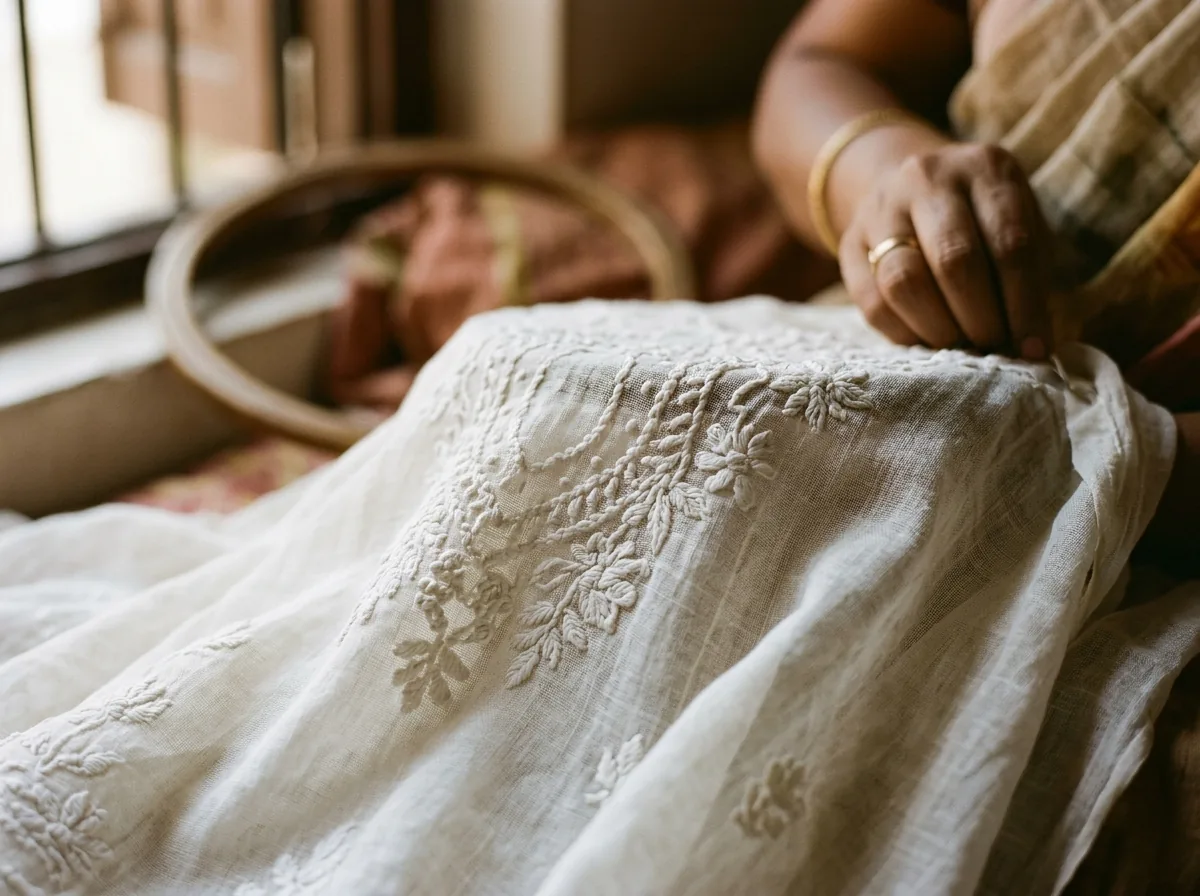
Among the flat stitches, "taipchi" is the most foundational, a running stitch used to outline motifs and establish the architecture of a design before the more elaborate work begins. "Bakhiya," the shadow stitch worked from the wrong side so that the pattern appears as a soft, ghost-like impression on the face of the fabric, is perhaps the most evocative: visible and yet not quite present, like a memory seen through fine cloth. "Phanda," by contrast, is a tiny knotted stitch used to fill in the centres of flowers, each knot no larger than a mustard seed.
The raised stitches include "murri," a raised grain stitch shaped like a small seed; "ghas patti," which renders blades of grass in stippled relief; and the celebrated "jali" work, where threads are carefully drawn out or manipulated to create open lattice panels that allow light to pass through the weave itself. Jali demands a steadiness of hand that takes years to acquire. Many artisans in Lucknow's surrounding villages spend a decade mastering only a handful of stitches before they are trusted to work on the finer fabrics.
These stitches are not interchangeable. Each is assigned to specific zones of a garment, specific seasons, specific occasions. The grammar is as precise as prosody.
The Atelier in the Lane: Craft as Collective Memory
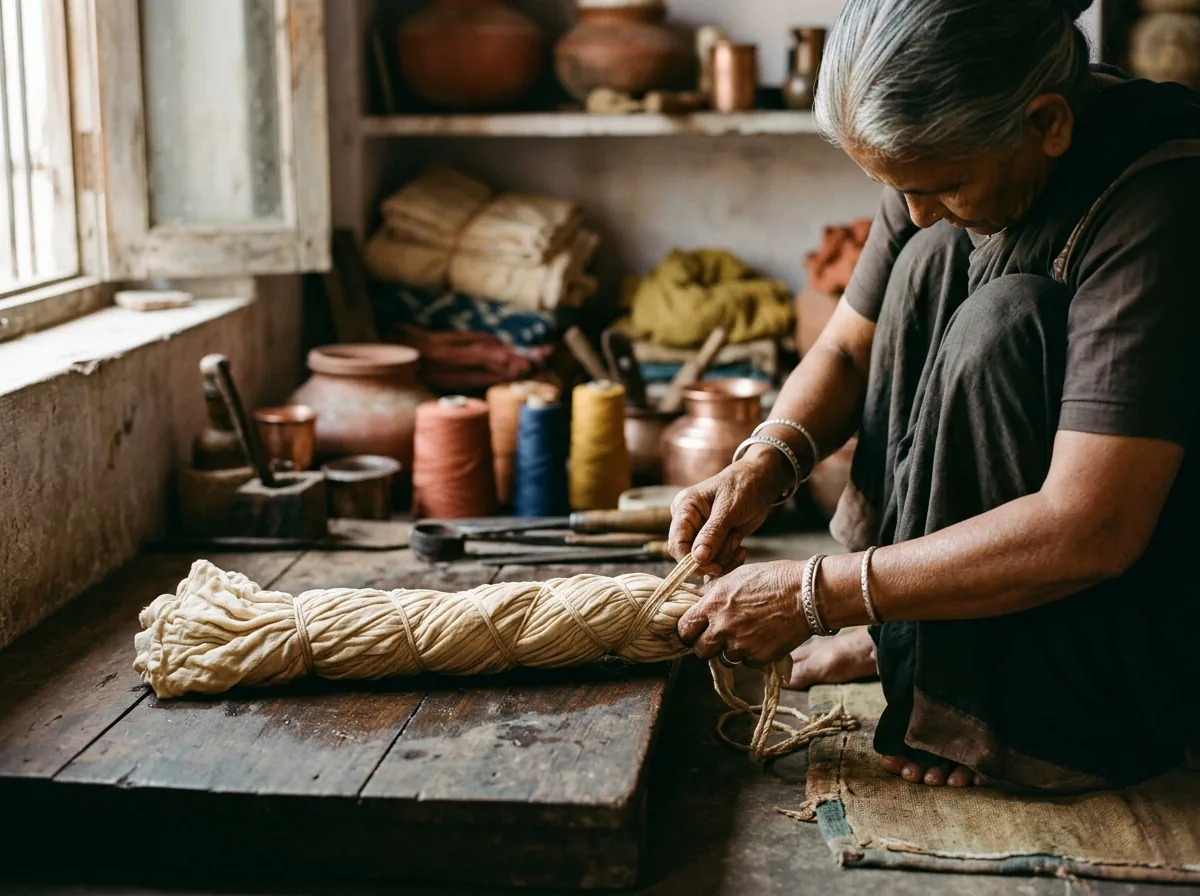
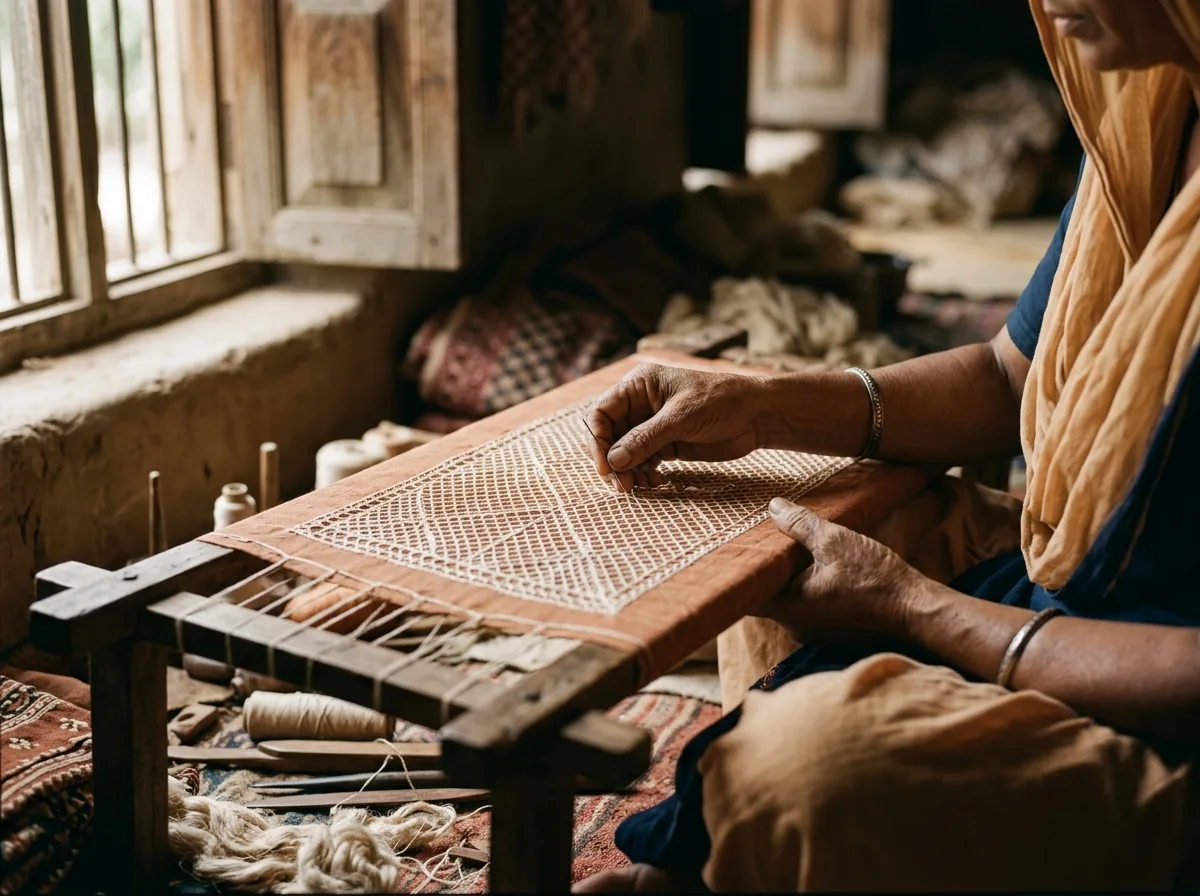
To understand how Chikankari actually moves from concept to cloth, one must set aside the romanticised image of a solitary artisan bent over a frame. The craft operates as an intricate, distributed system, a form of collective authorship so layered that no single person can claim the whole work. This system is centred on the karkhanas, the small ateliers that cluster in the lanes of old Lucknow, particularly in the neighbourhoods of Chowk, Phool Mandi, and the winding streets near the Rumi Darwaza.
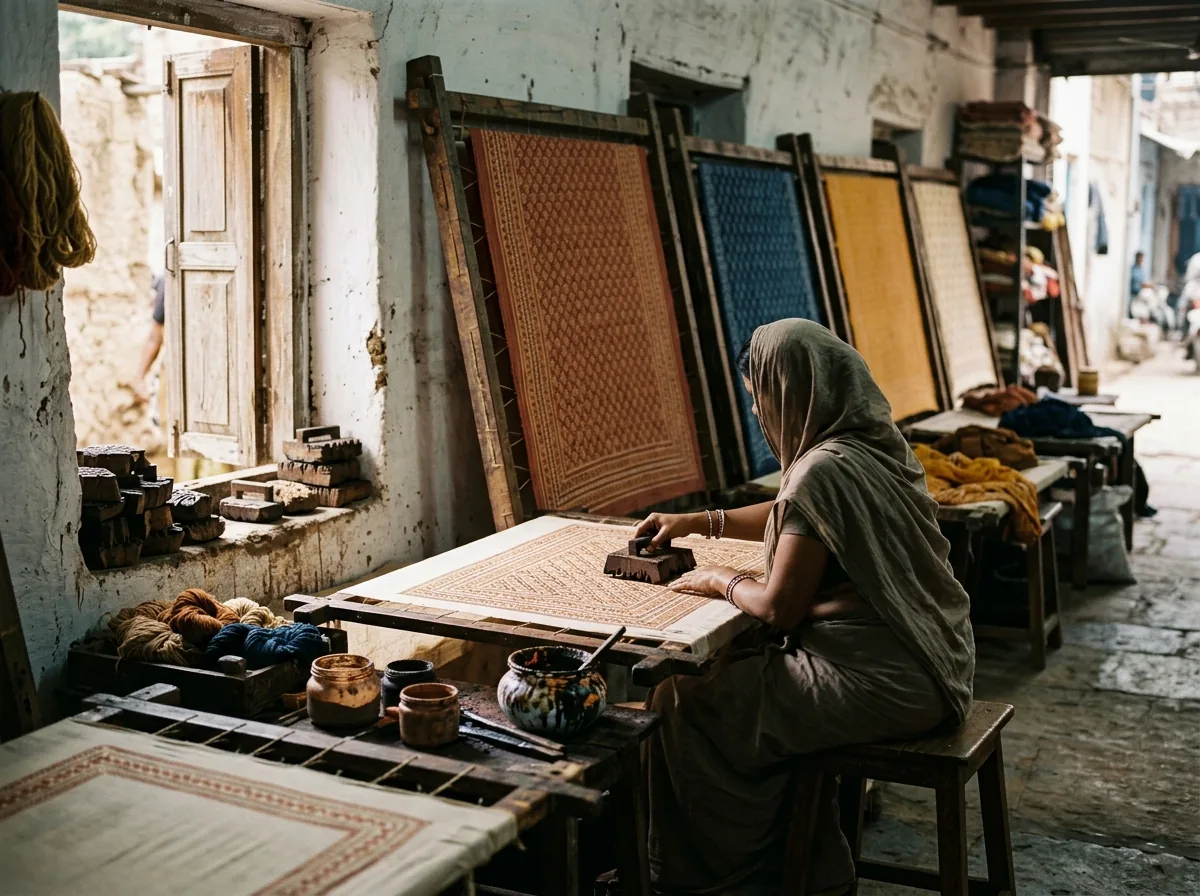
The process begins with the fabric cutter, who sizes and prepares the cloth. The cloth then passes to the designer, who sketches the motifs in the traditional ink made from a mixture of indigo and starch. These outlines will wash away entirely after the embroidery is complete, leaving only the stitched forms behind. From the designer, the cloth moves to the block-printer, who stamps the more complex, repeating patterns using carved wooden blocks that may themselves be generations old.
Then the fabric travels outward from the city. It moves into the villages that ring Lucknow: Kakori, Mal, Banthra, Malhour, and dozens of smaller settlements where women, many of them working within their homes, undertake the embroidery itself. The Muslim craftswomen of these communities, known locally as the karigar households, have carried these stitches through matrilineal transmission for generations. A girl begins by watching her mother and her aunts. She begins practising on scrap cloth before she is ten. The knowledge is embodied, held in the wrists and the fingertips as much as in the mind.
When the embroidered cloth returns to the city, it goes to the dhobi for washing, to the stiffener for finishing, and finally to the master craftsperson for inspection. What began as a sketch becomes, at the end of this long passage, a garment.
Fabric as a Character: Muslin, Georgette, and the Question of Ground
The embroidery does not exist apart from the fabric it inhabits. In Chikankari, the ground cloth is not a neutral backdrop but an active participant in the work's final character. The most revered foundation remains the cotton muslin, historically imported from Dacca before Partition disrupted those supply chains, and today sourced principally from mills in Uttar Pradesh and Bengal. A fine cotton creates a surface soft enough that the shadow stitches register as gentle tonal variations, the cloth breathing through the work rather than resisting it.
Georgette, the woven crêpe fabric introduced more widely into Chikankari during the latter half of the twentieth century, changed the craft's visual register considerably. Its slight transparency and fluid drape suited a new generation of urban wearers who wanted Chikankari's elegance in silhouettes suited to formal evenings rather than the long kurta of a Nawabi afternoon. On georgette, the raised stitches take on a more three-dimensional quality, the slight give of the weave allowing the "murri" and "phanda" knots to sit proud of the surface.
More recently, artisans and designers have worked Chikankari onto organza, viscose, and even tussar silk, each transition requiring its technical adjustments. Silk demands a slightly firmer needle grip; organza requires an almost hypnotic attention to tension or the jali panels pucker and lose their geometric precision.
Each ground cloth asks different questions of the needle, and the artisans who answer those questions are, in the fullest sense of the word, translators: carrying a centuries-old conversation into new and sometimes unfamiliar territory.
Motifs Rooted in the Garden of Memory
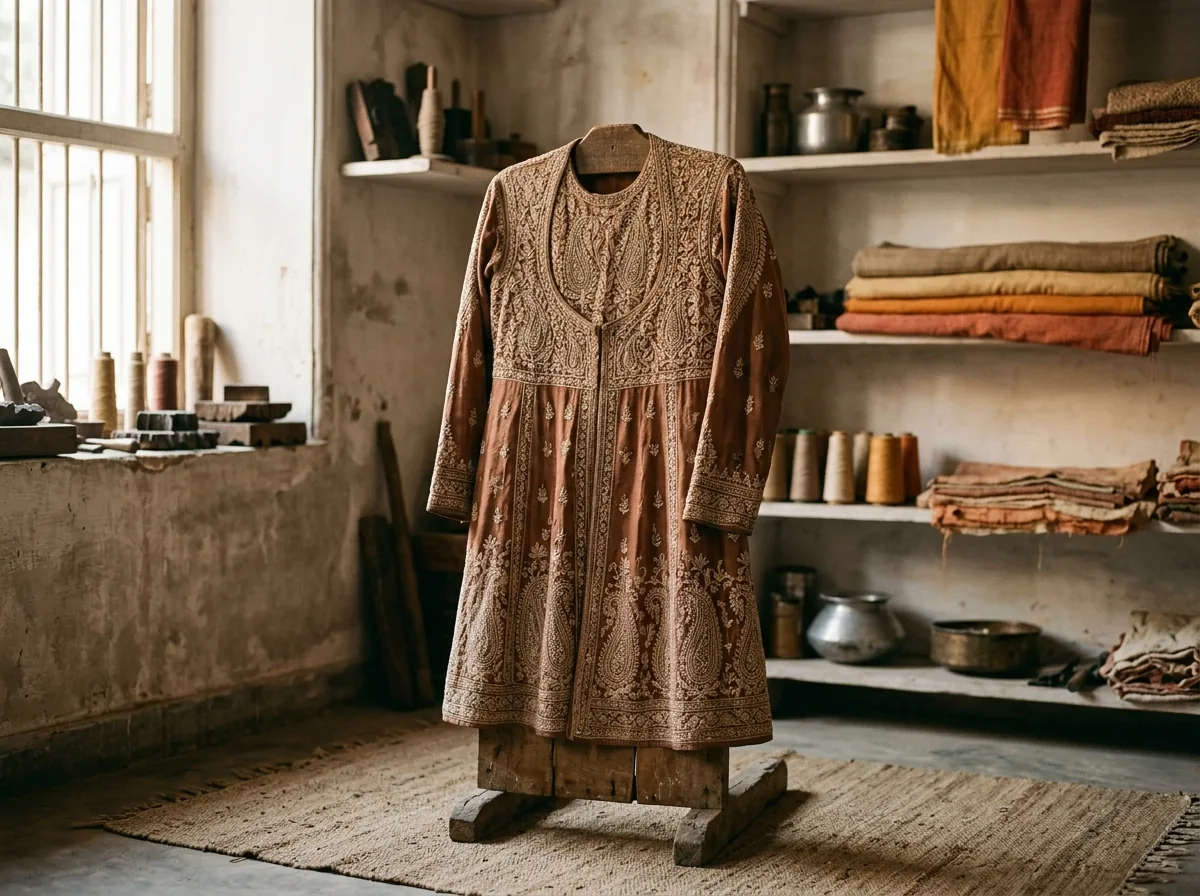
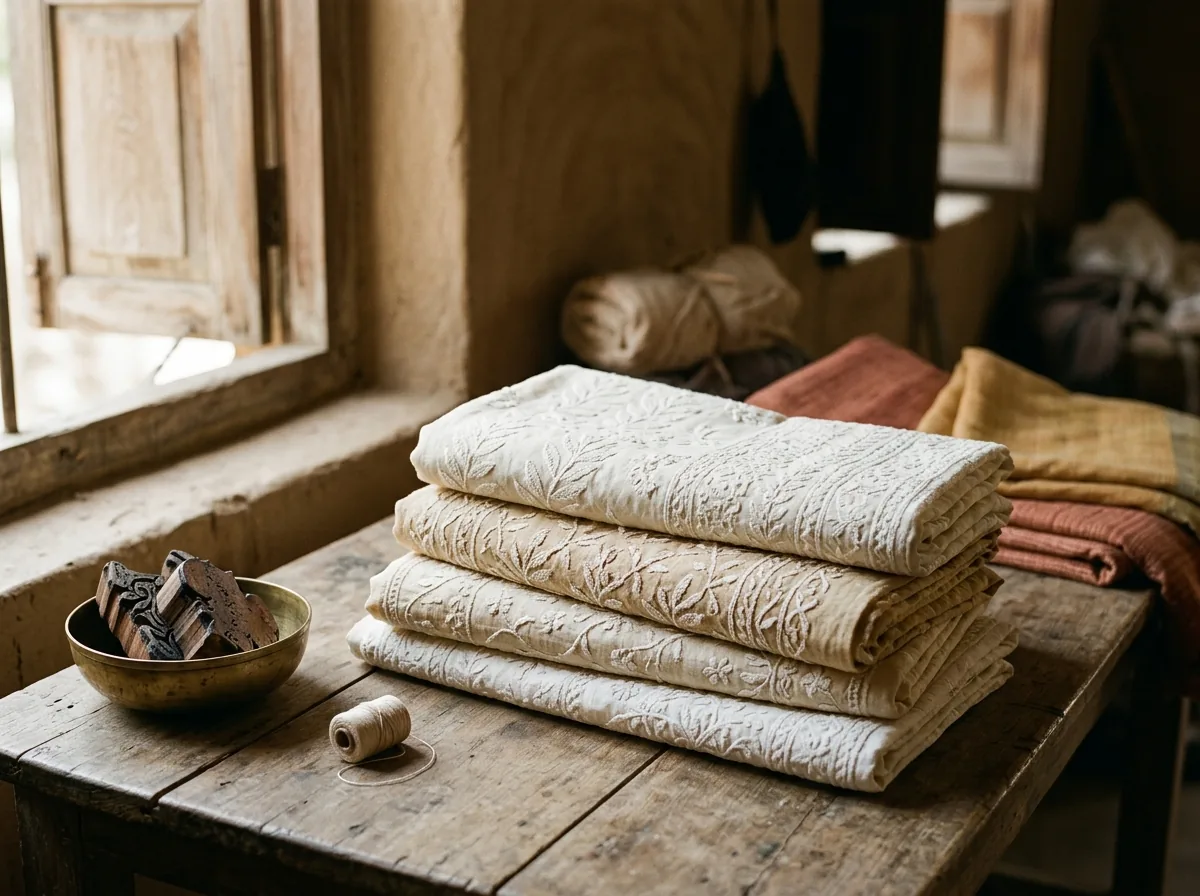
Chikankari's visual vocabulary returns, again and again, to the garden. This is not accidental. The Persian concept of the garden as paradise, the enclosed green world of abundance and order, filtered into Mughal art and architecture and settled, finally, into the embroidered cloth of Awadh as a permanent inheritance. The "kairi," the mango paisley form, appears in Chikankari in hundreds of variations. The lotus, the rose, the vine, the stylised peacock feather: these motifs recur across centuries and across the garments of very different occasions.
The "buti," a small, self-contained floral or leaf motif scattered across the ground of a fabric, is perhaps the most democratic form in the Chikankari lexicon. It appears on the everyday kurta as readily as it does on the bridal dupatta. The "jaal," a continuous lattice of repeated motifs spread across the entire cloth surface, requires a designer with particular spatial intelligence: the pattern must flow without interruption across seams and across the compound curves of a draped garment.
Regional variations within Uttar Pradesh have produced subtle differences in motif character. The work associated with Lucknow's old city tends toward finer, more closely packed arrangements; the embroidery coming from the villages of Kakori and Mal often carries a slightly bolder hand, reflecting the weavers' adaptation to coarser cotton grounds. Neither is inferior to the other. They are, rather, different dialects of the same careful language, each shaped by local hands and local light.
What the Needle Carries Forward
There is a particular quality of attention that Chikankari asks of everyone who touches it: the artisan who sets each stitch in the shifting light of a window, the designer who traces the outline of a motif that may have last appeared on a Nawabi court robe, the person who finally receives the finished cloth and holds it up to see the shadow work move across the weave like water over stone. That quality is patience, but patience of a specific kind. Not the patience of waiting for something to happen, but the patience of making something happen very, very slowly, trusting that slow work holds.
The narrow lanes of Lucknow are still full of this work. Behind doors that open onto rooms smelling of starch and cotton, karigar women sit with frames and thread, moving needles through cloth as their mothers and grandmothers moved needles through cloth before them. The techniques are not static. Each generation absorbs the forms it inherits and then, quietly, adjusts them, finds new ground cloths to work on, new silhouettes to fill, new ways to carry the thirty-six stitches forward without losing what they mean.
The craft does not need to be loud to survive. It has survived precisely because it was never loud. It has survived in the silence between two stitches, in the shadows that a running thread leaves on the face of fine cloth, in the patience of hands that know, without being told, that some things are worth taking time over.