Some things are not made. They are negotiated, thread by thread, with time.
The Loom That Does Not Hurry
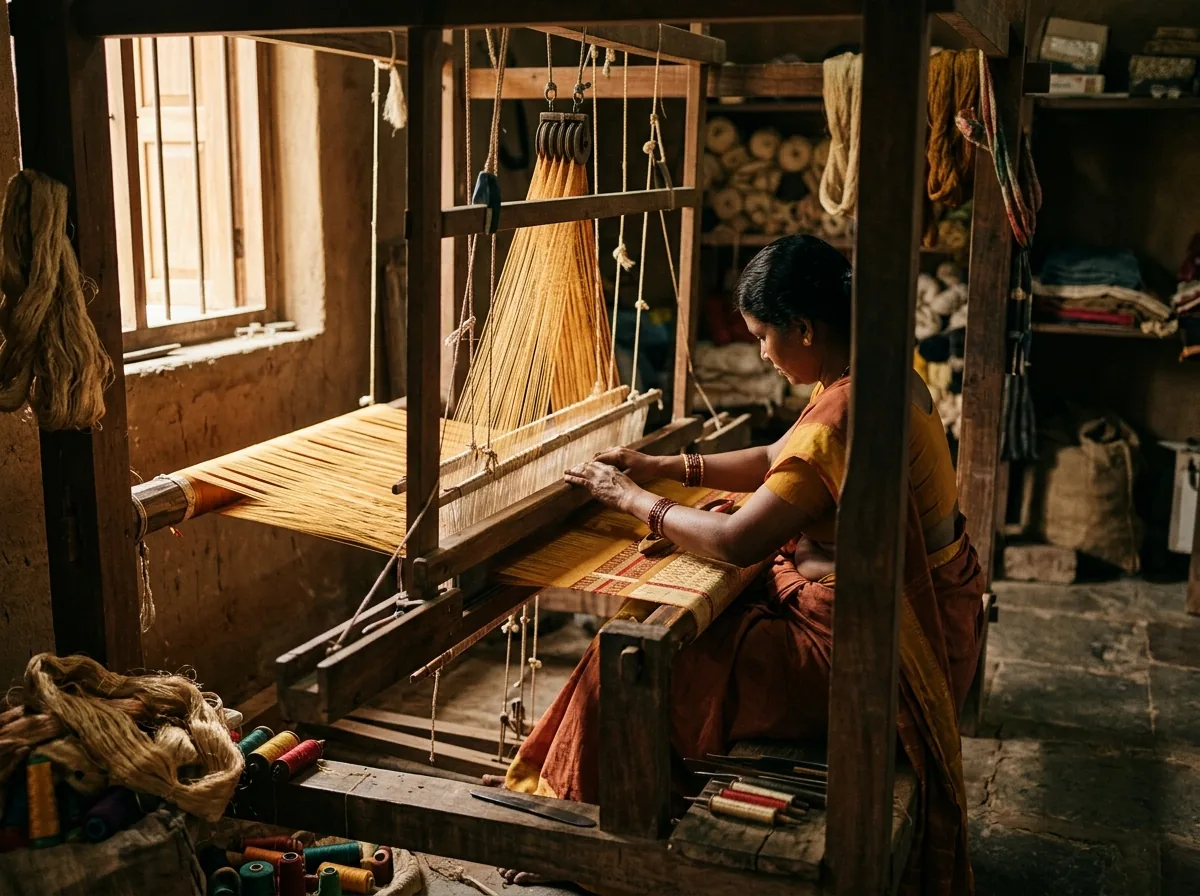
There is a particular quality of light in Kanchipuram before the rains arrive. It falls sideways through the narrow lanes of Thiruvalluvar Nagar and Pillayar Kovil Street, catching the dust of dried silk on the air, turning it briefly golden. In the weaving quarters of this temple city in Tamil Nadu, the day begins not with urgency but with ritual. The warp is checked. The silk is smoothed between palms. The loom is addressed, in a manner of speaking, before it is ever touched.
Kanchipuram, or Kancheepuram, sits roughly seventy kilometres southwest of Chennai, and has been a centre of silk weaving for well over a thousand years. Its weavers, the Pattu Saliyar community, arrived here centuries ago, migrating from Saurashtra in Gujarat, carrying their looms and their liturgy together. Today their descendants work in family units across weaving colonies that have grown dense and layered over generations. The craft has been passed from hand to hand, father to child, with corrections made in the half-dark of early morning before the school day begins.
What distinguishes a true Kanjivaram from every imitation is not merely the weight of the silk or the lustre of the zari. It is the structural logic beneath the surface. The saree is not woven in a single piece from a single warp. Body and border are woven separately and then interlocked, joined by a technique called korvai, a word that carries within it the entire philosophy of the loom: that strength comes from the meeting of two independent intentions.
Mulberry, Water, and the Long Patience of Silk
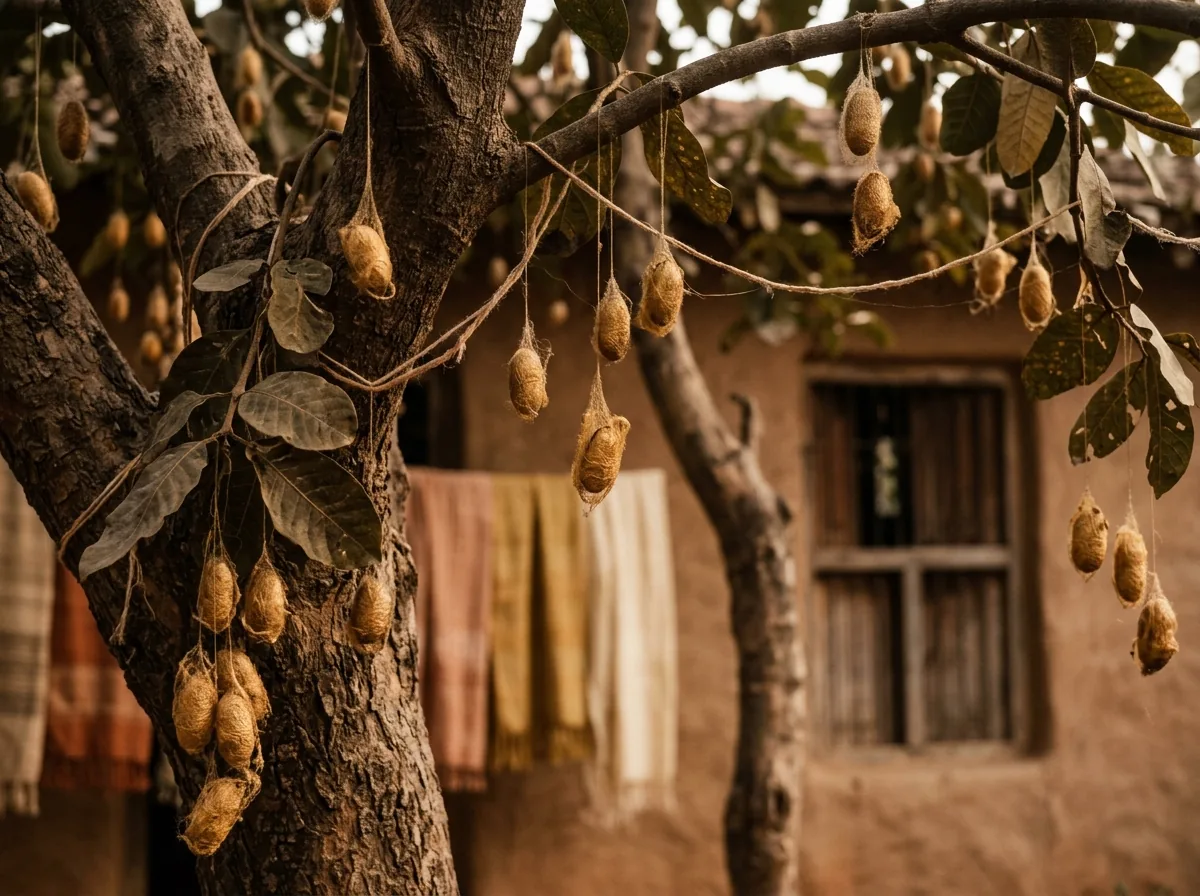
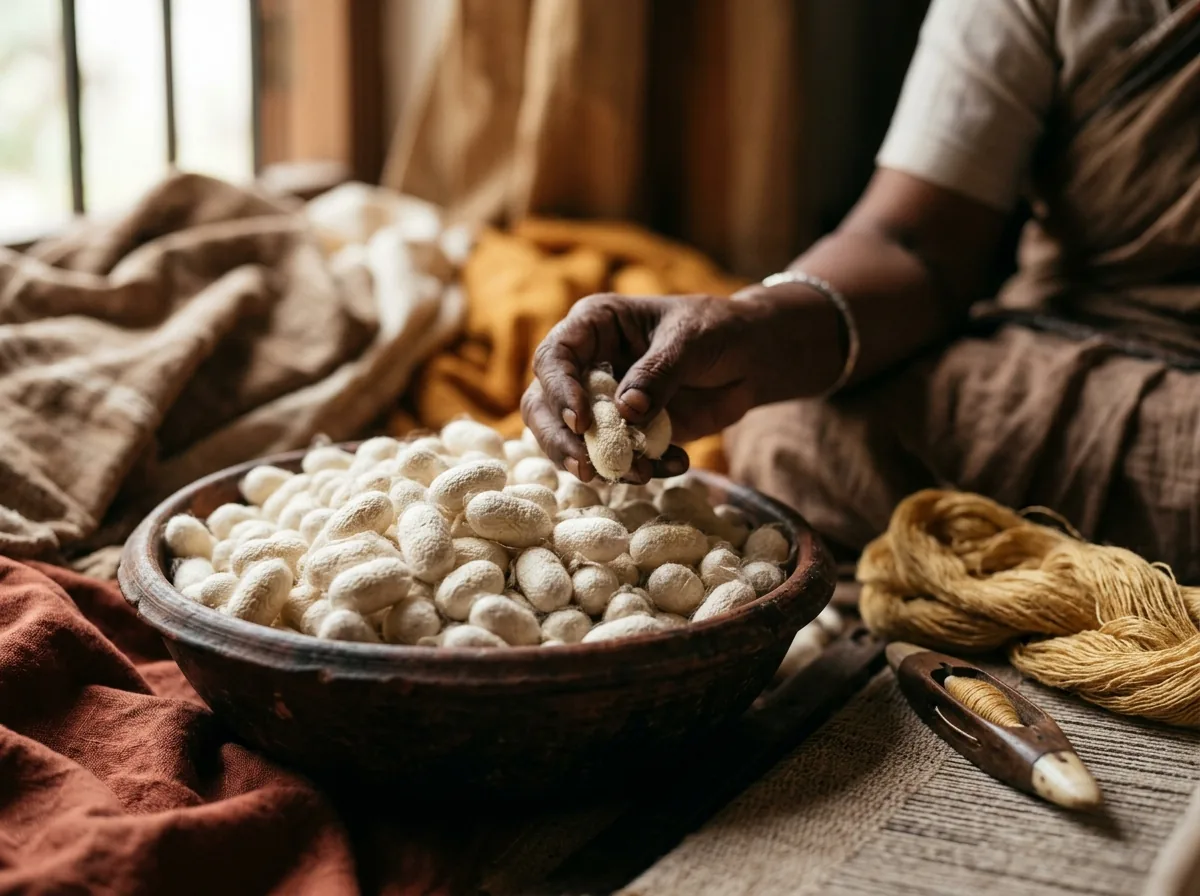
The silk that enters a Kanjivaram saree has already lived several lives before it reaches the loom. It begins in the mulberry orchards of Karnataka, primarily around Ramanagara and the villages of the Mysuru district, where silkworm cultivation has been practised for centuries under the humid shade of low trees. The silkworms fed on these leaves spin cocoons of an exceptional density, and it is the quality of this mulberry silk, reeled slowly and with care, that gives the Kanjivaram its characteristic weight and its particular drape, neither stiff nor fluid but something in between, the way a temple corridor holds both solemnity and movement.
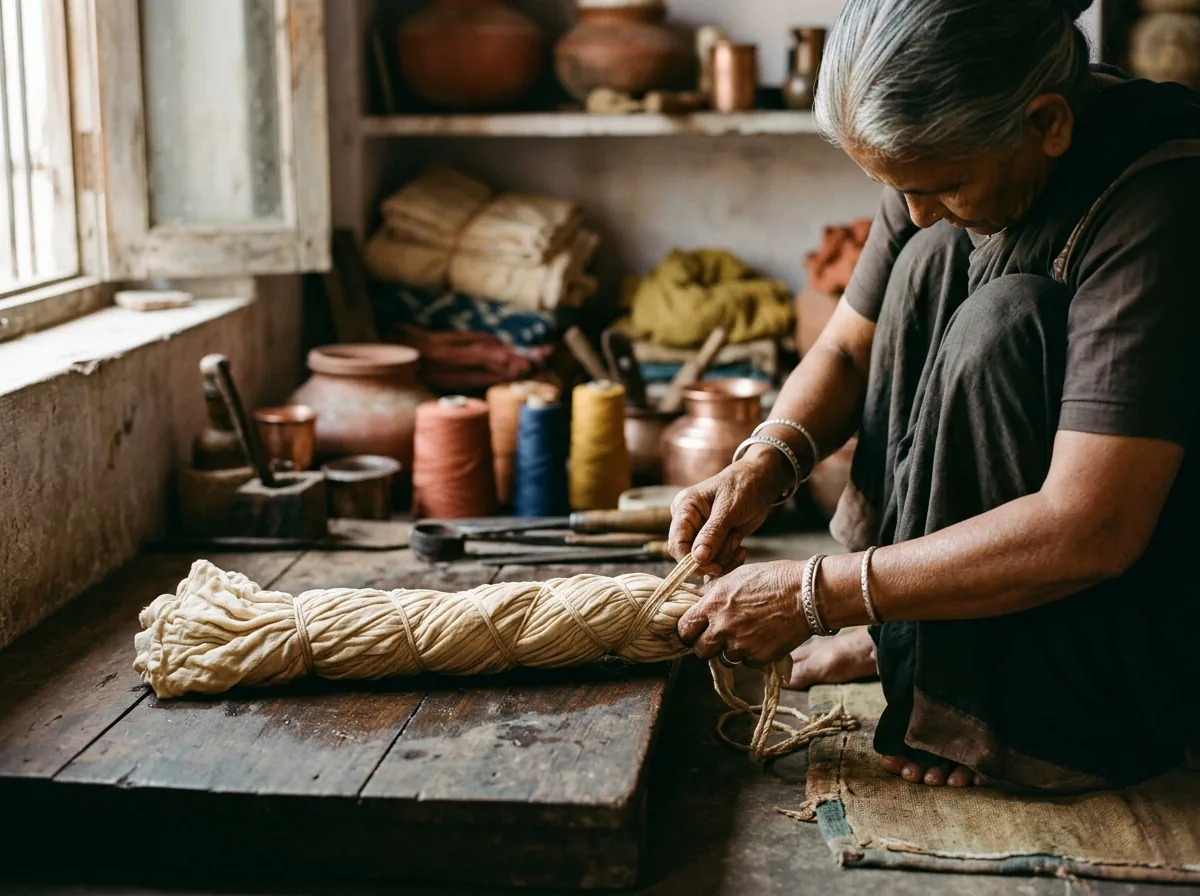
The reeled silk travels to dyeing units, many still run by small family operations in and around Kanchipuram town itself. The best of these use vegetable dyes prepared from indigo, pomegranate rind, and turmeric, though natural dye practice has become rarer as chemical dyes have simplified production timelines. The dyeing process demands precision: silk absorbs colour differently at different temperatures, and a Kanjivaram's famed depth of hue, the peacock greens, the temple reds, the dense mango yellows, depends entirely on a dyer's instinct built across decades of practice.
The zari, the metallic thread that runs through borders and pallav alike, comes largely from Surat in Gujarat, though some weavers work with locally sourced zari prepared with silver wire wrapped around a silk core and finished with gold plating. The proportion of real silver in the zari is a matter the discerning buyer learns to ask about, because it determines not only the richness of the finished surface but whether the saree will, over decades, soften and deepen in the way that genuine zari does.
Korvai: The Architecture of Interlocking
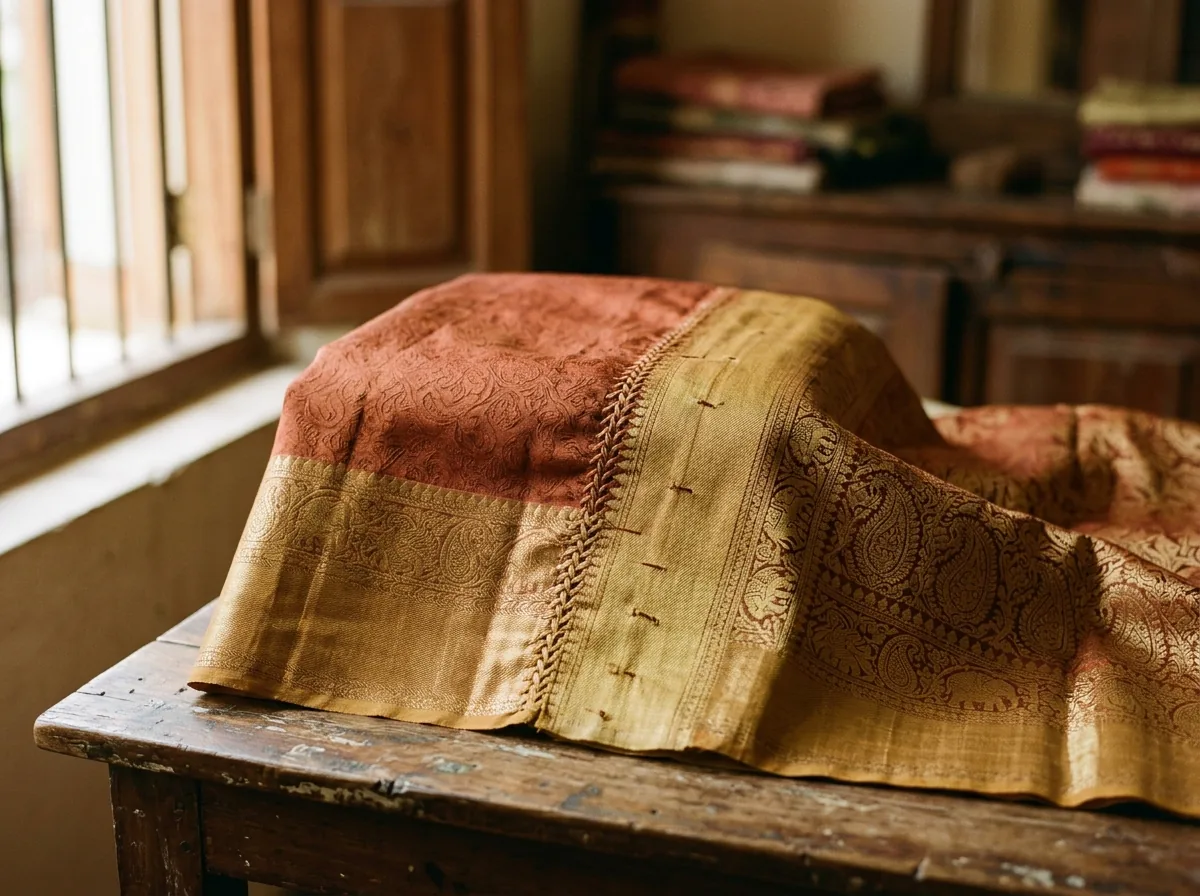
To understand the korvai technique is to understand why a Kanjivaram border never peels, fades separately, or loses its geometry at the edge. In most woven textiles, the border is part of the same continuous warp as the body. In the Kanjivaram, it is not. Body and border are set up on the same loom but as two distinct entities, each with its own warp threads and its own shuttle carrying its own weft. Where they meet, the weft threads of each section loop around the warp threads of the other, locking together in a structure that is technically referred to as interlocking weft joins.
This is not merely a decorative choice. It is what allows a Kanjivaram to carry, for example, a deep crimson border on a pale ivory body without the two colours ever bleeding into one another or weakening the weave at the join. The border can carry a different weight of zari, a different density of pattern, even a different weave structure, and the fabric will hold. The saree will drape as a single cloth, yet it is built from an architectural negotiation between at least two separate looms of intention.
The korvai join is invisible from the right side of the fabric, which is part of its genius. On the reverse, you can see the conversation, where one set of threads reaches across to embrace another. Weavers say that a poorly executed korvai will show as a slight ridge or a wavering line at the border edge. A master's korvai is seamless, and the only way to verify it is to hold the saree to the light and look along the join from the underside.
Learning korvai is not a matter of weeks. Young weavers in the Pattu Saliyar community typically spend years working on simpler patterns before they are trusted with the interlocking border. The technique does not forgive improvisation.
The Forty-Seven Days
The number in the title of this piece is not decorative. It represents the approximate minimum time required to produce a heavy, traditionally patterned Kanjivaram with a fully worked pallav, a korvai border, and a silk body woven with a figured ground. The preparation alone, before the first thread is passed through the shed, accounts for more than half this time.
Warping, which involves measuring and setting each individual silk thread on the frame, takes several days for a complex design. A saree body may contain anywhere from seven hundred to over a thousand warp threads per inch in the finest examples, and each thread must be aligned, tensioned, and checked. The design itself is transcribed onto graph paper by the weaver or a designer working alongside the family, then transferred to a jacquard card sequence or, in the oldest workshops, to a naksha, a pattern cord that hangs above the loom and controls which warp threads are lifted on each pass of the shuttle.
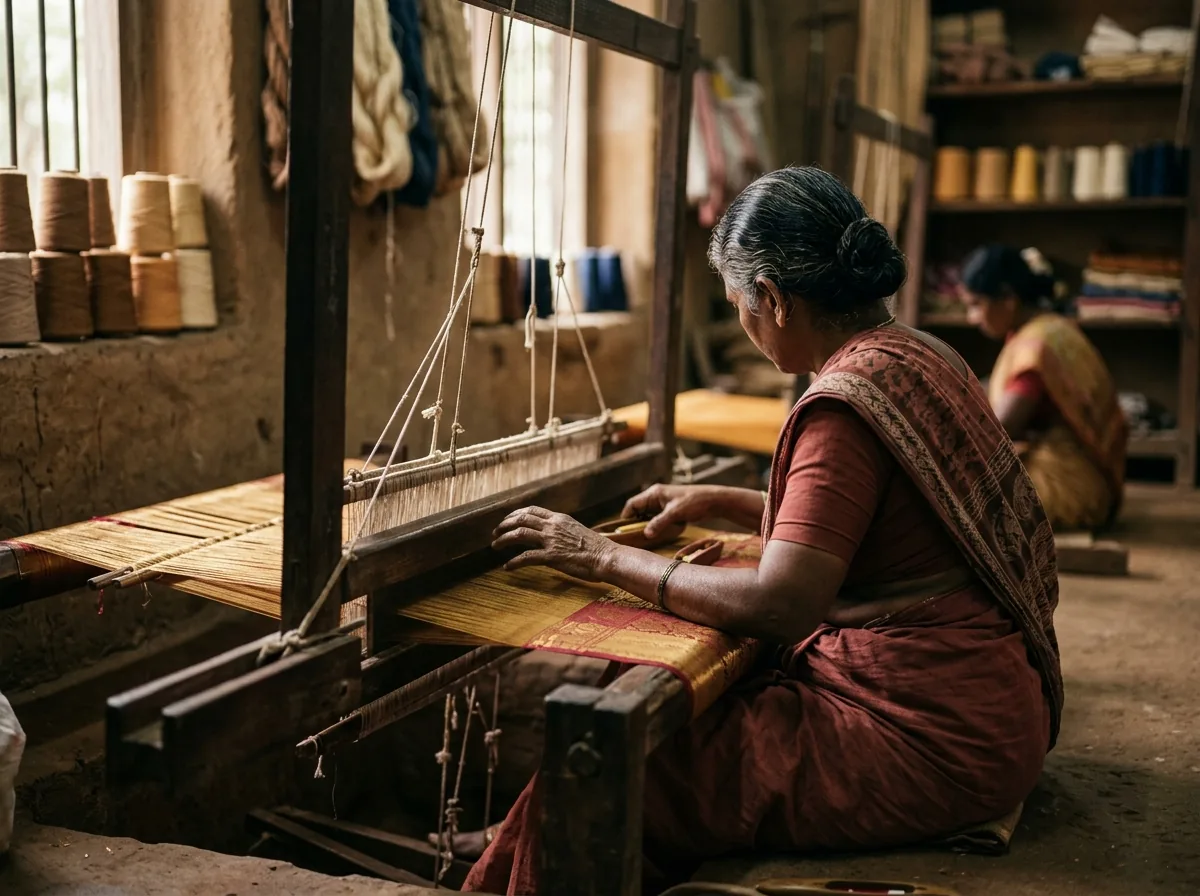
On the loom itself, the weaving proceeds slowly. A weaver working alone, without a second person managing the jacquard mechanism, might produce two to three inches of finished fabric in a full working day when the pattern is dense. A saree of five and a half metres in length, with a worked pallav of a metre and a half, requires thousands of individual shuttle passes, each placed by hand, each pressing the silk down to meet its predecessor.
The looms in Kanchipuram's weaving quarters are mostly pit looms, where the weaver sits with their feet in a recessed floor cavity, the treadles below them, the heddles at eye level. The rhythm of a working pit loom is one of the most distinctive sounds in South Indian craft, a steady, meditative percussion that continues from before dawn until the light fails.
What the Pattu Saliyar Carry Forward
The Pattu Saliyar community's migration story is part of their identity as weavers. Oral tradition within the community holds that they were invited to Kanchipuram by a Pallava king, though historians place the movement of Saurashtrian weaving communities across several centuries and several political shifts. What is certain is that the community brought with them a tradition of silk weaving that merged with the temple aesthetics of the Kaveri delta, producing a textile vocabulary rooted in the iconography of South Indian devotional life.
The motifs that appear on a traditional Kanjivaram reflect this accumulated language. The rudraksham, a pattern of interlocking circles representing the sacred bead. The mango or paisley, here called the manga motif. Temple towers rendered in geometric silk. Peacocks carrying the weight of Murugan's mythology in their feathered tails. Checks and stripes that reference the ancient plaid traditions of Saurashtra, now domesticated into the South Indian aesthetic with the addition of zari and temple borders.
In the weaving streets around the Sri Ekambareswarar temple and in neighbourhoods like Sengadu Theru, these motifs are not looked up in reference books. They live in the hands of weavers who have woven them ten thousand times. They are adjusted, slightly, each generation, and occasionally a new pattern enters the vocabulary through a weaver who has spent a season studying a temple carving or a patron's old sari preserved in a brass trunk.
A Cloth That Outlives Its Occasion
A Kanjivaram saree bought with intention and stored with care does not age the way most textiles do. The mulberry silk, if kept from prolonged damp and direct light, deepens over years. The zari, if it carries a genuine silver content, will acquire a warmth that new zari simply cannot replicate. Women across South India speak of their mothers' Kanjivarams as if they were living things, brought out at weddings, folded back with care, inherited not merely as garments but as a form of memory made textile.
This is what the forty-seven days purchase. Not just a length of cloth but a material argument for slowness, for the kind of making that does not accommodate shortcuts, for a tradition that has survived temple patronage, colonial indifference, and the pressures of synthetic imitation alike. The saree that arrives carefully folded carries within it the accumulated knowledge of the Pattu Saliyar community, the quality of a Karnataka mulberry harvest, the skill of a dyer's hand, and the patient arithmetic of a weaver counting warp threads in the half-light before the city wakes. It asks nothing of you in return except that you wear it with the seriousness it took to make it.