A collar that closes like a vow, a silhouette that neither bows nor boasts.
The Court That Dressed a Continent
Long before Savile Row had codified the dinner jacket into orthodoxy, the courts of Rajputana had already resolved the question of what a man should wear when the occasion demanded both authority and elegance. The bandhgala, whose name derives from the Hindi for "closed neck," was not born of fashion anxiety but of political clarity. It was the garment of a ruling class that understood that power, when it is genuine, requires no flourish at the collar.
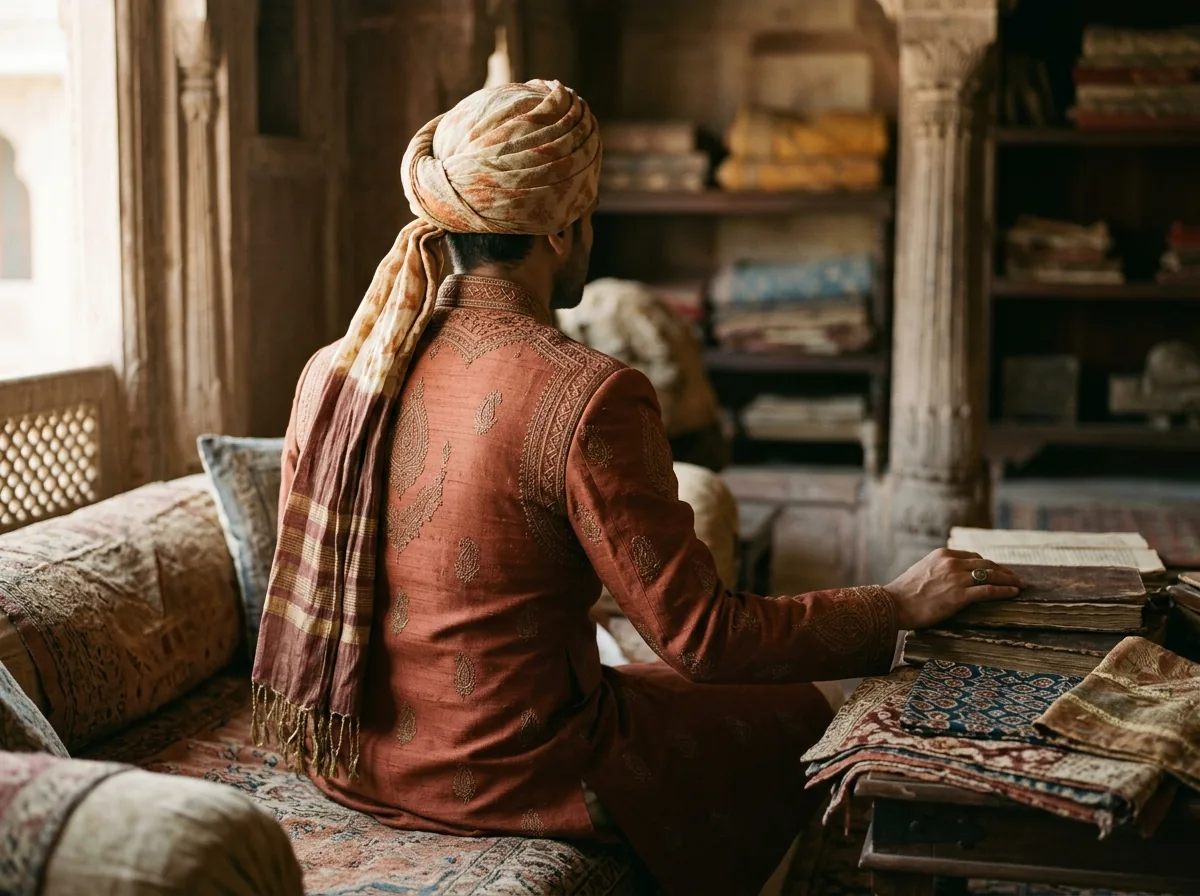
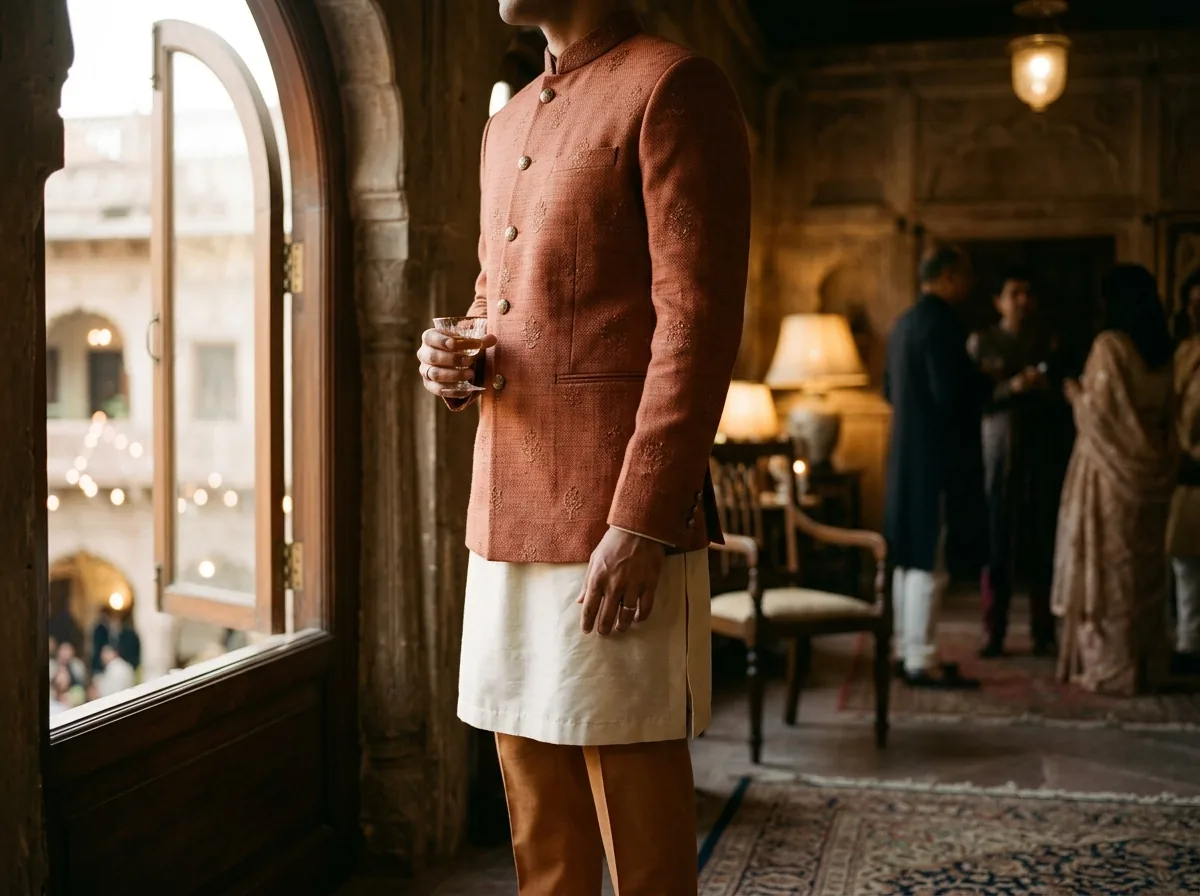
The story begins most convincingly in Jodhpur, the blue city of Marwar, where Maharaja Jaswant Singh II and his court tailors in the late nineteenth century began refining a silhouette that would eventually circle the globe. The Jodhpur court was, in that era, one of the most internationally visible of the princely states. Its maharajas rode at English hunts, sat for photographs with viceroys, and attended coronations in London. They needed a garment that could hold its own alongside European ceremonial dress without pretending to be European. The bandhgala was the answer: structured, closed at the throat, cut close to the body, yet entirely Indian in its sensibility.
What distinguished it from its contemporaries was precisely the absence of the lapel. The Western suit announces itself; the bandhgala simply stands. The closed collar, fastened with a neat row of buttons, communicates a self-containment that the open chest of a European jacket never quite achieves. It is a garment of considered restraint, and restraint, as any serious tailor will tell you, is the most difficult thing to cut.
The Geography of the Needle
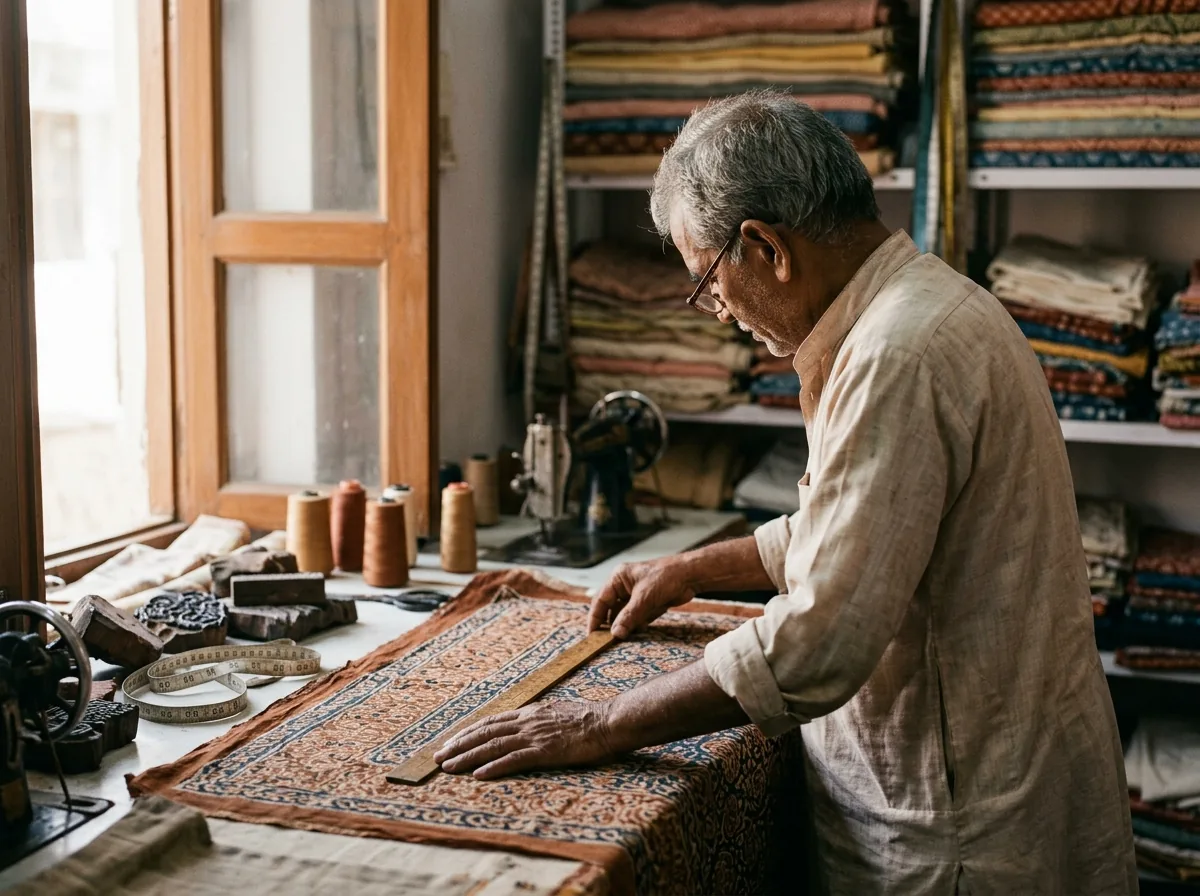
To speak of Rajasthani tailoring is to speak of a geography as varied as its landscape. The craft did not emerge uniformly across the state but concentrated itself, over generations, in specific towns and workshops whose reputations became inseparable from their geography. Jodhpur itself remains the primary centre, its old city's lanes still home to master darzi workshops whose families have been cutting bandhgalas for four or five generations.
In Jaisalmer, the desert light seems to have influenced the colour sensibility of local tailors, who have long favoured the ochres, camels, and muted golds that make a bandhgala look as though it were quarried from the sandstone havelis nearby. In Jaipur, the tailoring tradition intersects with the city's formidable textile heritage, with workshops sourcing their fabrics directly from the block-printers of Sanganer and the weavers of nearby Tonk. Each location brings its own material logic to the same essential silhouette.
The fabrics, too, have their geography. A traditional bandhgala might be cut from the fine wools that once came through trade routes from Kashmir and Bikaner, or from the handwoven silks of Kanjivaram or Banaras. Today, the most considered versions draw on the dobby weaves of Maheshwar, the cotton-silk blends of Chanderi in Madhya Pradesh, or the structured khadi that comes from the cooperative looms of Kutch. Each cloth brings its own drape, its own weight, its own argument for how a man should occupy a room.
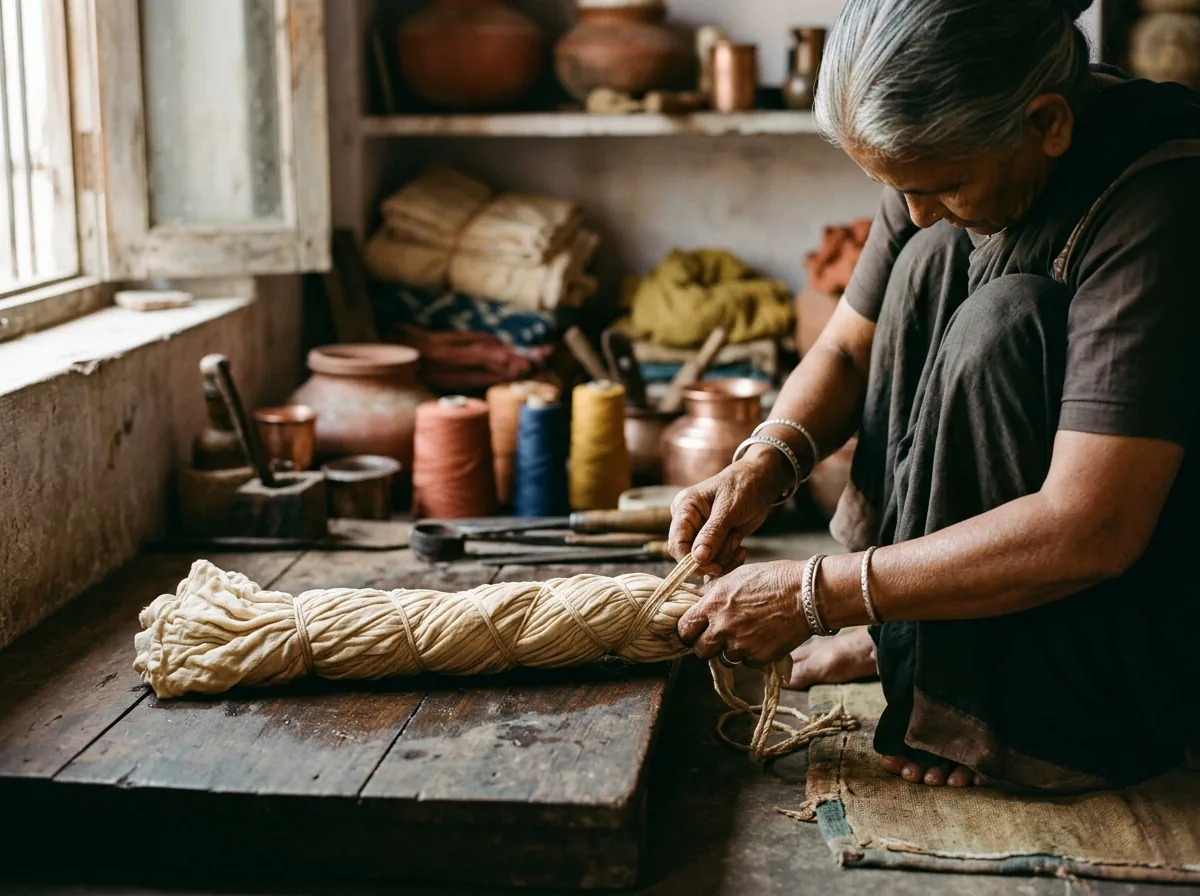
The darzi, the hereditary Muslim tailor community present across Rajasthan and beyond, has been central to this tradition. Their knowledge is oral and embodied, passed shoulder to shoulder across kitchens and workrooms, and it is this transmission that has kept the bandhgala honest.
When the West Looked East
The bandhgala's passage into global consciousness is not a simple story of colonised culture being noticed by the coloniser. It is, rather, a story of confident exchange. When Maharaja Bhupinder Singh of Patiala arrived at Buckingham Palace or the Maharaja of Mysore attended a state banquet in his formal sherwani-bandhgala, these were not men seeking Western approval. They were men who knew exactly what they were wearing and why.
The garment's international moment came in layers. The first was the Jodhpur suit, which European observers in the late nineteenth and early twentieth centuries noted with genuine admiration as an alternative formal silhouette. The second came through cinema and popular culture, when Hindi film's golden era dressed its heroes in forms of the bandhgala that carried both romance and authority. Dilip Kumar and later Amitabh Bachchan wore the garment on screen with a seriousness that kept it from becoming costume.
The third moment is the current one. Contemporary Indian designers, from the atelier houses of Mumbai to the smaller but no less rigorous workshops of Delhi's Lodhi Colony, have recognised in the bandhgala a garment that needs no reinvention, only interpretation. Designers such as Raghavendra Rathore, who is himself from Jodhpur, have spent careers arguing for the bandhgala's sufficiency, its capacity to be both traditional and forward-looking without the anxiety of either. The garment's entry into international fashion weeks and wedding wardrobes alike suggests that the argument has been convincingly made.
The Architecture of the Collar
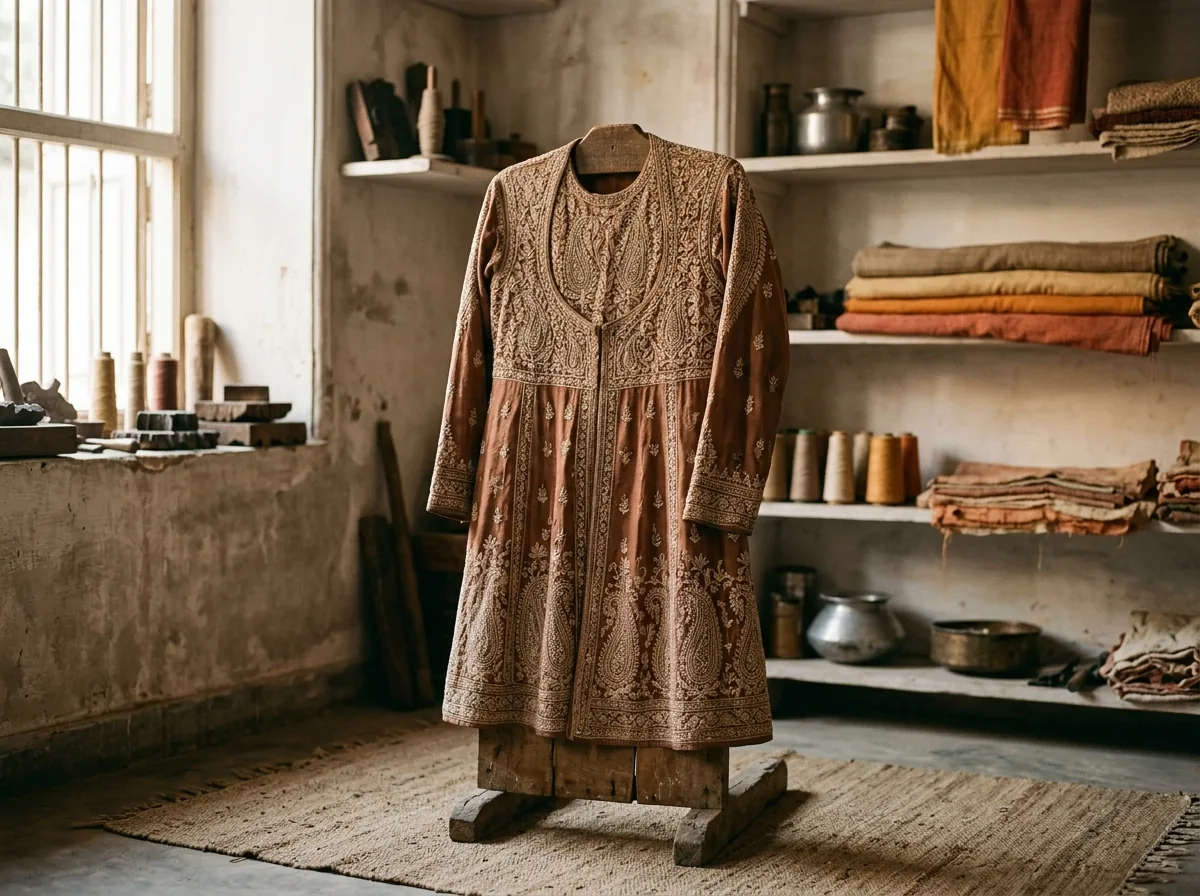
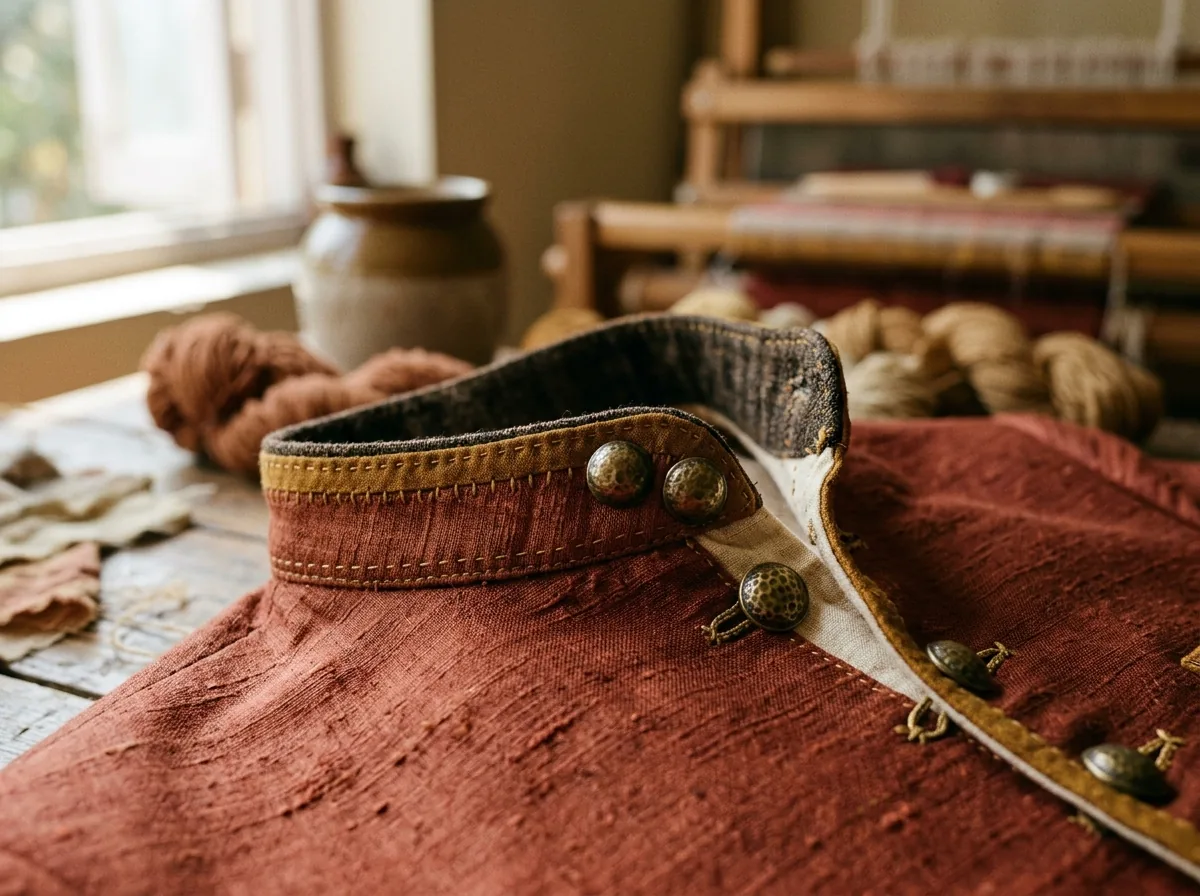
What makes the bandhgala technically distinctive is also what makes it culturally distinct: the Mandarin collar, standing between two and four centimetres above the neckline, fastened with a column of fabric-covered buttons or, in more embellished versions, with fine zari-worked closures. This collar is not merely an aesthetic choice. It is a structural decision that determines everything else about how the garment behaves.
A well-cut bandhgala collar must be interfaced with precision. Too stiff and it looks military to the point of discomfort. Too soft and the entire silhouette collapses. The Jodhpur tailors have historically used layers of cotton muslin, hand-stitched in a technique called pad-stitching, to give the collar its particular quality of being firm without being rigid. This is slow work. It cannot be replicated by a fusing machine without losing its essential quality.
The body of the jacket is typically single-breasted, cut with a slight waist suppression that acknowledges the body without clinging to it. The length falls just below the natural hip, covering the waistband of the accompanying churidar or, in contemporary styling, a well-cut trouser. The side slits, present in more traditional versions, allow movement without disrupting the jacket's line.
Lining choices matter enormously. The old workshops of Jodhpur favour light silk linings in contrasting colours, a flash of pomegranate or deep teal visible only when the jacket is removed, a private pleasure rather than a public display. This quality of concealed care is perhaps the bandhgala's most instructive lesson.
Fabric as Argument
To choose the cloth for a bandhgala is to make a series of quiet arguments about who you are and what you value. The garment's silhouette is sufficiently strong that it can carry a very plain fabric with grace, but it also rewards the extraordinary. This is where the bandhgala connects the wearer to a living textile geography that the Western suit, with its reliance on Yorkshire wools and Italian Super 120s, rarely invites you to consider.
The Chanderi weavers of Madhya Pradesh, working on pit looms in the town of Chanderi itself and in the surrounding villages of Badoha and Prithvipur, produce a cotton-silk blend of exceptional lightness that makes a summer bandhgala feel like wearing shadow. The silk weavers of Varanasi, concentrated in the Madanpura and Lallapura localities, offer brocade fabrics of such complexity that a single metre can take several days to produce on a traditional Jacquard handloom. The Maheshwari weavers of Maheshwar, on the banks of the Narmada in Madhya Pradesh, produce their characteristic reversible weave in a palette historically associated with the royal house of Holkar.
For the cooler months, the pashmina weavers of the Kashmir Valley produce shawl-weight wools that a skilled bandhgala tailor can construct into something of extraordinary warmth and quietness. And for those who wish to make the most deliberate possible statement about craft and conscience, the khadi produced by the weaving cooperatives of Kutch and by the Karnataka Khadi Gramodyoga Samiti offers a fabric whose very texture is a kind of argument for a different relationship between cloth and commerce.
A Garment Without Apology
The bandhgala has arrived at its present moment without having needed to argue for itself. It did not require a revival, because it never truly disappeared. It did not require a manifesto, because it carries its own logic in every seam. What it has required, and continues to require, is the patience of craftsmen who understand that certain things cannot be hurried, and the discernment of wearers who understand that elegance is not a performance but a practice.
In the wedding mandaps of Chennai and the corporate boardrooms of Mumbai, at diaspora celebrations in Leicester and Toronto, the bandhgala continues to appear as the garment a man reaches for when he wants to be entirely himself and entirely present. It asks nothing of the wearer except that he stand straight, which is, when you consider it carefully, exactly what the best garments have always asked. The tuxedo announced an era; the bandhgala holds a civilisation. Both have their place. Only one of them was sewn with a consciousness of the particular thread, the particular loom, and the particular hands that brought it into being.