A garment that bows before it speaks, that wraps before it holds.
A Court That Dressed with Intention
Long before the word "silhouette" entered the vocabulary of Indian fashion, the Rajput courts of Mewar, Marwar, and Amber had already solved the question of how a man should carry himself through a room. The answer was the angarakha: a tunic that crossed at the chest, tied at the side, and moved with the body as though it had opinions about posture.
The name itself is telling. Derived from the Sanskrit anga (body) and raksha (protection), the angarakha was, at its most literal, a body-guard. But protection in a royal context was rarely only physical. The garment protected dignity. It announced rank. The depth of the overlap, the placement of the ties, the weight of the fabric chosen: each detail was a sentence in a language that the Rajput court read fluently.
Historical accounts from the Mughal period describe the angarakha being exchanged as a gesture of honour, a khilat or robe of distinction, offered from a sovereign to a noble. To wear another man's angarakha was to carry his trust across your chest. This was a garment that understood ceremony.
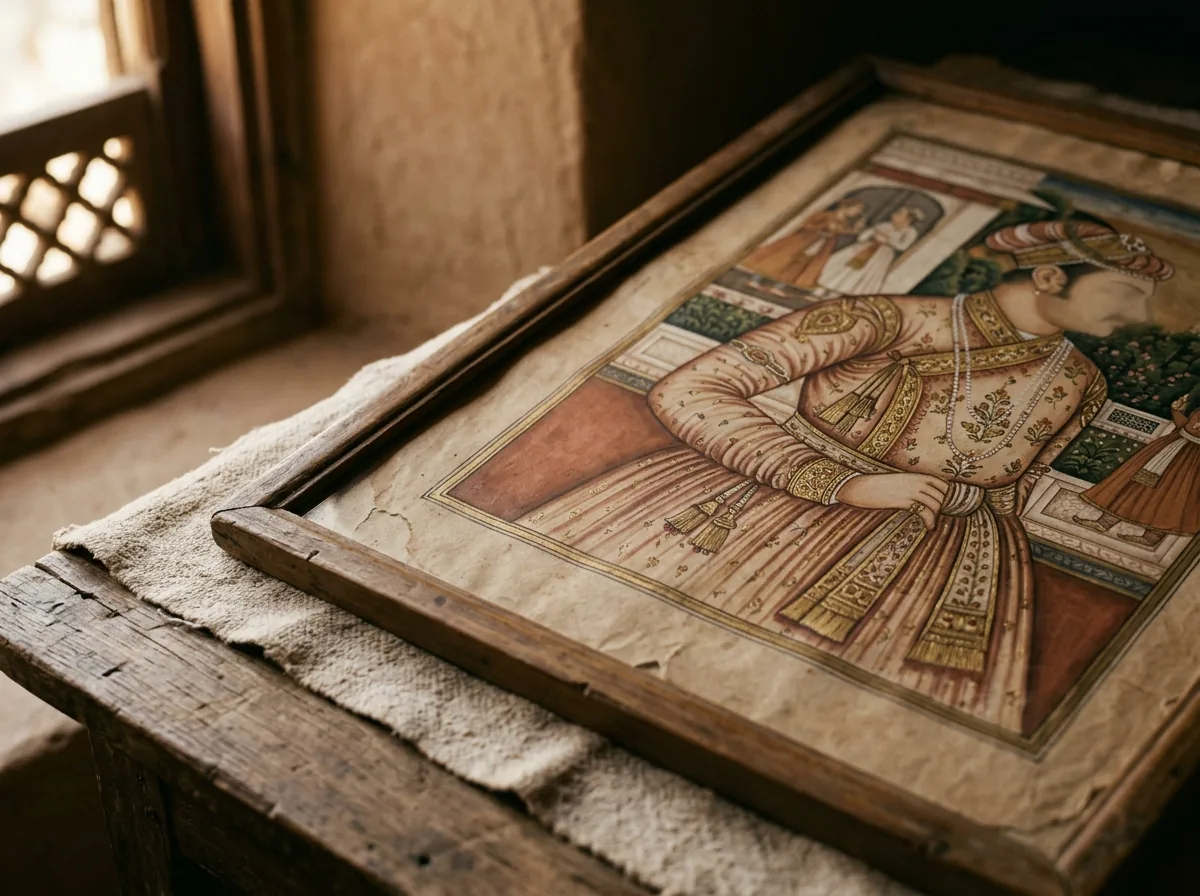
What is striking, looking at miniature paintings from the Kishangarh and Bundi schools, is how the angarakha is rendered with the same careful attention as a face. The painters understood that the way cloth falls from a shoulder is character. The asymmetric flap, crossing right over left or left over right depending on the wearer's community and occasion, was never accidental. It was grammar.
The Architecture of the Asymmetric Closure
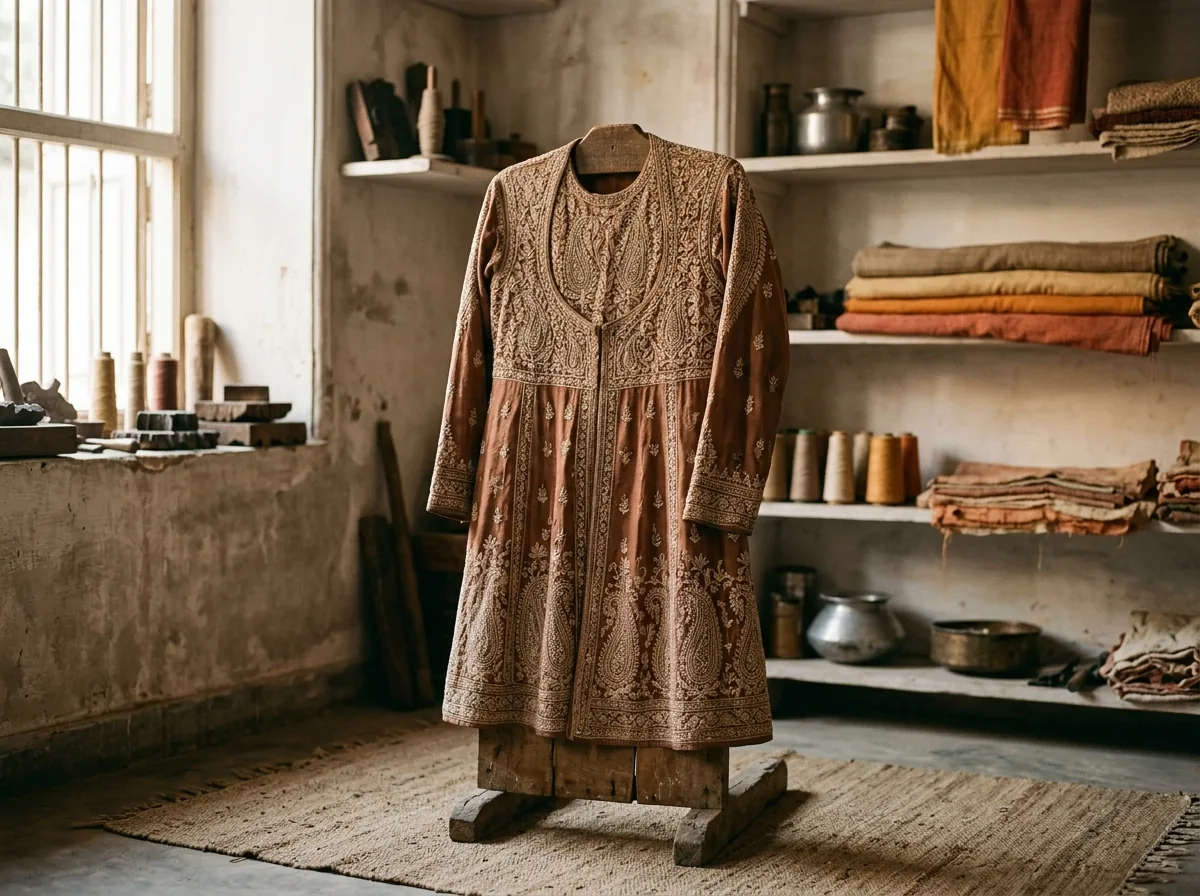
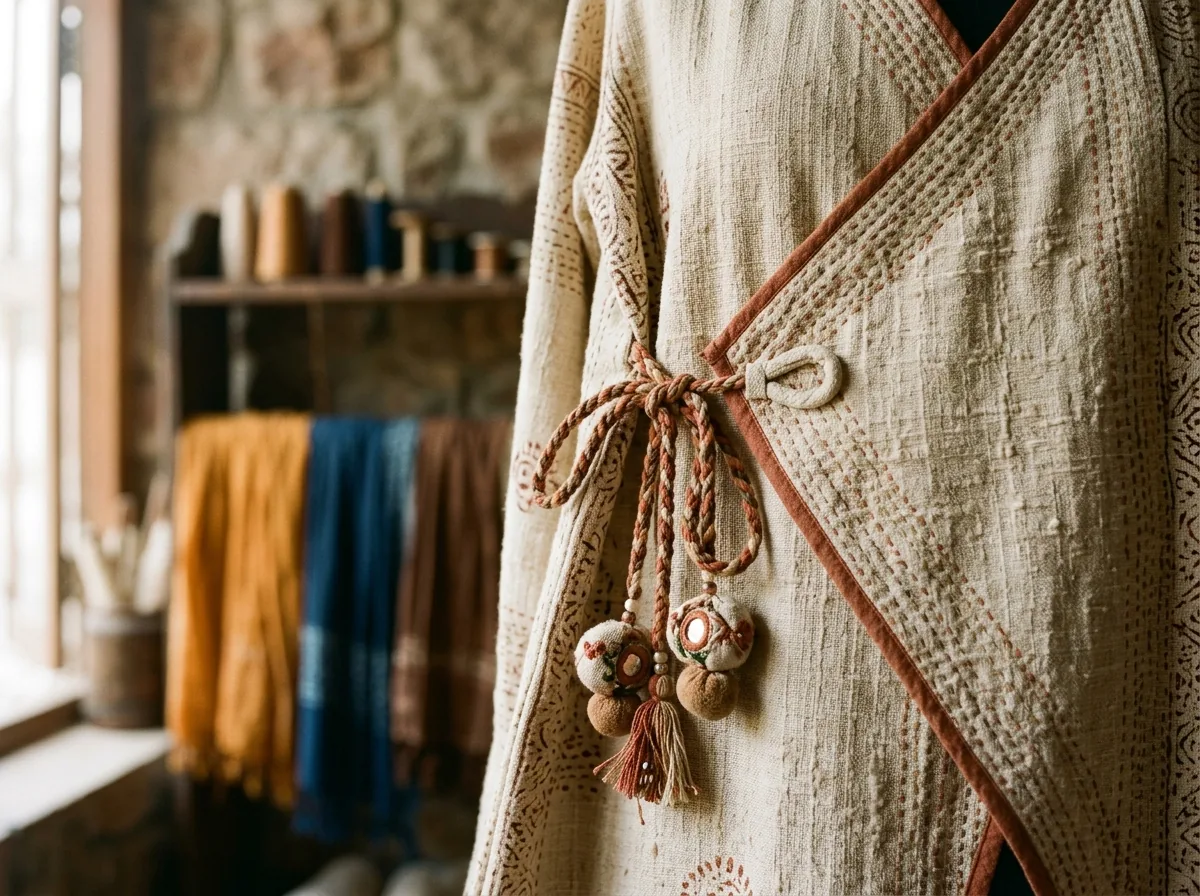
Every garment has a logic, and the angarakha's logic is architectural. Unlike the symmetrical placket of a European shirt, or the centre-fastening of a kurta, the angarakha resolves itself off-centre. One panel travels across the body and ties, variously, at the underarm, the waist, or the hip. The result is a diagonal line that runs from shoulder to side seam, and it is this line that gives the garment its particular quality of movement.
The closure typically involves two sets of ties: one internal, fastening beneath the outer panel, and one external, visible at the side. In older examples preserved in palace collections and museum archives, these ties are finished with tiny knots, tassels, or loops of twisted silk. They are not afterthoughts. They are the punctuation of the garment's sentence.
What this asymmetry achieves, beyond the visual, is a relationship between the garment and the body that requires a small act of attention each time it is worn. You cannot pull an angarakha over your head. You must open it, settle into it, and close it deliberately. This is a garment that will not be rushed.
The cut also creates a practical interior pocket of air at the chest, a feature that made the angarakha well-suited to both the dry heat of the Thar desert and the brief cold of Rajasthan's winter mornings. Form and function, as they always are in the best Indian textiles, are not separate conversations.
Contemporary artisans working in Jodhpur and Jaipur, particularly those supplying smaller craft labels, have studied these historical proportions with great seriousness. The angle of the overlap, the width of the collar, the length of the ties: these are not arbitrary. They are inheritances.
Fabric as Argument
An angarakha made of the wrong cloth is not an angarakha. It is only a shape. The garment's intelligence is inseparable from its material, and the tradition of pairing specific fabrics with specific occasions runs very deep in its history.
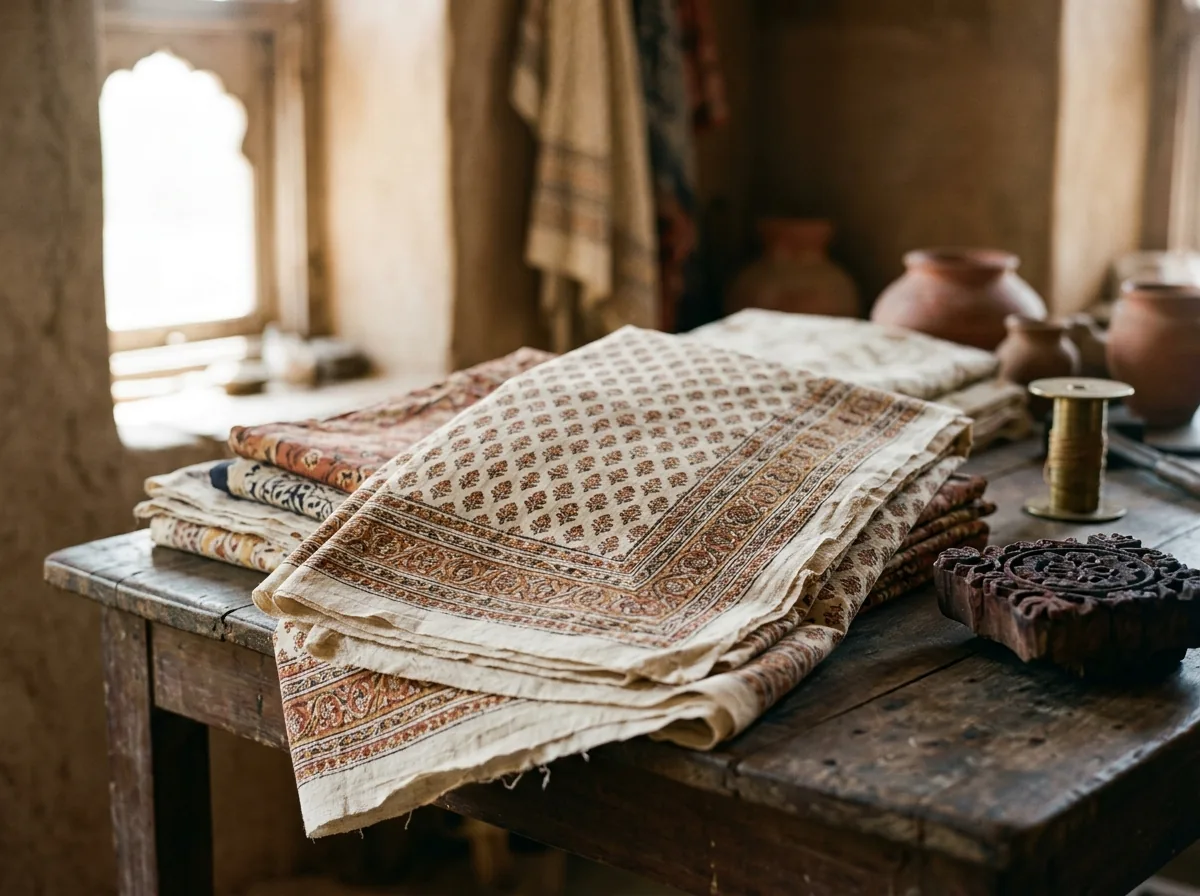
For everyday court wear, fine cottons from the looms of Sanganer, in Jaipur district, were common. Sanganer's block-printers have worked these fabrics for centuries, laying floral repeats and geometric borders across cloth with a precision that still defines the region's identity. An angarakha in Sanganeri print carries the weight of that continuity.
For ceremonial occasions, the choice moved toward silk. The Gaji silk of Surat, woven by the Salvi community, was and remains a cloth of quiet luxury, its slight slub and warm lustre making it an ideal surface for the long vertical folds the angarakha creates. Alternatively, the chanderi weavers of Chanderi town in Madhya Pradesh produced fabrics so fine they were described in Mughal-era texts as woven air. A chanderi angarakha is an argument for restraint.
Wool, too, had its place. The pashmina shawl-weavers of the Kashmir valley, specifically the kani weave communities of Kanihama village, have occasionally supplied fabric for cold-weather angarakhas, though this pairing is rarer and historically associated with the highest levels of patronage.
What the tradition teaches is that the angarakha is not a garment designed to overpower its fabric. It holds the cloth up to the light and asks it to speak. This is why, when revivalists choose the wrong textile, something registers as wrong even to a viewer who cannot name the source of the discomfort.
A Women's Garment Reclaimed
The angarakha's association with men's wear is historical habit, not historical law. Records from the Rajput courts show that women of the zenana wore forms of the angarakha, often paired with a ghagra and odhani, the crossover front creating a silhouette both practical for movement and appropriate for the elaborate embroidery that was applied to women's dress.
The garment's disappearance from women's wardrobes was, in part, a casualty of colonial-period fashion shifts, when certain forms of traditional dress were gradually repositioned as masculine by convention. The women's angarakha quietly receded, though it never entirely vanished in some communities, particularly among the Rajput and Banjara communities of rural Rajasthan.
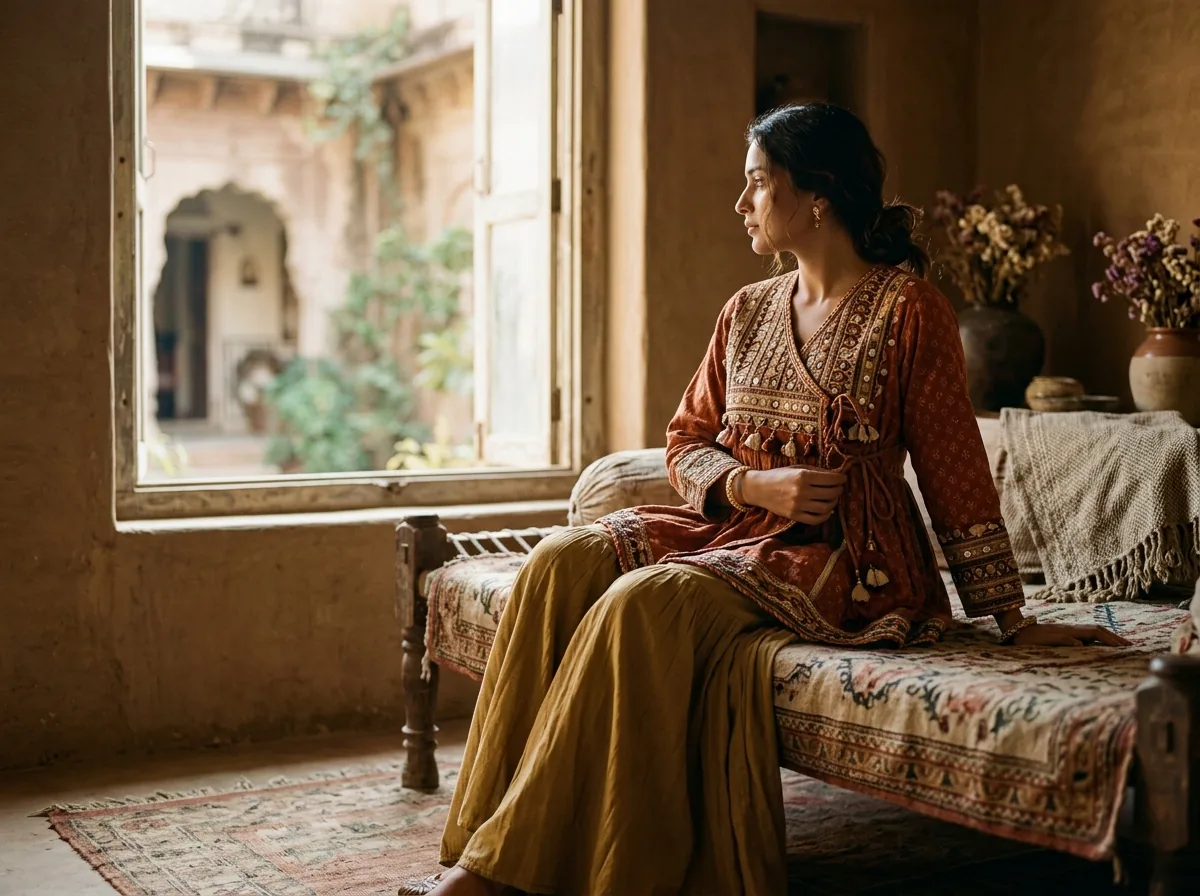
Its return in contemporary women's fashion over the last decade has been neither nostalgic cosplay nor trend tourism. It has been, at its best, a principled recovery. Designers working out of Delhi, Jaipur, and Ahmedabad have returned to archival references and recut the garment for the female form with genuine fidelity to the original proportions. The ties have been retained. The asymmetric closure has been kept intact. What has changed is the pairing: an angarakha over slim trousers, or a longer angarakha tunic worn as a dress, retains the grammar of the original while entering a new sentence.
The craftswomen of the Barmer embroidery tradition in western Rajasthan have found renewed purpose in the angarakha revival, their mirror-work and chain-stitch embellishment lending the neckline and hem a vocabulary that feels authentically continuous with the garment's origins. This is not decoration. It is dialogue.
How to Read an Angarakha Today
There is a kind of literacy required for wearing an angarakha well, and it has nothing to do with being Rajput or being steeped in court history. It has to do with understanding that the garment will ask something of you.
It asks you to stand a certain way. The diagonal line of the closure creates a visual energy that rewards an upright posture. Slouch, and the garment works against you. Stand easily and well, and it opens into its full dignity.
It asks you to be patient with the ties. The internal tie must be secured first, drawing the underlap flat against the body. The external tie should fasten without bunching, and should fall naturally at the side seam rather than migrating toward the front. This is a two-minute act of attention. It is not inconvenient. It is ritual, and ritual has value.
It asks you to think about what lies beneath. The angarakha is not a garment that competes with a busy underlayer. A solid churidar, a plain salwar, a clean-pressed trouser: these are its natural companions. Let the angarakha carry the print, the embroidery, the weave. Offer it clear ground to stand on.
For those new to the form, the knee-length version is the most accessible entry point. It carries all the angarakha's essential character while sitting within a proportion that feels familiar to those accustomed to the standard kurta. From there, the longer angrakha-as-dress is a natural next step, and the shorter, jacket-length version is a separate study entirely.
The Garment That Remains
The angarakha has survived the disappearance of the courts that first perfected it. It has survived colonial dress reform, the long dominance of the stitched-and-symmetrical kurta, and several decades in which heritage garment forms were either museumified or mined for trend. It remains because it is, structurally and philosophically, a very good idea.
Good ideas in clothing are rare. Most garments are solutions to temporary problems. The angarakha solves something more durable: how to wear fabric that has been made with care, in a form that honours the body without constraining it, with a closure that asks the wearer to be present. These are not small things.
In the weaving villages of Maheshwar in Madhya Pradesh, where the Maheshwari silk tradition continues under the guidance of the Rehwa Society and the families of weavers who have worked these looms for generations, fabric is still made with the understanding that it will eventually become a garment with a life of its own. The angarakha is one of the forms worthy of that fabric. It holds the cloth in a way that lets the weave breathe, lets the selvage show, lets the maker's hand remain visible in what the wearer carries.
This is a garment with manners. And manners, in the deepest sense, are a form of memory.