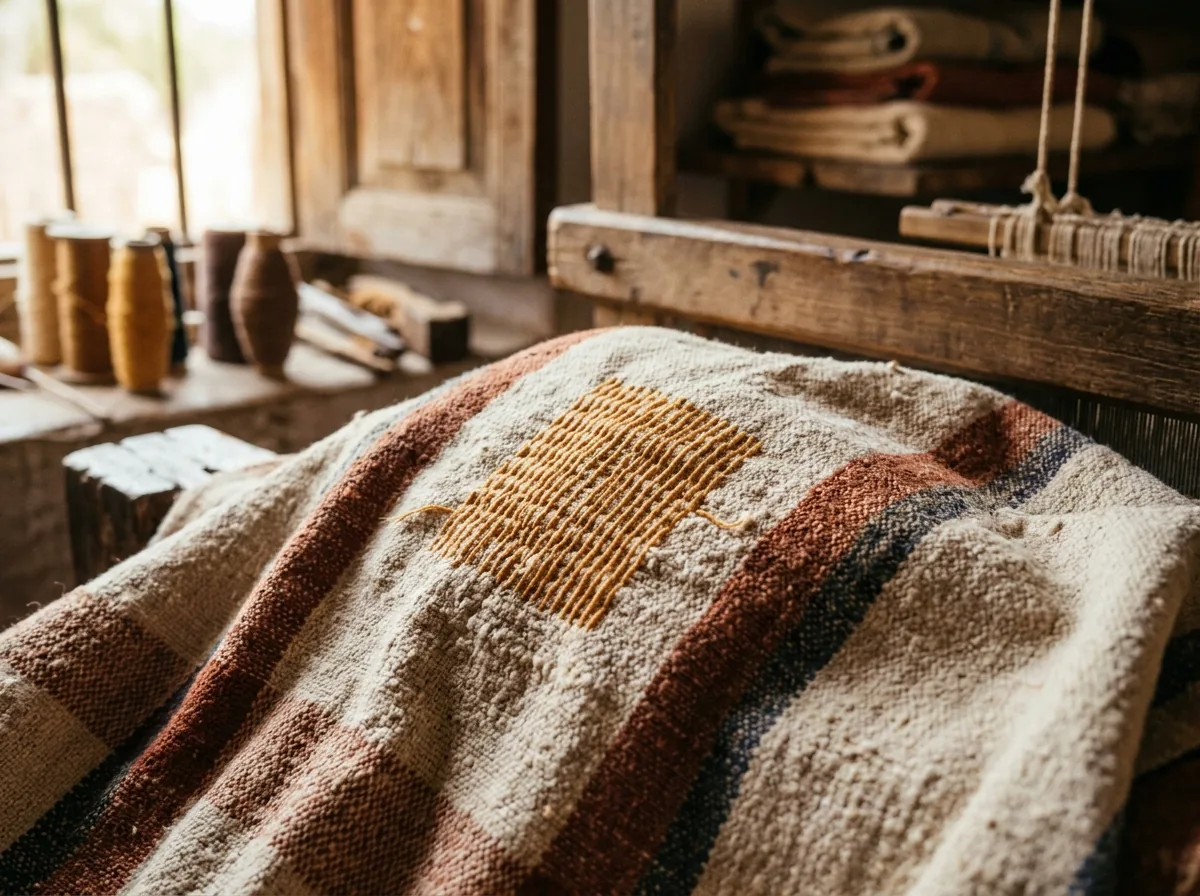
She stitched the sun into coarse khaddar, and the fields remembered how to bloom.
The Thread That Carries a Whole Sky
There is a particular quality of light in the Punjab in spring, when mustard flowers crowd the fields and the horizon seems to lean in close. It is this light, embroidered generations deep into cotton and silk, that lives inside every piece of Phulkari. The word itself is simply translated: phul, flower; kari, work. Yet the simplicity of the name masks a tradition of extraordinary complexity, a craft that has carried the emotional and ceremonial weight of Punjabi womanhood for at least five centuries.
Phulkari is not a single textile. It is a language. Within its vocabulary sit harvests and weddings, lullabies and laments, the specific redness of a bride's joy and the quieter ochre of a grandmother's memory. The base cloth, most traditionally a coarse hand-spun khaddar of undyed cotton, serves as the earth into which colour is pressed. From there, the embroiderer works from the reverse side, counting the threads of the warp and weft with a precision that borders on meditation, pulling silk floss through in the darn stitch so that the face of the cloth erupts into geometry and petal, into a world far more vivid than the plain ground would suggest.
What makes Phulkari remarkable is not only its beauty but its intimacy. This was not craft made for sale. It was made by women for women, passed between generations in dowry chests, carried across borders during Partition in suitcases already too heavy with grief. To hold a piece of old Phulkari is to hold a long conversation.
Bagh: When the Garden Covers Everything
Within the broader world of Phulkari lies its most celebrated expression: the bagh, meaning garden. If Phulkari describes embroidery in which the khaddar ground remains visible between motifs, the bagh is an altogether more consuming ambition. Here the silk floss covers the cloth so completely, so densely, that the cotton base beneath almost entirely disappears. The ground becomes the secret held beneath a garden in full riot.
Bagh work was produced most abundantly in the districts of Amritsar, Gurdaspur, Hoshiarpur, and Patiala, each region developing its own regional preferences for colour and pattern. The bagh of the Malwa region, the flat agricultural heartland of south-east Punjab, tends toward geometric rigour, its repeating angular units assembled with near-architectural discipline. Those associated with the Majha region, centred around Amritsar and the rural villages surrounding the Golden Temple, carry a somewhat freer disposition, with floral forms that breathe a little more openly across the surface.
The silk thread used historically was the lustrous pat silk, drawn fine and dyed in colours that bore the names of the natural world: genda (marigold), surkh (vermillion), neel (indigo), zard (a golden yellow that speaks directly to the mustard fields). These were not arbitrary choices. The colour vocabulary of Phulkari was as codified as a classical raga, with specific combinations carrying specific meaning: the bride wore red and orange; the mourning cloth quieted to white and deep blue.
Bagh pieces of genuine age are rare objects now. Their survival often depends on what they were asked to carry and how far they had to travel.
The Dowry Chest and the Months of Stitching
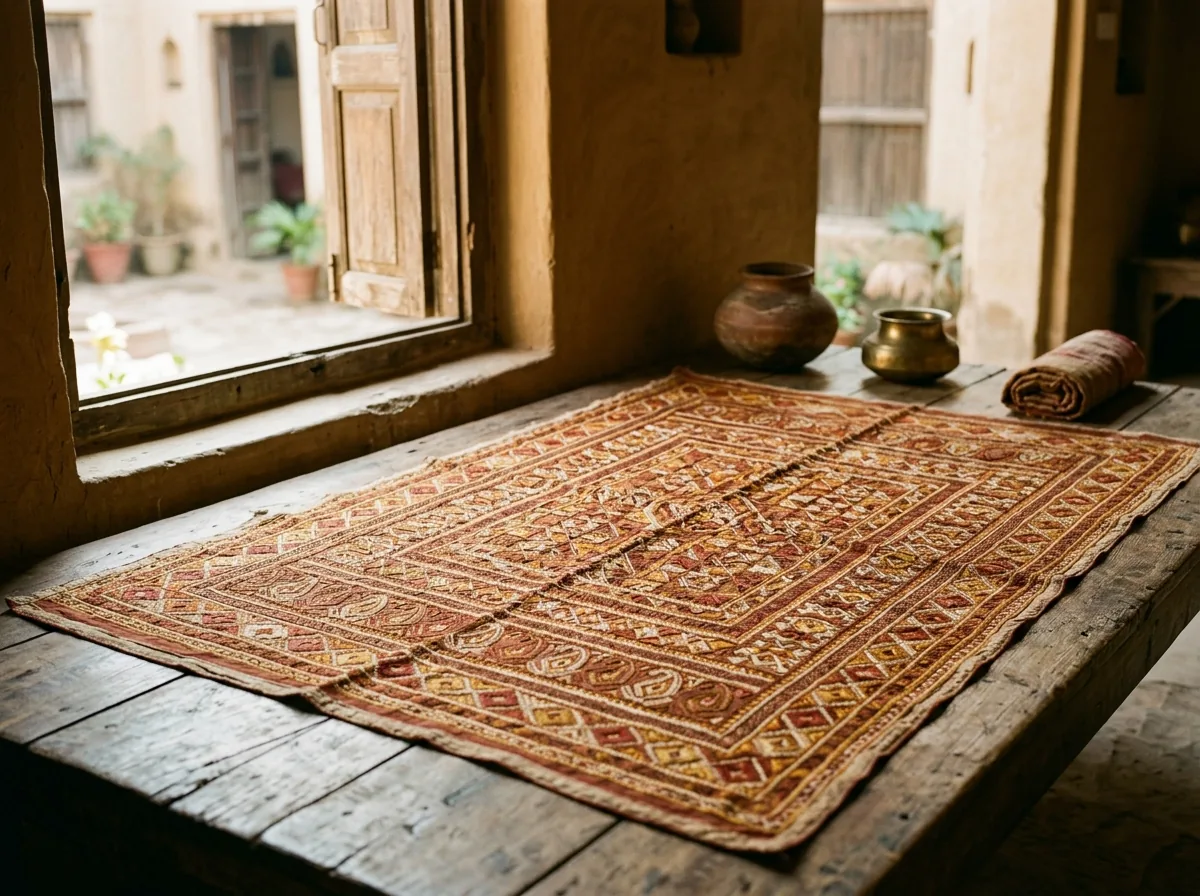
A daughter's Phulkari did not begin with her engagement. It began at her birth. In villages across what is now the Indian state of Punjab, and in the Pakistani districts of Lahore, Rawalpindi, and Multan, the women of a family would begin preparing a girl's trousseau years before any match was spoken of. The dowry chest, or sandook, held not simply cloth but time: months and sometimes years of evenings given over to the darn stitch, the accumulating labour of mothers, aunts, grandmothers, and sisters.
The pieces made for a bride carried specific names according to their function and meaning. The suber was given by the maternal grandmother; the vari-da-bagh was part of the gift from the groom's family; the sainchi incorporated figurative motifs, women at wells, peacocks, horses, the small dramas of rural life, and was considered among the most artistically accomplished of all Phulkari forms. Each piece in the trousseau was identifiable not only by its beauty but by the social relationship it encoded.
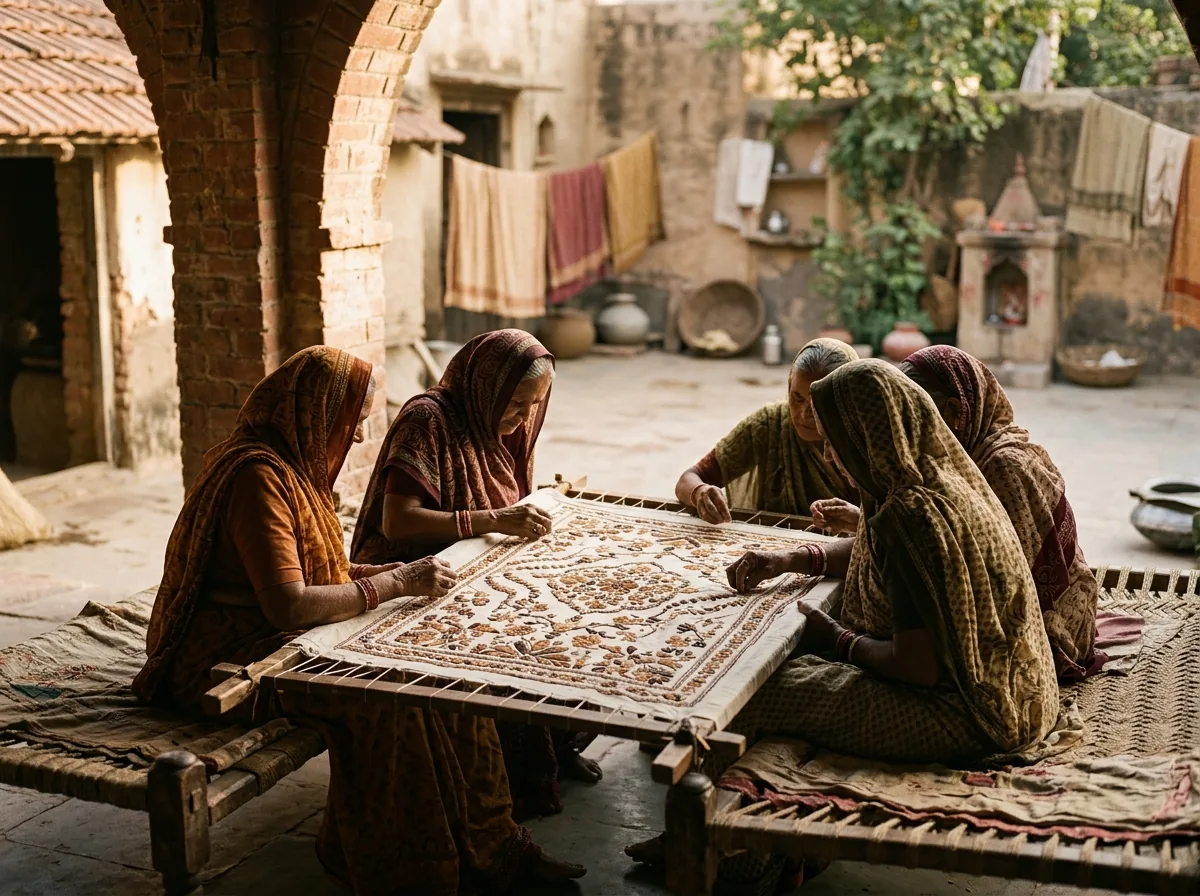
In Punjabi villages such as Patiala, Barnala, and those scattered through the Doaba belt between the Beas and Sutlej rivers, this system of communal stitching, where women gathered in the evenings to embroider together, was called trokna. The sessions were social as much as productive. Songs were sung. Stories were passed. The needle and the conversation moved together.
The craft's intimate connection to female solidarity is not incidental to its aesthetics. It is the source of them.
The Partition and the Survival of the Stitch
No account of Phulkari can pass around 1947 without pausing there. The division of Punjab along the lines that Cyril Radcliffe drew in five weeks cut through the geographical heart of the craft. Families that had maintained embroidery traditions for generations found themselves on one side of a border that had not existed the week before. Women fled with what they could carry. Some carried their Phulkari. Some left it behind in houses they would not enter again.
The Phulkari tradition that survived and was eventually revived in Indian Punjab did so largely through the determination of displaced communities resettling in cities such as Amritsar, Ludhiana, Jalandhar, and later Delhi. Refugee women who had been embroiderers in Lahore or Rawalpindi brought their needles and their knowledge into the camps and colonies of the new Indian Punjab, and gradually, over the following decades, the craft found new ground.
The Government of India, recognising the cultural and economic value of the tradition, began supporting Phulkari clusters through bodies such as the Khadi and Village Industries Commission and later through schemes run by the Punjab state government. The craft received a Geographical Indication tag in 2010, recognising its origin and protecting it, at least in principle, from imitation.
Today, active embroidery clusters exist in and around Patiala, Faridkot, and the villages of Bathinda district. Non-governmental organisations, including some operating within the Phulkari cooperative networks of rural Punjab, work directly with women embroiderers to maintain wages and quality standards. The tradition carries its wounds, and it carries on.
Geometry as Devotion: Reading the Motifs
To look closely at Phulkari is to learn a second alphabet. The motifs are not decorative in any casual sense. They are a system of meaning developed over generations, refined by women who understood that beauty and symbol need not be separate concerns.
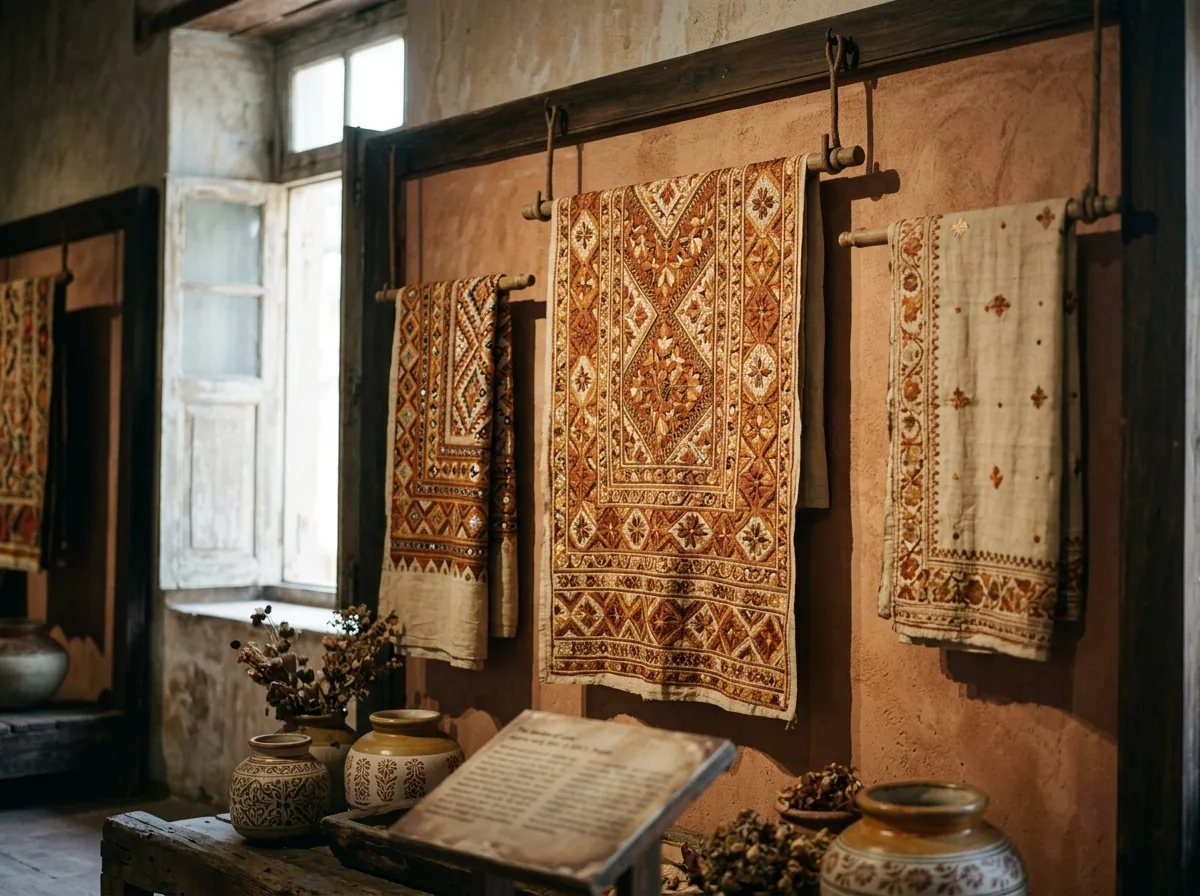
The most fundamental unit is the geometric: the triangle, the hexagon, the stepped diamond, the interlocking chevron. These forms appear across both Phulkari and bagh textiles and connect the craft to a much older visual language shared with other north-west South Asian traditions, including the mirror-work of Sindh and the geometric kilims of the mountain districts further north. The repetition of these units across a large bagh surface creates a meditative rhythm, a sense that the cloth is breathing in a regular, measured pattern.
Over these geometric foundations, Phulkari layers the figurative: the charkha or spinning wheel, the peacock with its tail spread wide, the parrot that in Punjabi poetry carries the messages of lovers, the lotus, the mango, the rice plant heavy with grain. In sainchi Phulkari particularly, human figures appear, arranged in the processional manner of folk narrative, small women carrying pots on their heads, small men riding small horses, the world of the village made miniature and eternal in silk.
Colour saturation itself functions as meaning. A bagh saturated in a single dominant colour reads differently from one that deploys a full range. The monochromatic red bagh, known as lal bagh, is among the most visually powerful objects in all of South Asian textile art.
Where the Needle Rests Now
Phulkari in the present moment exists in several registers at once, and this complexity is perhaps the most honest thing that can be said about any living craft tradition. In certain villages of Patiala and Faridkot districts, women continue to embroider using the traditional darn stitch on hand-spun khaddar, their work supported by cooperatives and by collectors who understand the difference between machine-made approximation and the real thing. These pieces carry the irregularities that are the signature of the human hand: a slight variation in tension, a colour shift where one length of floss ends and another begins. These are not flaws. They are the proof of presence.
Alongside this, a broader contemporary Phulkari market has developed, ranging from high-quality handloom work in traditional forms to lighter adaptations of the embroidery on stoles, dupattas, and kurtas aimed at a younger, urban audience. The best of this contemporary work honours the grammar of the tradition even as it adapts its vocabulary. The worst reduces Phulkari to a pattern, something printed rather than stitched, something recognised rather than felt.
What the tradition asks of those who care for it is a quality of attention. Phulkari was always made slowly, stitch by careful stitch, the count held in the mind, the colour chosen with knowledge of what it meant. To receive it well asks for something similar: a willingness to look closely, to learn the language, to understand that what appears to be a flower is also a field, a family, a long history of women who kept the light.