Where the river bends gold, the worm spins light.
A Silk Born of Floodplain and Forest
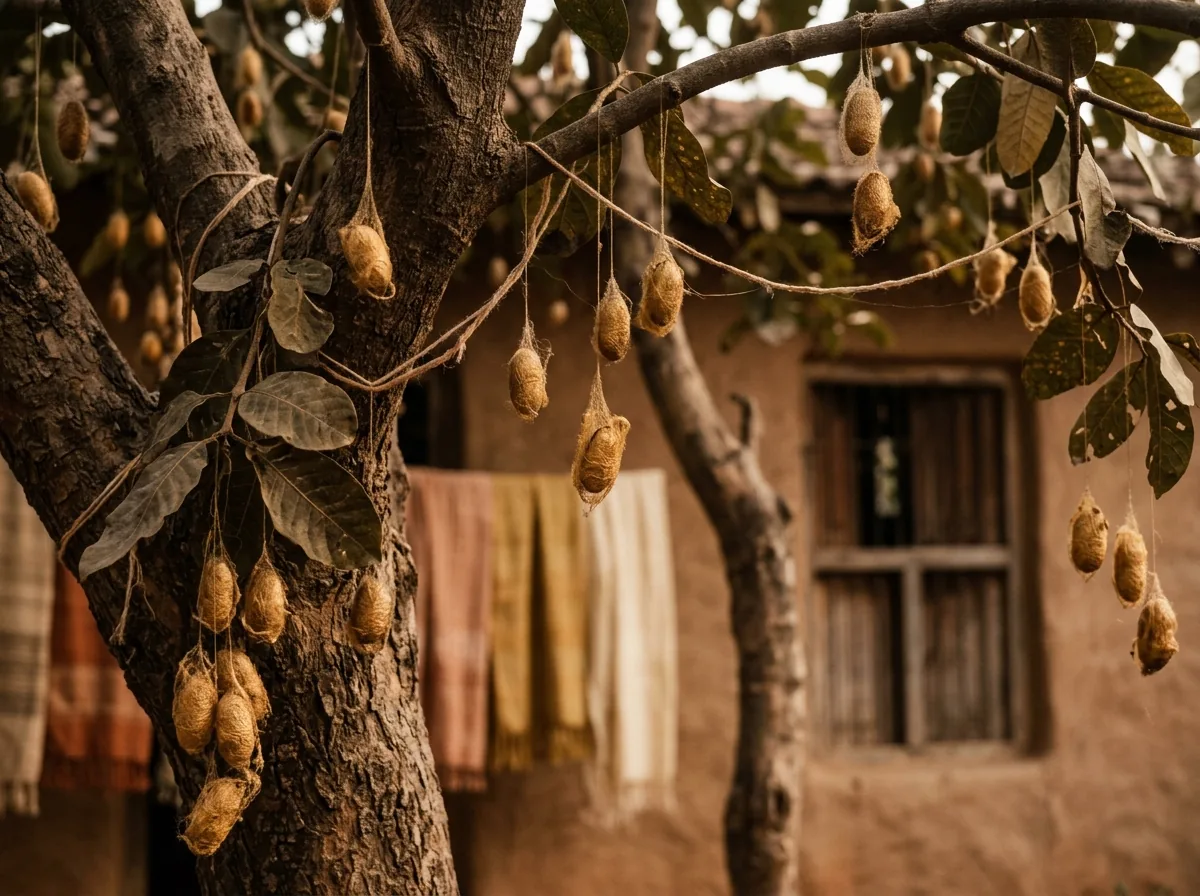
There is a silk that does not begin on a loom. It begins in the canopy of som and sualu trees, in the shifting light of Assam's river valleys, where the air carries the faint mineral coolness of the Brahmaputra and its tributaries. Muga silk is the product of the Antheraea assamensis silkworm, a creature found nowhere else on earth in its cultivated form, reared almost exclusively in the mid-Brahmaputra valley and the foothills that frame it.
The word muga is believed to derive from the Assamese for amber, and the name is entirely honest. Raw muga filament carries a natural golden lustre that deepens rather than fades with each washing, with each year of wear. This is not a quality that can be replicated in a laboratory or approximated with dye. It is a consequence of the particular sericin protein that coats each filament, a protein shaped by the specific ecology of the Assamese forest, by the leaves the silkworm consumes, by the humidity of a land that floods and breathes and floods again.
Muga was not always available to the general public. For centuries it was reserved for Assamese royalty and the ritual garments of the Vaishnavite monasteries, the satras, that dot the landscape from Majuli island downstream to Hajo. A mekhela chador woven in muga was gifted at weddings, preserved across generations, handed from mother to daughter with the quiet gravity of heirloom silver. That heritage of restraint and ceremony has never quite left the cloth.
Sualkuchi: The Village That Became a Loom
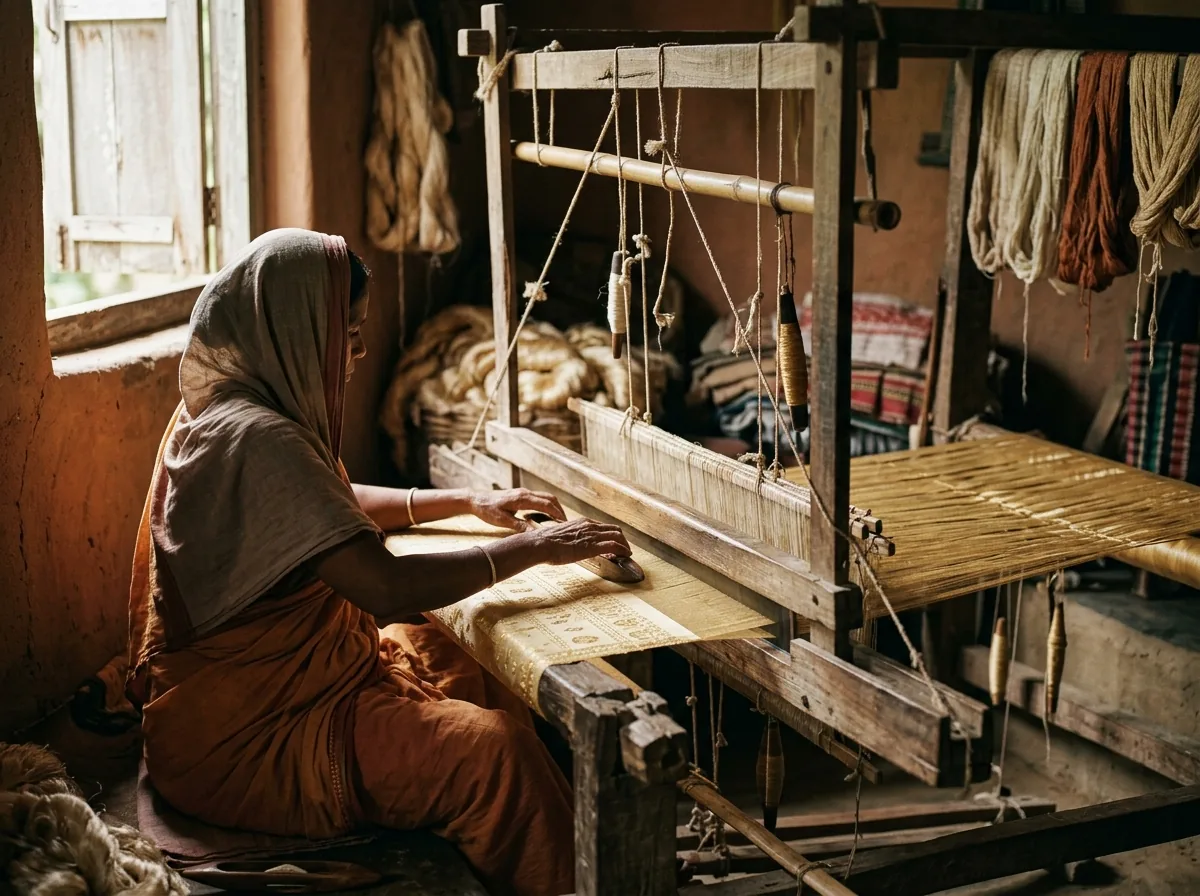
Sixty kilometres upstream from Guwahati, on the northern bank of the Brahmaputra, sits Sualkuchi. The town is sometimes called the Manchester of Assam, a comparison that does it no particular justice, because Sualkuchi is not industrial in any cold sense. It is a community organised entirely around the act of weaving, where the sound of the pit loom and the frame loom is as ambient as birdsong, present in nearly every household from early morning to the last of the afternoon light.
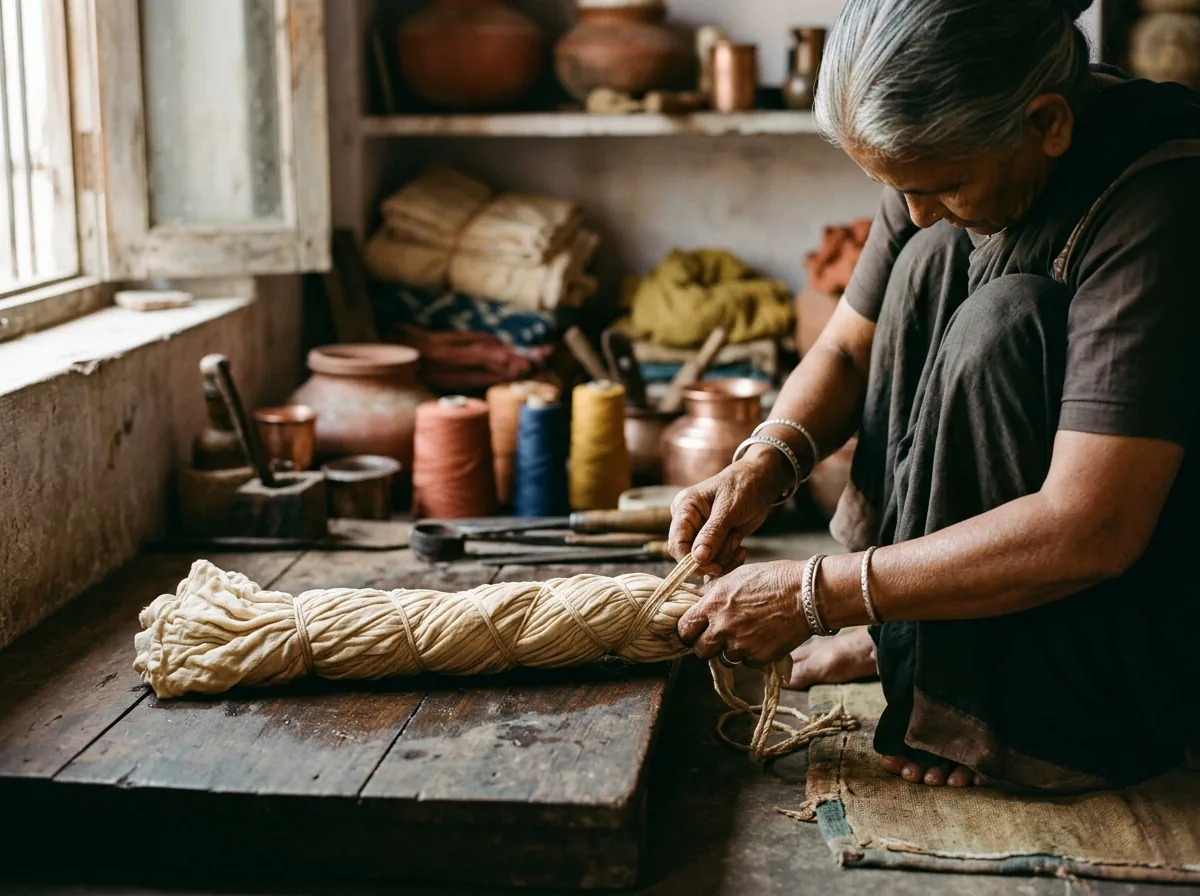
The weaving families of Sualkuchi belong primarily to the Koibarta community, though Brahmin and other Assamese communities have historically contributed to the town's textile tradition as well. The Koibarta weavers carry a body of technical knowledge that has been transmitted through apprenticeship and household practice across many generations. Their understanding of silk preparation, of warp tension, of the particular behaviour of muga thread under humidity, is the kind of knowledge that cannot be fully transcribed. It lives in the hands.
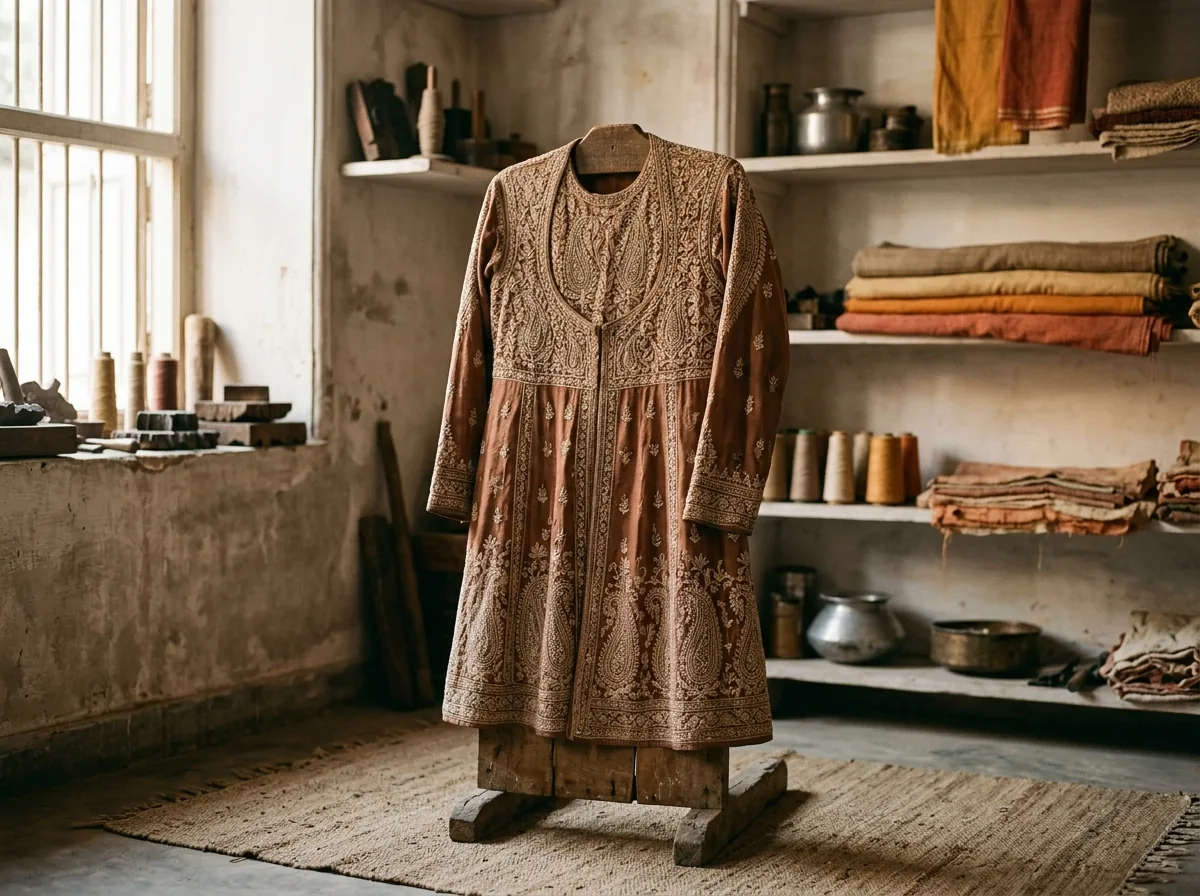
Sualkuchi produces not only muga silk but also pat silk and eri, giving it a breadth of textile vocabulary unusual even among India's great weaving centres. The mekhela chador, the two-piece garment that is the foundational dress of Assamese women, reaches perhaps its finest expression here. The border work, known as paar, is often woven separately and joined with extraordinary precision. Motifs of kingfishers, elephants, the geometric patterns called dhekia drawn from the fiddlehead fern, appear in the supplementary weft with a sureness that speaks to long practice. A well-made Sualkuchi muga mekhela chador is not a product. It is a text.
The Lifecycle of Luminescence
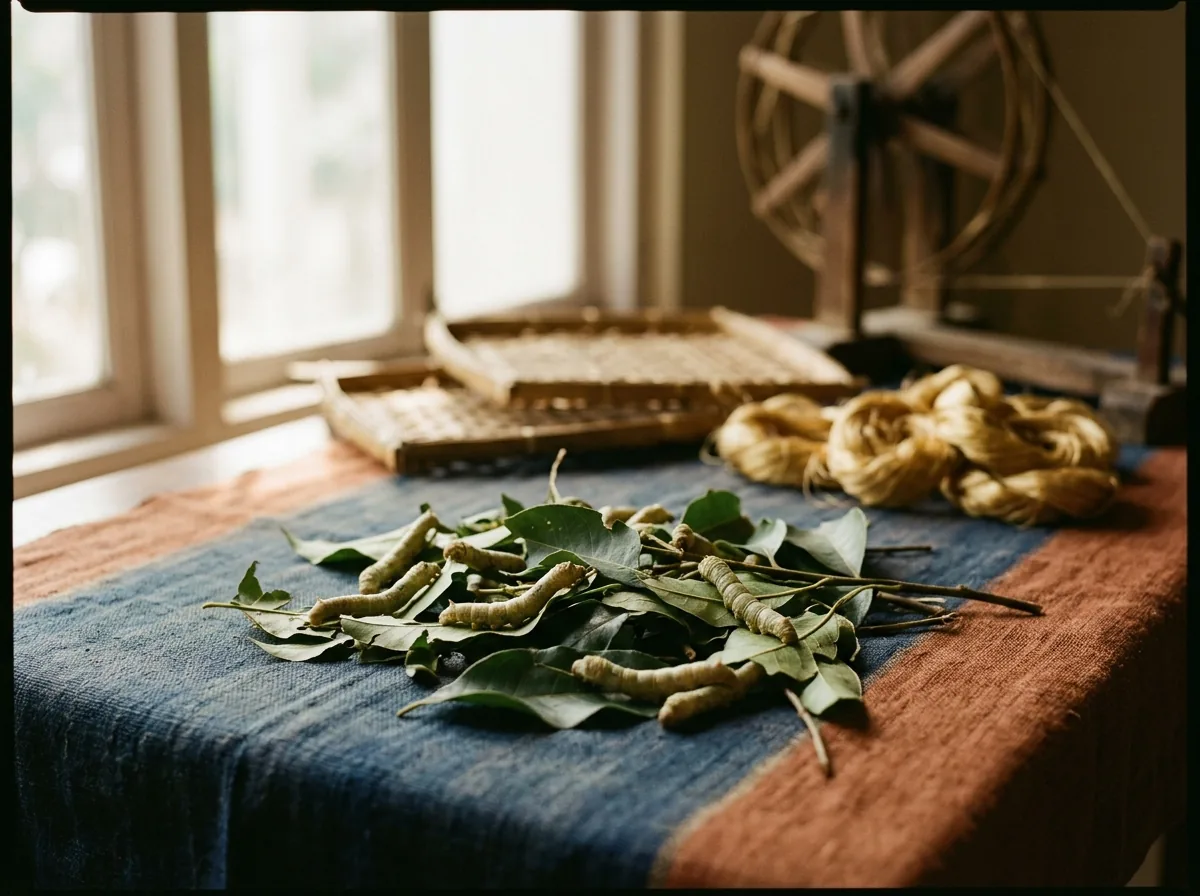
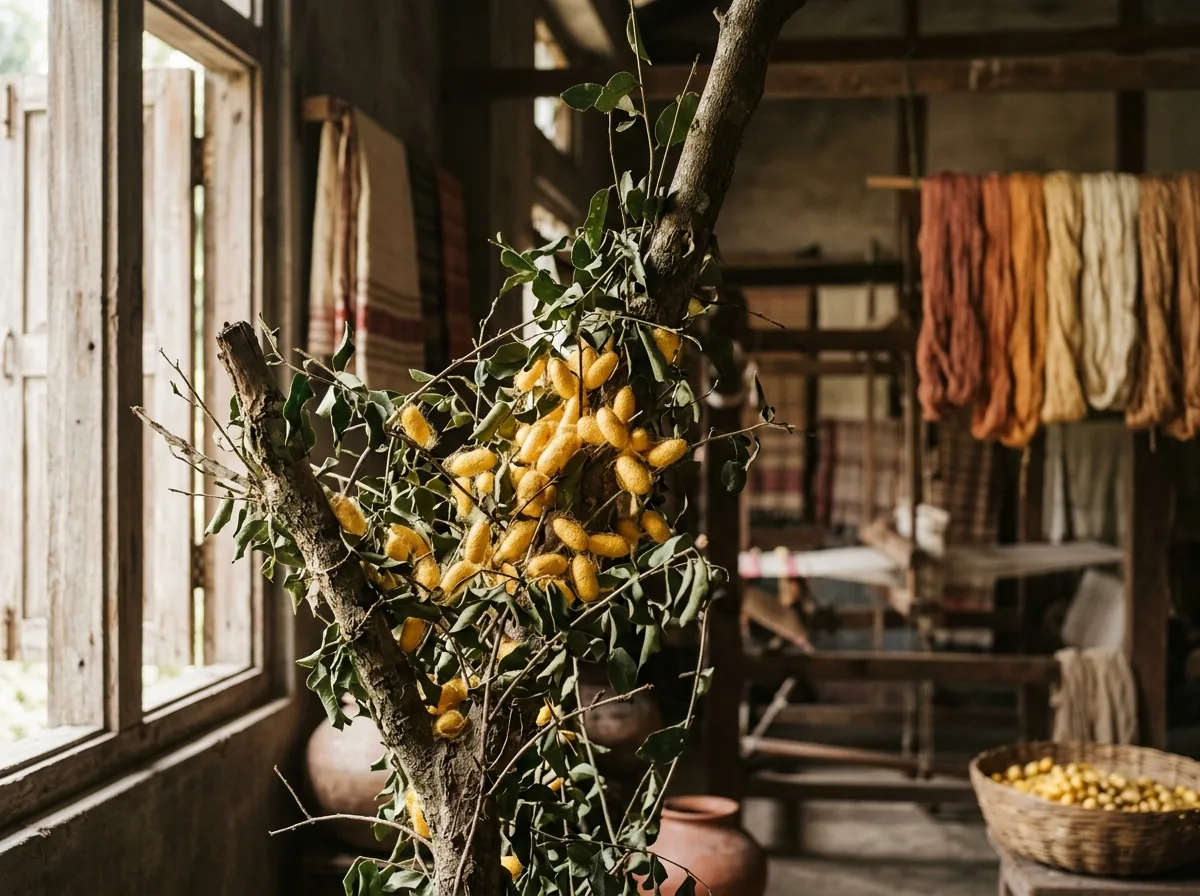
To understand why muga silk behaves as it does, one must understand something of its rearing. The Antheraea assamensis silkworm is semi-wild, reared on the branches of living trees rather than in trays, a practice called arboreal sericulture. The primary host plant is the som tree, Persea bombycina, whose leaves impart the specific amino acid composition that determines the filament's character. Secondary host plants include sualu and mejankari, used at different stages of the silkworm's development.
The rearing season follows Assam's agricultural calendar. There are several broods through the year, but the muga reared in the post-monsoon months, from October through December, is considered to yield the finest thread, when the air is cooler and the silkworms feed more steadily. Cocoon reeling is done by hand, a process requiring skill and patience, because muga filaments are finer than those of tropical tasar and must be handled without the heat-based degumming that other silks undergo. Muga is reeled in warm water, preserving its natural sericin, which is precisely what gives the cloth its characteristic stiffness when new and its increasing suppleness and sheen over time.
The result is a thread with tensile strength significantly greater than mulberry silk, a natural resistance to insects, and a warmth-to-weight ratio that makes a muga mekhela chador comfortable in Assam's cool winters without feeling heavy. These are not marketing attributes. They are structural realities, born of ecology and rearing practice. The land makes the cloth, and the cloth holds the land inside it.
Motif and Meaning: The Grammar of Muga Textiles
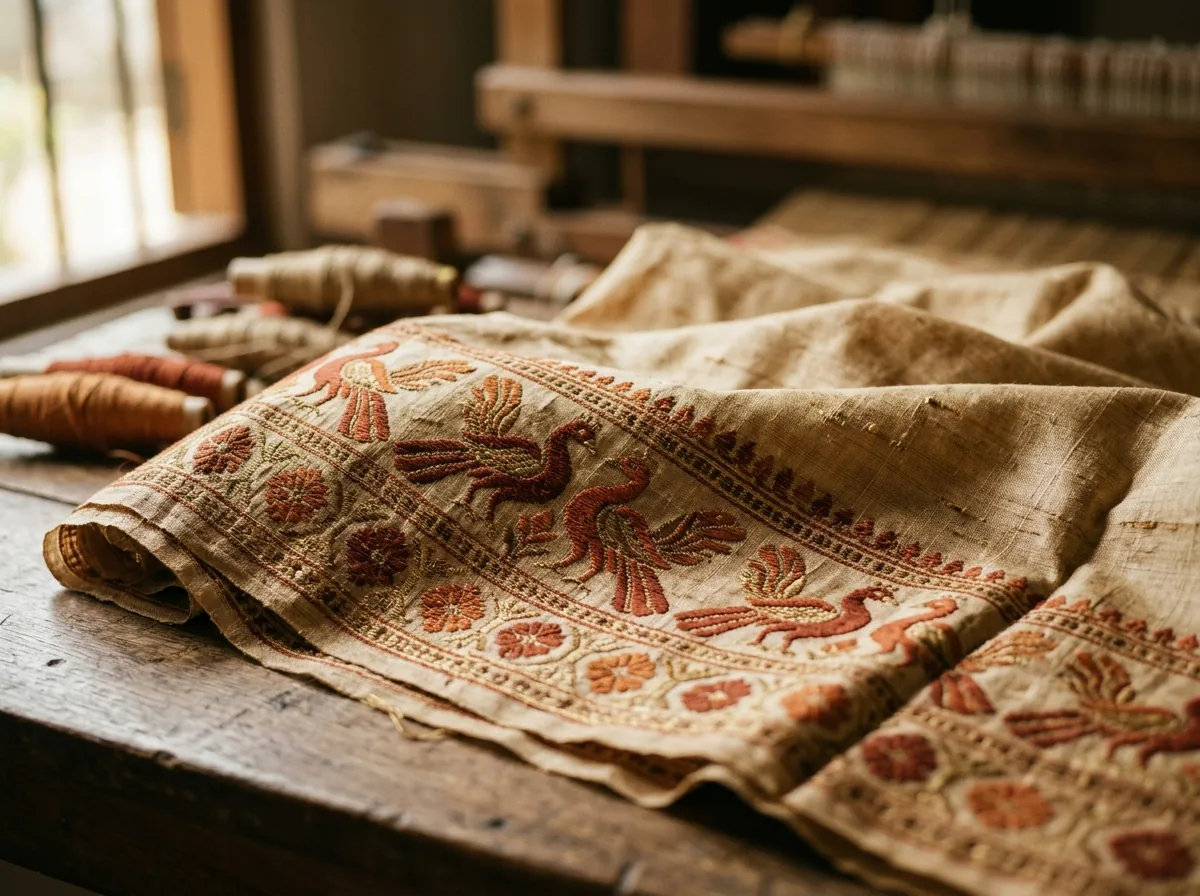
Assamese textile tradition carries a distinct visual grammar, one that draws from the natural world of the Brahmaputra basin and from the iconographic vocabulary of Vaishnavite devotion. In muga silk specifically, this grammar tends toward restraint. The golden ground of the fabric is itself so visually active that the weaver often allows it to breathe, deploying motifs with spacing and confidence rather than crowding the surface.
The jaapi, the traditional conical hat of Assam, appears as a motif. The kingfisher, the elephant, the lotus in its many formal variations, and the lozenge-based geometric patterns drawn from weaving's own geometry all recur in the supplementary weft borders. In festive pieces, the bodies of dragons and peacocks move through the paar in silk thread of deep red and forest green, colours that vibrate against the amber ground with an intensity that no synthetic dye has yet equalled, because the muga itself is not neutral. It participates in every colour placed beside it.
The bihuwan, a long scarf given as a gesture of welcome and blessing during Bihu celebrations, is woven in muga with particular care. To receive a bihuwan is to receive something of the giver's time and attention, something made in the hours before dawn, on a loom in a household where the smell of silk and wood oil is permanent. This is also true of the riha, the third piece of the traditional Assamese woman's dress, worn across the shoulder at ceremonies. Each of these textiles carries a social function that is inseparable from its physical form.
A Silk in Its Own Time
Muga silk holds a Geographical Indication tag, granted in 2007, which restricts the authentic designation to silk produced in Assam. This legal protection matters, because the market pressure on handwoven muga is real. Power-loom imitations exist, woven from blended yarns or from inferior silk, and the visual similarity can be convincing to an untrained eye. The difference becomes apparent only in the hand, in the particular weight and warmth of true muga, and over time, in the way the cloth responds to wear.
The weaving families of Sualkuchi navigate a complex economy. Raw silk prices fluctuate with sericulture yields, which are vulnerable to unseasonal rain, to disease among the silkworms, to the gradual reduction of som tree groves as agricultural land use shifts. The time required to produce a single high-quality muga mekhela chador, sometimes six to eight weeks of sustained work on a handloom, is rarely reflected in the price the market bears without deliberate effort from buyers who understand what they are choosing.
To purchase muga with attention is to participate in the continuity of something that has taken centuries to develop and could diminish, quietly, without most people noticing. The cloth does not advertise its own fragility. It sits in its amber light, warm and self-contained, as it always has.
What the River Carries Forward
There is a quality in well-worn muga that no other textile quite replicates: the way the golden tone deepens season by season, the way the cloth softens at the fold lines into something almost liquid while retaining its structural memory. A muga mekhela chador that has been worn to a dozen Bihus, to a daughter's wedding and a mother's prayer, carries its history in its lustre rather than in its wear. It does not thin or grey. It simply becomes more entirely itself.
The Brahmaputra floods every year, remaking its own banks, depositing silt that shifts the character of the soil and the forest floor. The som trees grow in this altered ground, and the silkworms feed on their leaves, and the thread that comes from those cocoons carries some particle of all that seasonal transformation. The weavers of Sualkuchi have been reading this thread for generations, making from it something that is, quietly and persistently, one of the great textiles of the world. To hold a length of muga is to hold the valley, the river, and the long patience of the people who learned to make gold from leaves and light.