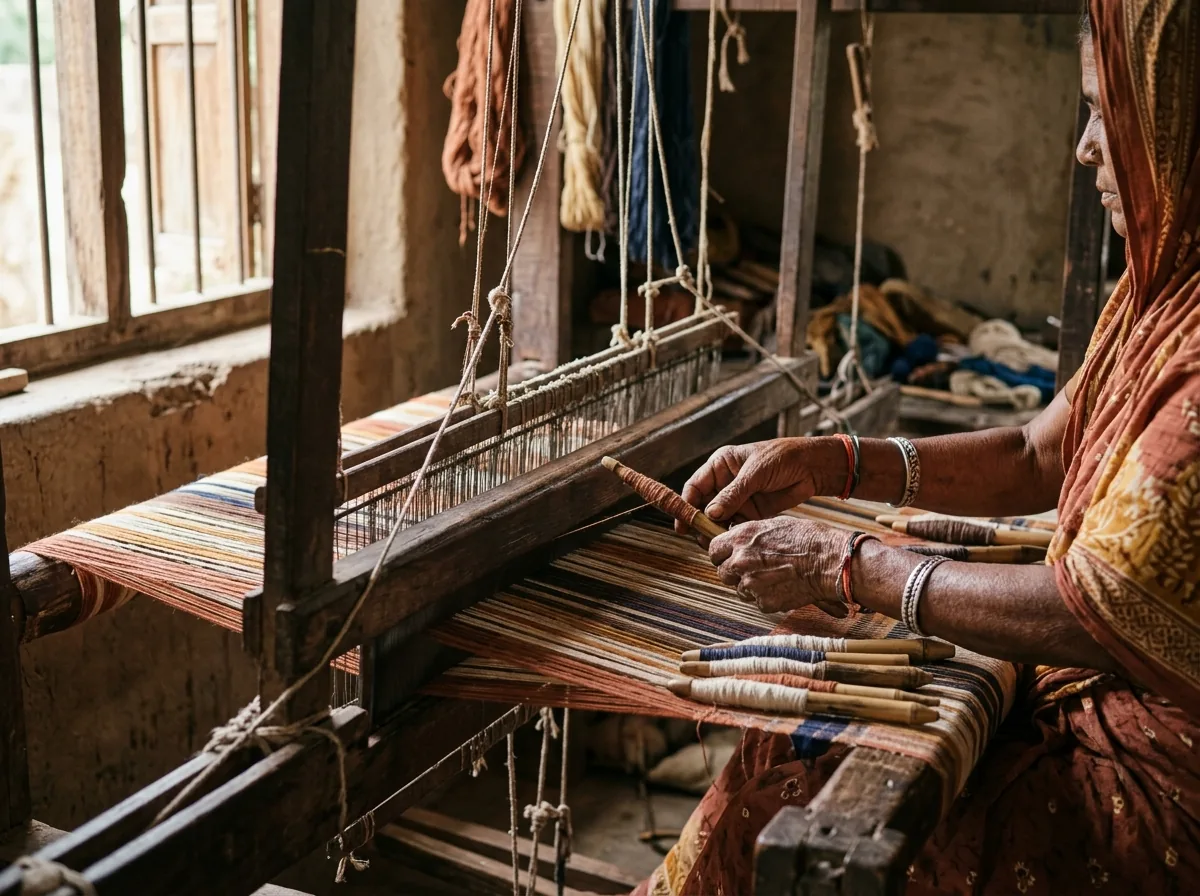
In the valley where silence weaves itself into wool, a man bends over a loom and becomes, for a season, the pattern itself.
The Loom That Refuses to Hurry
There is a particular kind of patience that belongs only to Kashmir. You find it in the mist that lingers over Dal Lake long after the sun has risen, in the way apricot blossoms refuse to be rushed by the calendar, and in the hands of a Kani weaver in the village of Kanihama, guiding dozens of small cane bobbins through a warp of the finest Pashmina with the unhurried certainty of someone who has made peace with time.
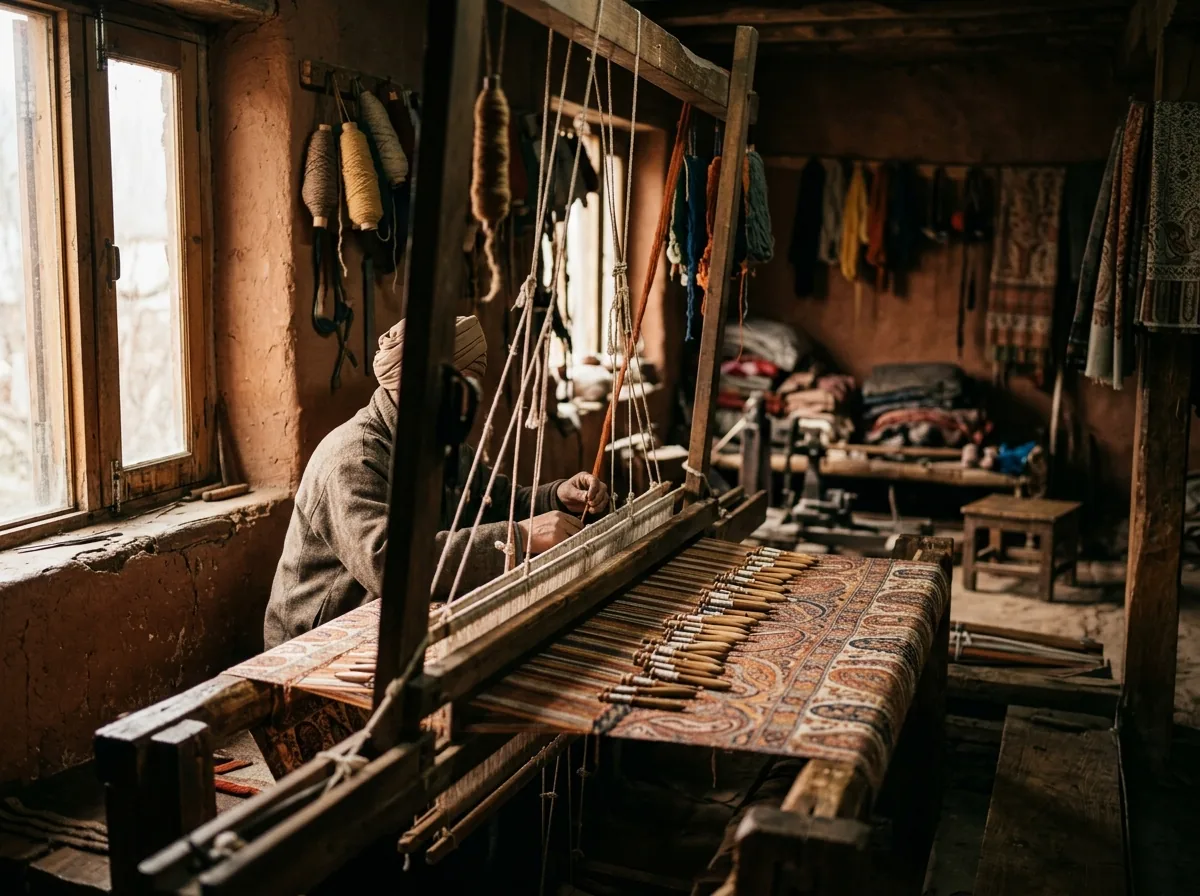
Kani weaving, sometimes called the woven tapestry of the Himalayas, takes its name from the Kashmiri word for the small wooden or cane stick, the kani, that substitutes for the conventional shuttle. There is no single flying shuttle here. Instead, each colour in the design is carried by its own individual bobbin, called a tojli, and the weaver interlaces them one horizontal line at a time, following a handwritten code called a talim. The talim is itself a document of extraordinary precision, a notated script that translates a complex floral or paisley pattern into numerical instructions, so that the weaver reads the loom as a musician reads a score.
The result is cloth that has no right side and wrong side in the conventional sense. Turn a fine Kani shawl over and the reverse is nearly as pristine as the face, the floats clipped short, the construction almost architectural. This quality, which the trade calls a double-sided weave, is not an accident of technique but a statement of intention. Kani weaving does not perform. It simply is.
Kanihama and the Geography of Mastery
The village of Kanihama, situated in the Budgam district of the Kashmir Valley, is considered the heartland of Kani weaving. It is a modest place by any measure, its houses close-set against the cold, its lanes quiet in the way that villages built around a single absorbing craft tend to be. Families here have been weaving Kani for generations, and the knowledge travels not through formal institutions but through proximity, through watching a father decode a talim, through learning to read the rhythm of the tojli before one is old enough to understand the pattern it creates.
Beyond Kanihama, pockets of Kani skill persist in Pampur, better known for its saffron fields, and in parts of Pulwama district, where some weaving families have practised the craft alongside agriculture for as long as anyone in the community can recall. The broader Kashmiri weaving economy also includes the Shawl Weavers of the Karfew area of Srinagar, though the handloom Kani tradition remains most concentrated in the rural Budgam belt.
What distinguishes this geography is not merely location but ecology. The cold of the Kashmir Valley is essential. Pashmina, the fibre most associated with fine Kani weaving, comes from the Changthangi goat of Ladakh, combed not sheared during the spring moulting. The fibre travels from the Changthang plateau to the valley, where the moist, cool air keeps it pliable enough to work at the extreme fineness that Kani demands. Attempt the same weave in a drier climate and the yarn snaps. The valley does not merely host this craft. It makes it possible.
The Talim: A Score for the Loom
Every Kani shawl begins not with thread but with marks on paper. The talim is the master document, and its creation is a specialised calling in its own right. A talim guru, sometimes the master weaver himself and sometimes a separate craftsperson, translates a painted or drawn design into a line-by-line numerical code. Each entry in the talim tells the weaver which tojli to bring forward, which to hold back, and precisely how many warp threads each coloured bobbin must travel across before yielding to the next.
A single shawl can require a talim of several thousand lines. A complex pattern with many colours might use forty or more bobbins at a single point in the weave, each one being passed through the shed in a specific order, the weaver's fingers moving with the particular confidence that comes only from years of embodied practice. Errors in reading the talim create visible mistakes in the cloth, and unlike a painted canvas, a weaving cannot be corrected by painting over. The only remedy is to unweave and begin again.
This vulnerability to error is, paradoxically, what makes the finished textile so extraordinary. Every square centimetre of a Kani shawl is a decision that was made, held, and executed correctly. The pattern you see is a record of attention sustained across days and months of uninterrupted concentration. To wear a Kani shawl is to wear the accumulated focus of another human being, pressed into fibre, line by careful line.
Time Woven In: The Multi-Year Saree
The vocabulary of Indian fashion has grown comfortable with the idea of the handloom saree as a labour-intensive object, and rightly so. But the Kani weave saree exists in a category that challenges even seasoned textile lovers to recalibrate their understanding of what making something by hand truly means.
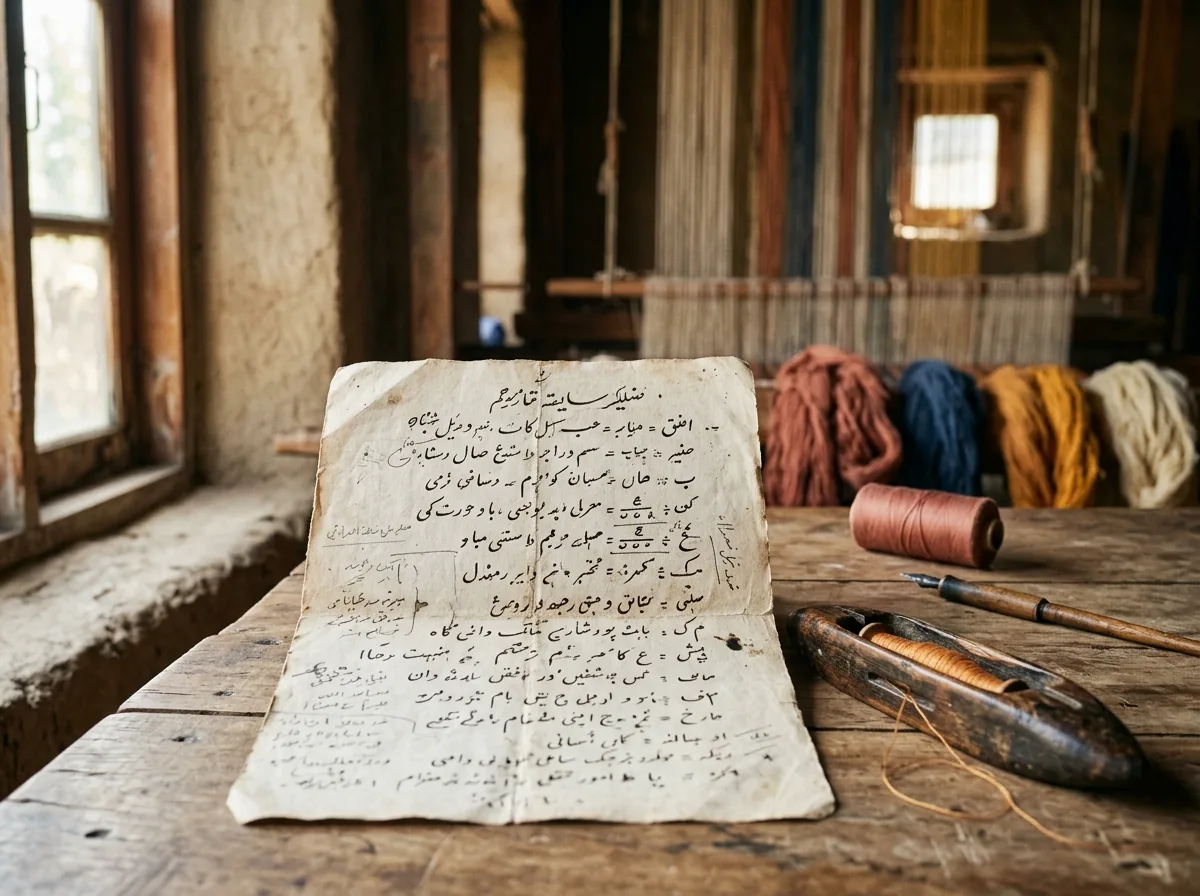
A Kani shawl of moderate complexity, measuring roughly two metres by one metre, can take a skilled weaver between three months and a year to complete. A Kani saree, which at six metres is three times the length and typically demands an all-over field pattern rather than the bordered simplicity possible on a shawl, can occupy a weaver, or a pair of weavers working a single loom in alternating shifts, for two to four years. Some of the grandest documented pieces, with dense floral jals covering the full field, have taken longer.
This is not metaphor. This is arithmetic. A weaver produces perhaps four to six centimetres of woven cloth per day on a complex Kani saree. At five centimetres a day across three hundred working days a year, a six-hundred-centimetre saree requires a minimum of four hundred working days, and that assumes no errors, no reworking of the talim, and no interruptions from the cold months when even the valley's moist air cannot protect the Pashmina from brittleness.
The implication for the wearer is one that genuine textile culture takes seriously: such a saree is not a seasonal purchase. It is an inheritance that happens to arrive new. It will outlive the occasion for which it was bought and very probably the person who bought it.
Motif and Memory: The Language of the Buta
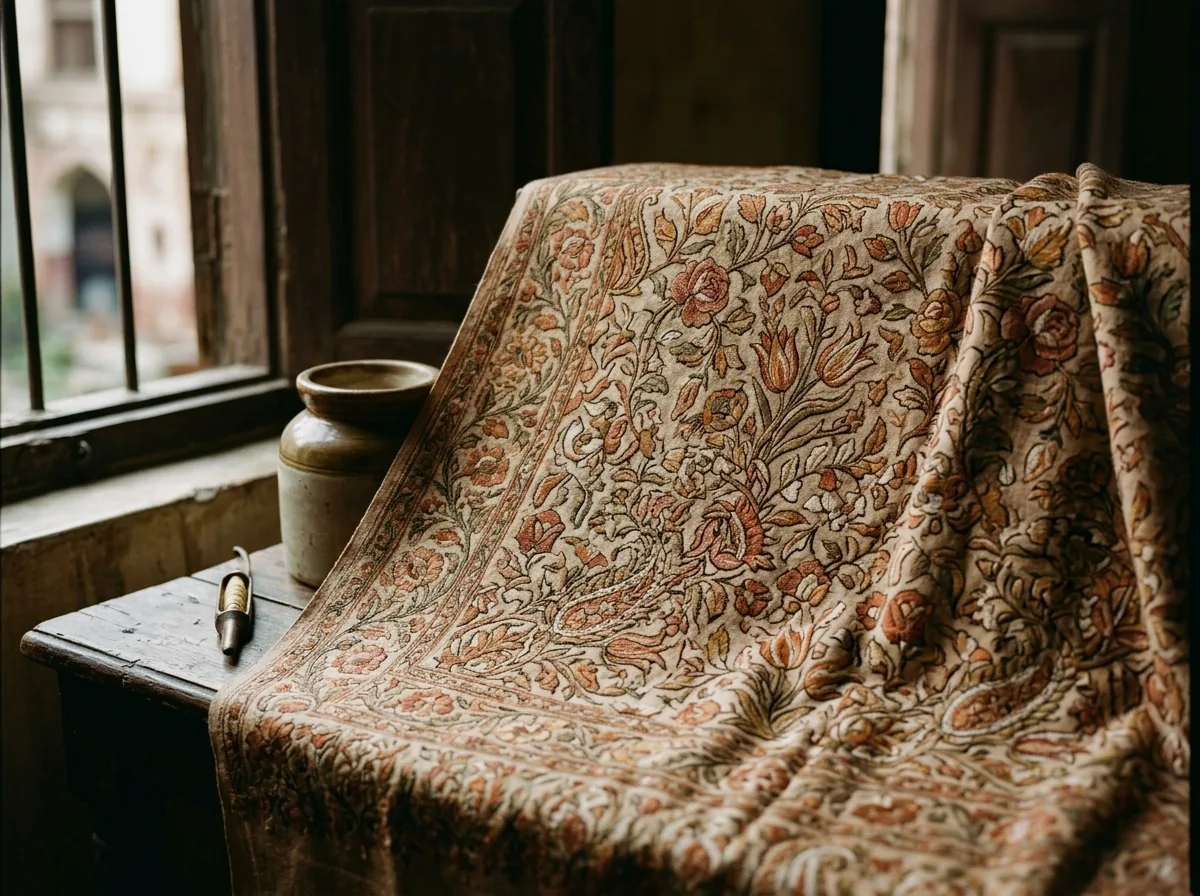
To look closely at a Kani weave is to encounter a vocabulary of form that is centuries old and yet remains immediately legible. The buta, the single detached motif most often described in Western textile scholarship as the paisley, is the primary unit of Kani patterning. But calling it a paisley is a little like calling a ghazal a rhyming couplet. The term captures the outline and loses the interior entirely.
In its Kashmiri form, the buta is a universe in miniature. Within the curving teardrop body, a skilled talim guru and weaver will render a chinar leaf, a lotus blossom, a cypress silhouette, and sometimes an entire garden of sub-motifs rendered in thread so fine that the eye requires stillness to read them fully. The butadar shawl, one filled with repeating buta arrangements, and the jaldaar shawl, where the motifs connect into a continuous lattice or jal, represent two distinct compositional traditions, each with its own talim conventions and its own place in the hierarchy of Kani production.
Colours in Kani weaving were historically derived from natural sources: walnut husks for warm browns, indigo for the deep blues that shimmer slightly differently from the chemically dyed versions that followed. Contemporary Kani weavers in Kanihama work in both traditions, with some producers maintaining natural dye practice and others using carefully chosen synthetic dyes selected for colorfastness and compatibility with Pashmina's particular lustre.
A Living Craft, A Quiet Continuity
It would be easy, and fashionable, to frame Kani weaving as a craft in crisis. Easier still to note the migration of younger Kashmiris toward other livelihoods, the competition from power-loom imitations that are sold in the same markets and sometimes in the same breath as hand-woven pieces. These are real pressures, and people within the weaving community speak of them plainly.
But Kani weaving also has something that many threatened crafts do not, which is an aesthetic that cannot be convincingly replicated at speed. The machine-made Kani-inspired shawl, for all its improved sophistication, lacks the slight irregularity of the hand-guided tojli, the almost imperceptible variation in tension that gives a hand-woven piece its particular warmth under the fingers. Those who have handled both tend to know the difference immediately, and that difference is not nostalgia. It is evidence.
Families in Kanihama continue to decode their talims each morning. The cane bobbins are still carved and distributed. Children still grow up watching the loom, absorbing the rhythm before they absorb the theory. The craft endures not because it has been preserved in amber but because the people who carry it have found, generation after generation, that it is worth the extraordinary commitment it demands. A Kani weave, more than almost any other textile tradition in South Asia, makes you feel the weight of that commitment. Not as burden, but as gift.