The hand that holds the kalam holds the river, the root, the god.
The Kalam and Its Covenant
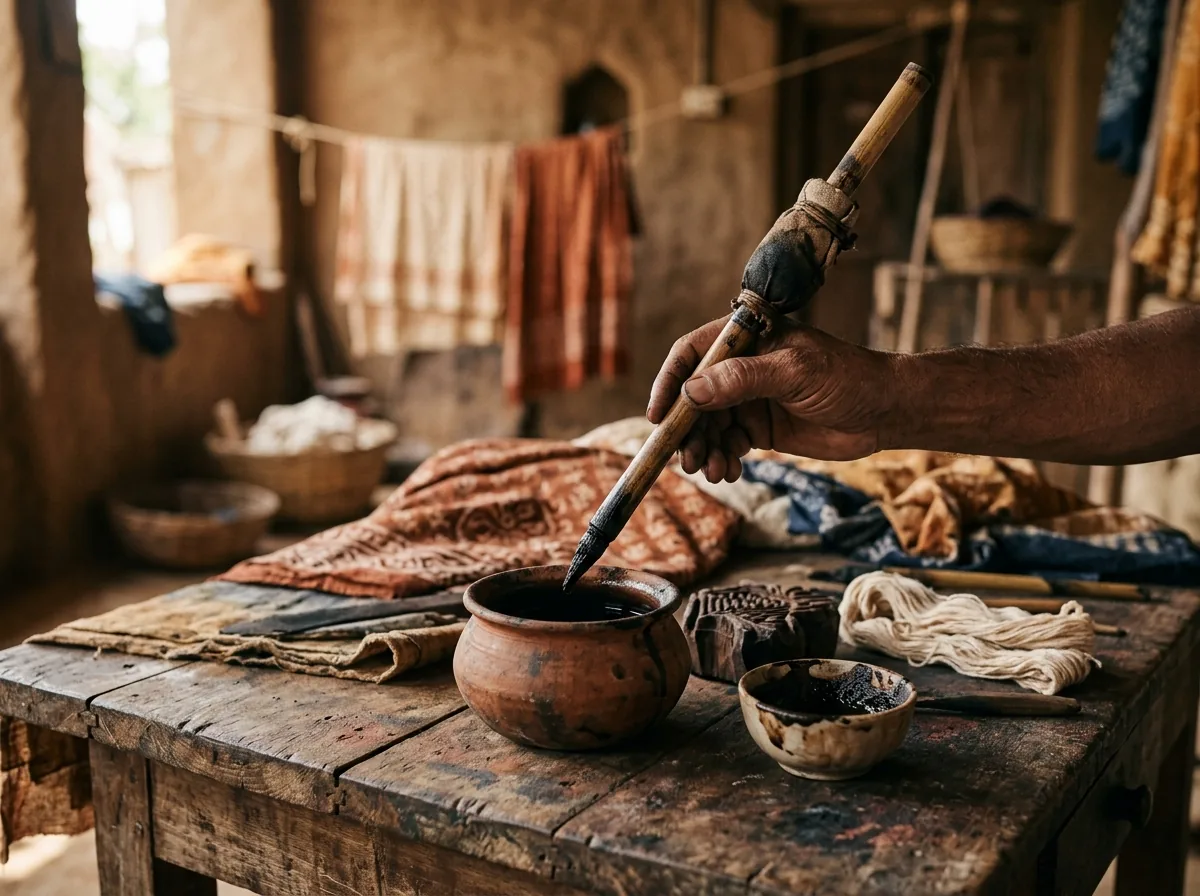
There is a particular kind of patience that does not announce itself. It settles into the body like breath, like the slow darkening of cloth in a fermentation vat. In Srikalahasti, a temple town on the banks of the Swarnamukhi river in Andhra Pradesh, this patience has a name: kalamkari. Translated literally, it means the work of the pen. But translation, as always, loses something essential. The kalam is not merely a pen. It is a bamboo stylus tipped with hair or wool, held like a prayer, dipped into mordants that have been coaxed from iron filings left to rust in jaggery water for weeks. What the kalam draws, the cloth receives. What the cloth receives, it does not easily forget.
The Srikalahasti tradition is one of two great kalamkari lineages in Andhra Pradesh, the other being Machilipatnam, a coastal town whose block-printed textiles carry their own distinct character. Srikalahasti is entirely freehand. No block, no stencil, no mechanical repetition. Every line is the direct consequence of a single artist's concentration, and the tradition has been sustained over centuries by a community of craftspeople known as the Kalamkari Chitrakars, Hindu artisans who historically worked in devotional service to the Srikalahasti Shiva temple, producing large narrative panels to be displayed during festivals. The relationship between the temple and the textile was not commercial. It was covenantal, a form of offering made in colour and story.
The Grammar of Natural Dye
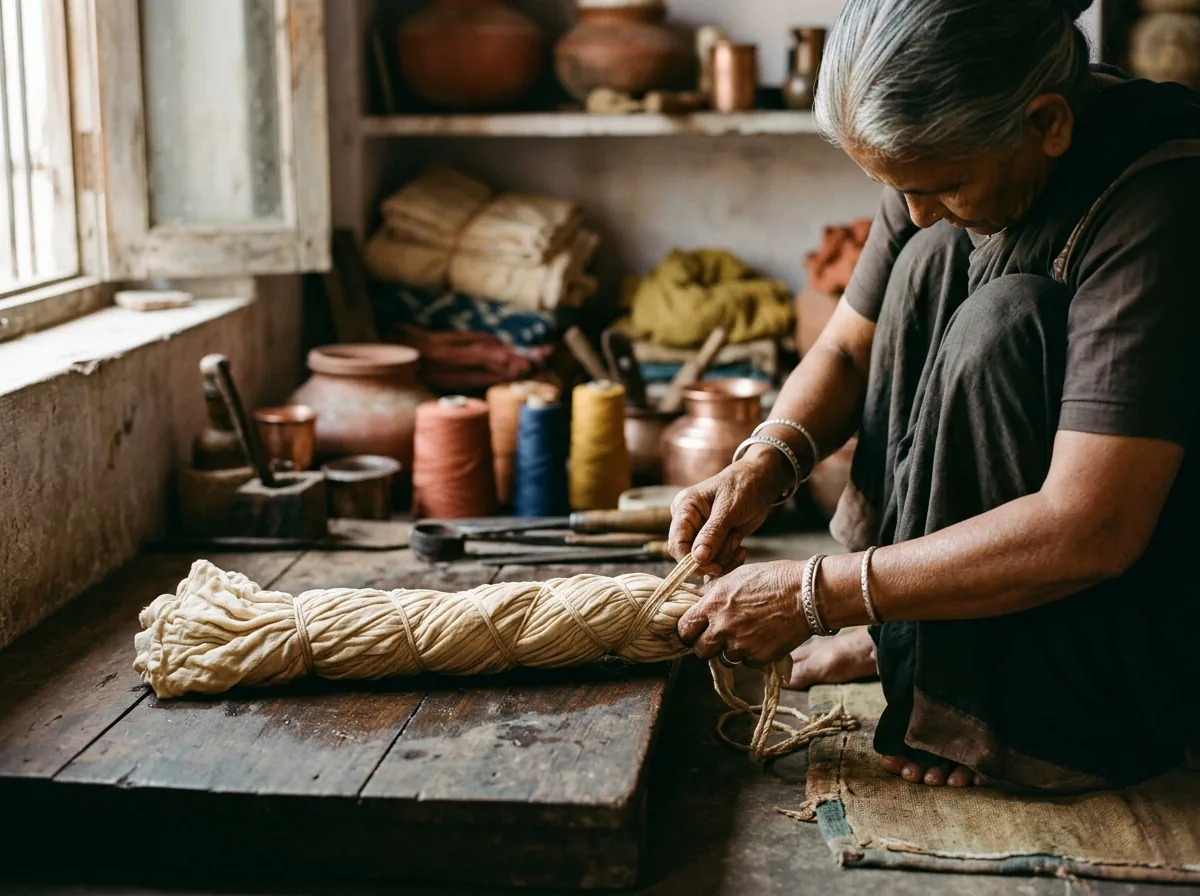
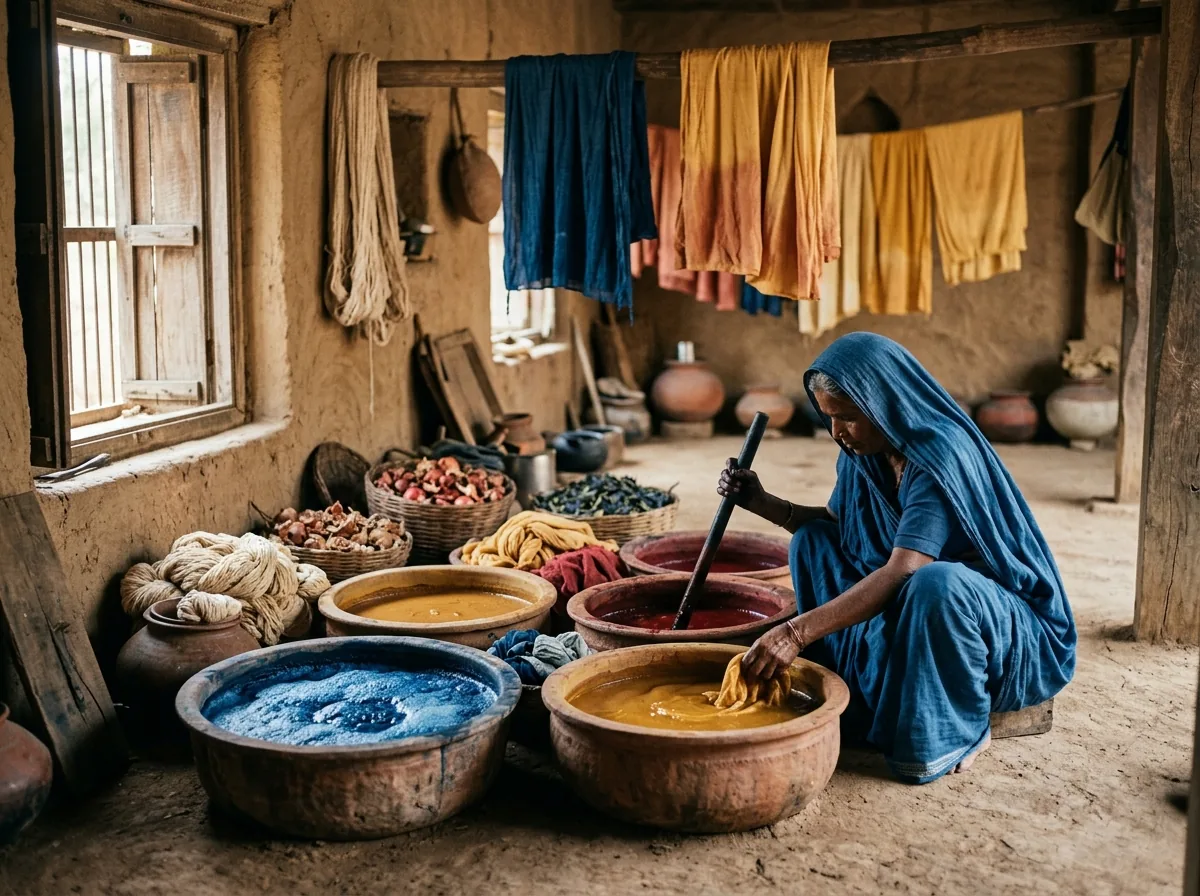
To understand kalamkari, one must first understand the preparation of cloth, because in this tradition the fabric is as much a participant as the artist. Raw cotton, usually a fine handwoven variety, undergoes a sequence of treatments that would seem, to an uninitiated eye, almost alchemical. The cloth is soaked in a solution of myrobalan, the astringent dried fruit of the Terminalia chebula tree, known across South Asia as haritaki or kadukkai. Myrobalan is a tannin-rich mordant, a substance that opens the fibre's molecular structure and allows it to receive and hold colour. Without this step, natural dyes would sit on the surface of cloth and fade within a season.
After myrobalan, the cloth is treated with a milk-and-water solution, then sun-dried on the banks of the Swarnamukhi. The river itself is part of the process. Rinsing in running water at various stages brightens and fixes colour. Alum dissolved in water serves as the primary mordant for reds, drawn from the roots of the Rubia tinctorum plant, the madder vine. Iron-rich liquid, prepared by fermenting scrap iron with jaggery and water over many weeks, functions as a mordant for blacks and outlines. When the same dye is applied over an alum-treated area, it turns red. Over an iron-treated area, it turns black. The artist, who must hold this chemistry in their hands while also holding a story in their imagination, is a kind of scientist-poet, working in a language where the variables are living and seasonal.
Indigo comes later, applied cold in a reduction vat, and it blooms blue against the warmth of the madder reds. Yellow derives from pomegranate rind. Green is achieved by layering indigo over yellow, a secondary colour requiring two separate applications and two separate rounds of patience.
A Saree as Scripture
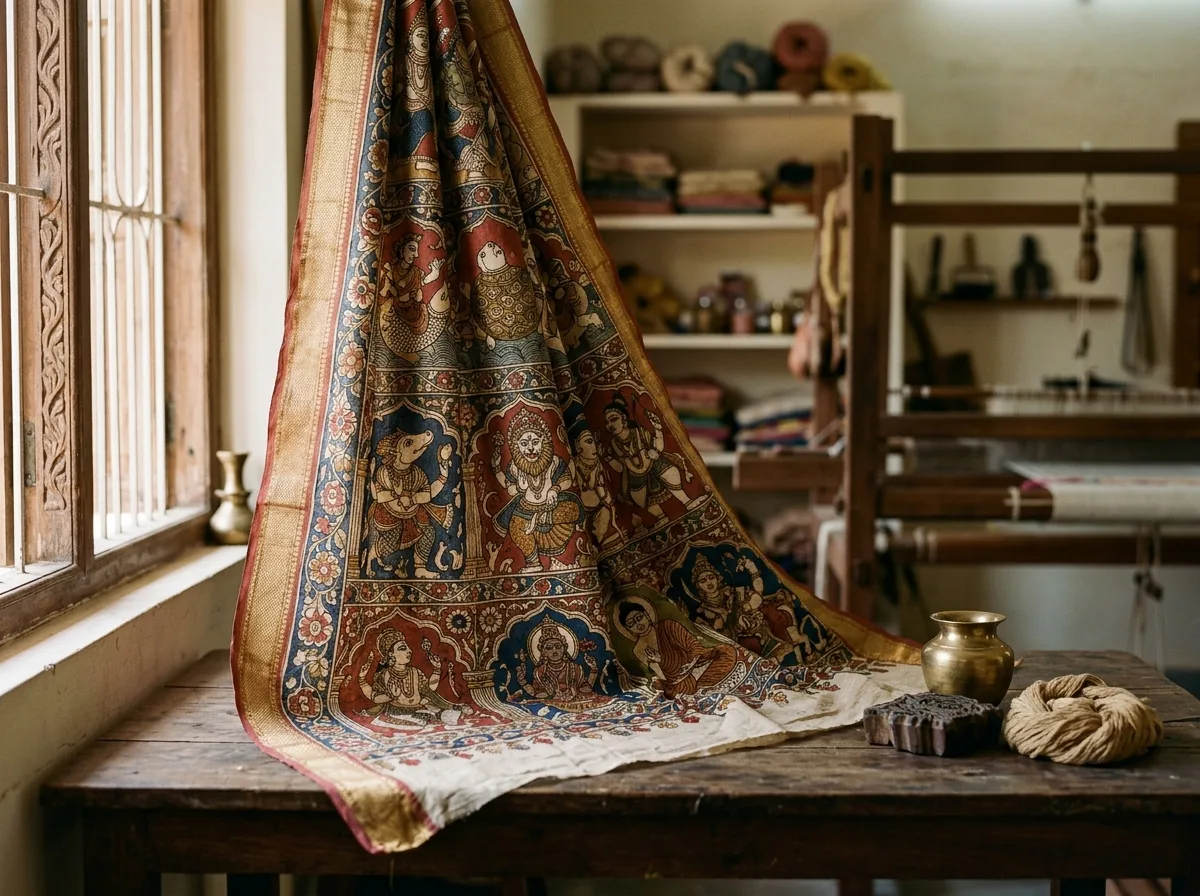
The narrative tradition of Srikalahasti kalamkari draws directly from Hindu devotional literature: the Ramayana, the Mahabharata, the Bhagavata Purana, the stories of the Shaiva saints. When this tradition migrated from temple panels to wearable cloth, the saree became a new kind of surface for these inherited stories. A six-yard length of fabric offered a continuous field, and the Chitrakar artists began to arrange their narratives accordingly, placing panels of story along the border, devotional motifs in the pallu, and fine floral or peacock-derived repeats across the body of the cloth.
The decision of what story to tell was rarely random. A saree made for a wedding might carry scenes of Rukmini's swayamvara, the moment of her choosing Krishna, or the celestial wedding of Shiva and Parvati on Mount Kailash. A saree made for a devotee of Vishnu might carry the Dashavatara, the ten incarnations rendered in ochre, madder red, and indigo blue across the pallu. The convention of framing, the way each narrative scene is bordered by a thin black kalam line, relates directly to the conventions of manuscript illustration and temple mural painting. The Chitrakar artist was trained in these conventions, not through formal schooling in most cases, but through years of watching and working alongside a senior member of the family or community.
This is how style is transmitted in living craft traditions: not as doctrine, but as absorption. The way a line curves around a deity's crown, the particular fullness given to a lotus petal, the angle at which an archer's bow is drawn, these are inherited decisions, carried in the hand.
The Swarnamukhi and the Ritual of Rinsing
The town of Srikalahasti sits approximately 36 kilometres from Tirupati in the Chittoor district of Andhra Pradesh. Its identity has been shaped by the presence of the Srikalahasteeswara temple, one of the Pancha Bhuta Stalas, the five Shiva temples associated with the five elements. This temple is the home of Vayu, the element of air, and the flame kept inside the sanctum is said to tremble in an invisible wind even when the stone doors are sealed. The town that grew around this temple became, over time, a centre of both pilgrimage and production.
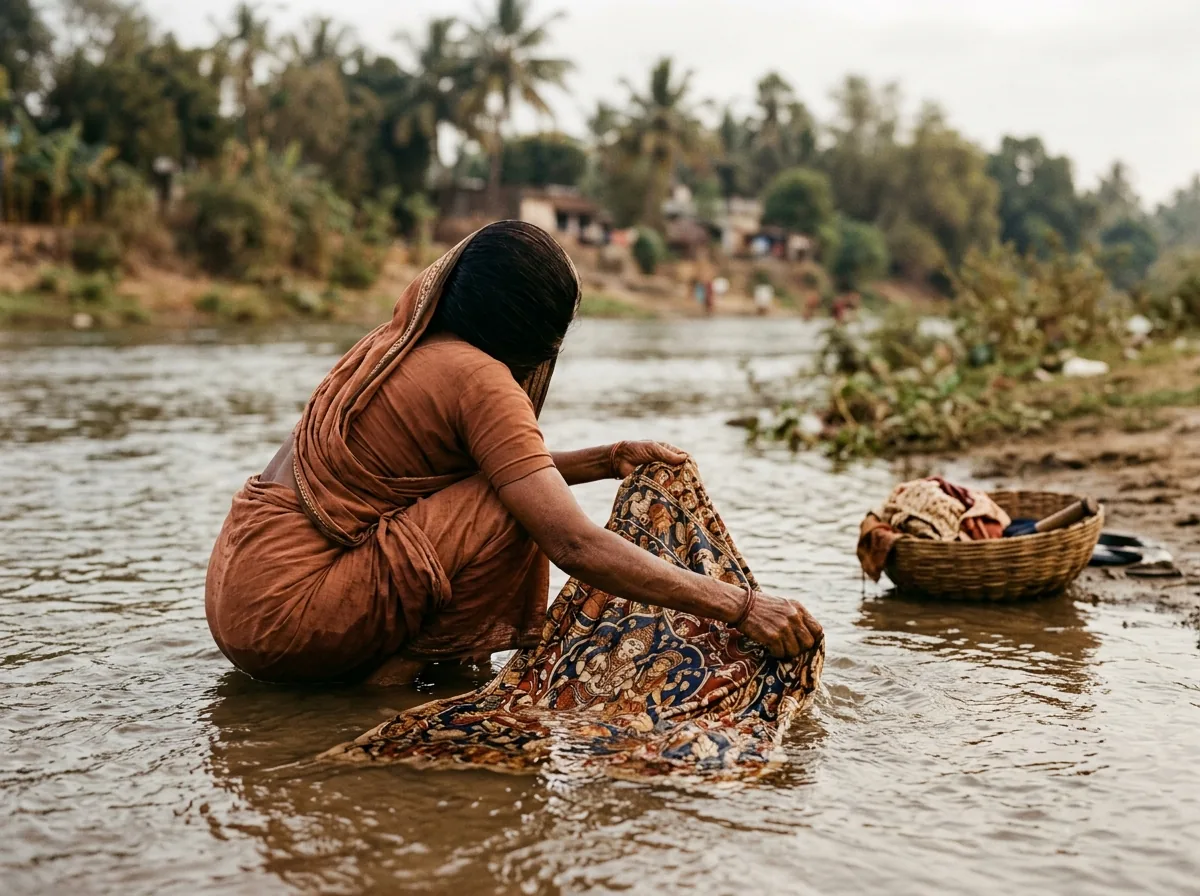
The Swarnamukhi river, whose name means golden-faced, is not a wide or spectacular river. It is a modest, seasonal river of the Deccan, and it is entirely essential to the kalamkari process. Craftspeople carry their cloth to its banks repeatedly during production. The rinsing that happens at the river is not merely practical. It is the step that reveals. A cloth heavy with mordant and dye is submerged in clear flowing water, and what emerges is often surprising: a brightness that the vat did not predict, a softening of outline, a deepening of contrast. The river is the final editor of colour.
This intimacy between craft and geography, between the specific quality of one river's water and the character of a finished textile, is what makes Srikalahasti kalamkari irreplaceable in the way that a particular terroir makes a wine irreplaceable. Replicate the dyes, replicate the kalam, replicate the motifs, and something will still be absent: the particular mineral quality of this water, the light of this riverbank, the hands that have worked within this specific inheritance.
What the Collector Understands
A saree in the Srikalahasti kalamkari tradition is not a fast acquisition. It does not ask to be bought quickly or worn once and set aside. It accumulates meaning with time, in the wearing, in the recognition of a story detail that the wearer had not noticed on first examination, in the slow deepening of colour that natural dyes develop after repeated gentle washing and sun exposure. This quality, of revealing itself gradually, is part of what draws collectors to the tradition.
The collector of kalamkari tends to be someone who has developed a habit of looking. They will notice that the outline of a figure's hand has been drawn with extraordinary sureness, a single kalam line with no hesitation and no correction, because correction is not possible in this technique. They will notice the difference between a piece in which the natural dye palette has been rigorously maintained and a piece in which chemical shortcuts have been introduced, usually visible in a harshness of red or an opacity in the blue that natural indigo does not possess. Learning to read these differences takes time, and the tradition rewards the investment.
Communities of Chitrakar artists in and around Srikalahasti continue to work in the traditional method, though the pressures on them are familiar: the expense and labour intensity of natural dye preparation, the competition from printed imitations, the difficulty of communicating the value of process to a market accustomed to valuing only product. Those who seek out authentic pieces support not only an aesthetic tradition but a living relationship between story, geography, and hand.
Wearing a Cosmology
There is something quietly radical about wearing a garment that carries a complete narrative tradition on its body. The woman who drapes a Srikalahasti kalamkari saree is not simply choosing a textile. She is choosing to carry on her skin a cosmology: the battles of dharma, the devotion of lovers separated by exile, the playfulness of gods who took animal form to restore balance to a world that had lost it.
The colour of the cloth has come from roots and bark and fermented iron. The line has come from a hand trained over years in a town beside a river whose water is part of the cloth's own making. The story has come from texts that predate the printing press by centuries. When all of this converges in a single six-yard length of cotton, the word saree becomes insufficient. What you hold is closer to a manuscript. What you wear is closer to a temple wall made soft and portable, brought down from stone into cloth, from permanence into the intimate dailiness of a draped body. That this is possible at all remains one of the quieter miracles of Indian craft.