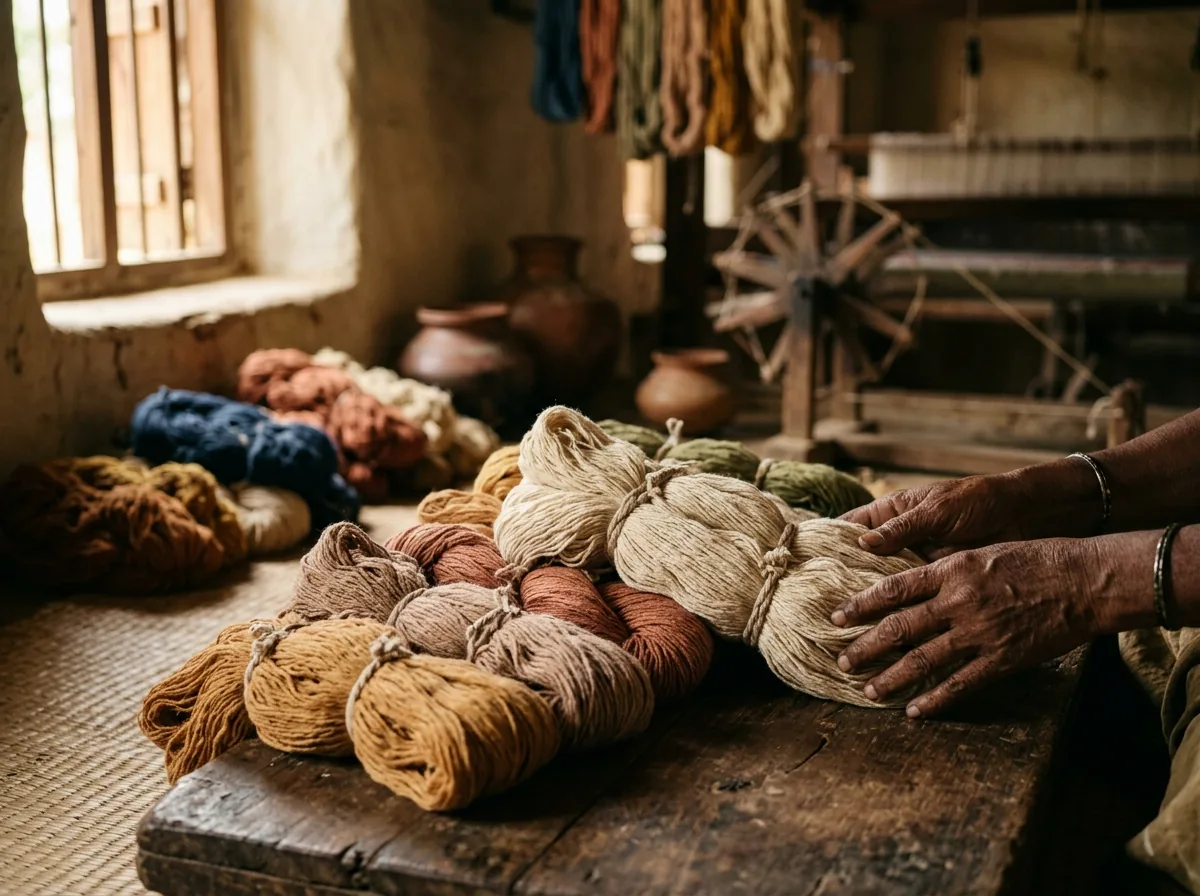
Thread remembers what the eye cannot yet see.
The Grammar of Resistance
There is a moment, somewhere in the middle of a Pochampally workshop, when the logic of ikat becomes almost philosophical. The yarn has been stretched, bound, and submerged in dye. It has been unbound, re-stretched, bound again. And now, coiled on the loom, it holds within itself a pattern that no one can yet read. The weaver works from memory and mathematics, from inherited rhythm and practised instinct. The cloth does not yet exist, but the cloth already knows what it will become.
This is the essential paradox of ikat, and it is one of the oldest textile technologies in the world. Unlike embroidery, which builds image upon existing cloth, or block-printing, which applies pattern to finished fabric, ikat encodes its geometry into the very fibre before a single shuttle has passed through. The resist-dyeing happens upstream, at the level of individual threads. The weaving is, in a very real sense, a revelation rather than a construction.
The word itself is borrowed from the Malay-Indonesian term mengikat, meaning to bind or to tie. But the craft in India has roots that predate colonial cartography, woven into the domestic economies of particular villages, particular families, particular looms. To speak of ikat in India is to speak of at least two distinct and magnificent traditions, each with its own geography, its own dye logic, its own community of weavers who have kept the language alive across generations of economic pressure and changing fashion.
To understand ikat is to understand that textiles are not merely decorative. They are documentary. They hold knowledge in the way that manuscripts do, quietly, without announcement.
Pochampally: Geometry at the Speed of Thought
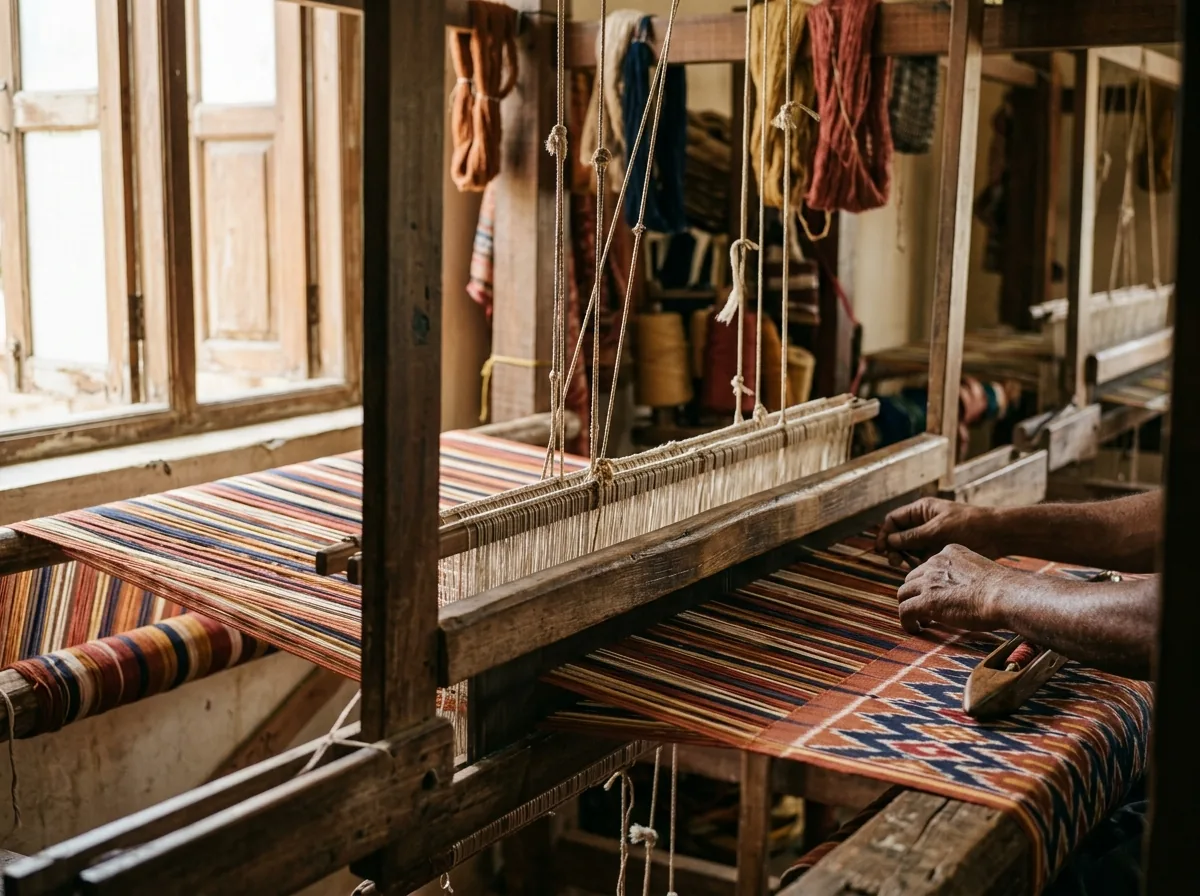
The town of Pochampally sits about fifty kilometres from Hyderabad, in the Nalgonda district of Telangana. It is not a large place, but it carries an outsized reputation in the world of handloom. The streets here have a particular sound in the morning hours, the clatter of pit looms reaching out from open doorways, and it is impossible to walk through the weaving quarters without understanding that cloth-making here is not a boutique pursuit. It is a way of life, a collective inheritance passed between generations of weavers from the Padmasali and Devanga communities, among others.
Pochampally ikat is celebrated for its double ikat, a technique in which both the warp and the weft threads are resist-dyed before weaving, and then aligned with extraordinary precision on the loom so that the patterns on each axis interlock to form a single, unified image. Elsewhere in the world, double ikat is produced in only a handful of locations: the Patola silks of Patan in Gujarat, the geringsing cloths of Tenganan in Bali. The rarity of the technique is not accidental. It demands a spatial intelligence that defies easy description, the ability to hold an entire geometric schema in the mind and transfer it, thread by thread, into physical reality.
The characteristic motifs of Pochampally are angular and exact: diamond grids, interlocking chevrons, stepped borders that recall the geometric vocabularies of temple architecture. Colours tend toward the saturated and the contrasting, turmeric yellows and deep indigos, brick reds against ivory, though contemporary weavers have expanded the palette to include softer gradations that appeal to a changed market without abandoning the structural rigour that defines the tradition.
In 2007, Pochampally ikat received a Geographical Indication tag, a legal recognition of its regional origin. The GI tag matters, but the weavers themselves are the keepers of authenticity, not the paperwork.
Sambalpuri: The Sacred Weave of Western Odisha
Travel north-east from Hyderabad, cross the plateau of the Deccan, and descend into the river valleys of western Odisha, and you arrive in a different ikat country entirely. The Sambalpuri tradition takes its name from Sambalpur, the cultural and commercial centre of this region, though the actual weaving occurs across a wider geography: in the towns of Sonepur, Bargarh, and Boudh, and in the villages that surround them, where weaver communities including the Bhulia, Meher, and Kostha families have practised their craft for centuries.
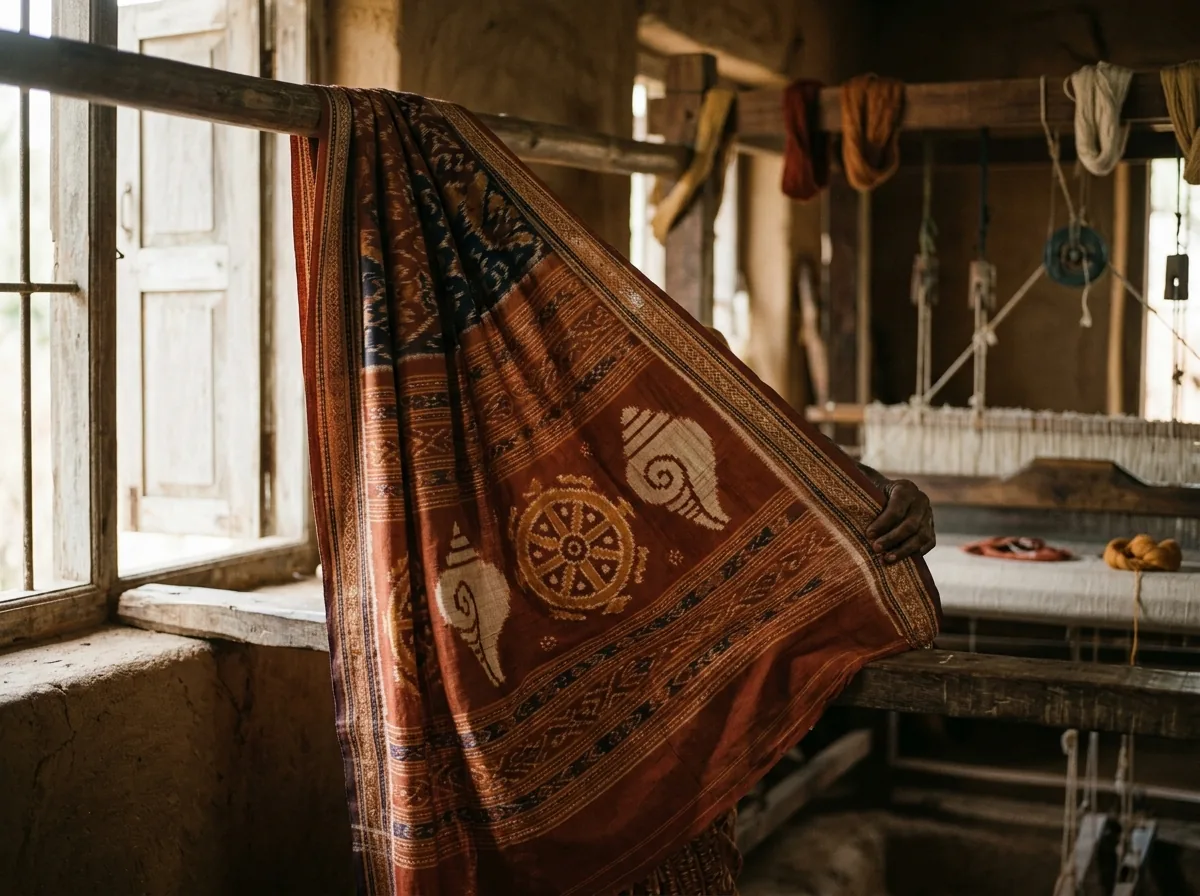
Sambalpuri ikat is, in the main, a single and warp-ikat tradition, though double ikat pieces are produced for special occasions and ceremonial use. What distinguishes it immediately from Pochampally work is its vocabulary of motifs, which are drawn not from abstract geometry alone but from a rich symbolic repertoire connected to Odishan religious life. The shankha (conch shell), the chakra (wheel), the phula (flower), the deer, the fish: these are not merely decorative elements. They carry associative meaning, and their appearance on cloth situates the wearer within a particular cultural and spiritual landscape.
The silk and cotton sarees woven here are worn at weddings and festivals, presented as gifts at significant life transitions. A Sambalpuri Bandha saree, as it is locally known, is not purchased casually. It is chosen with the knowledge that its patterns speak a language shared by the community, that the cloth is a form of communication as much as it is a garment.
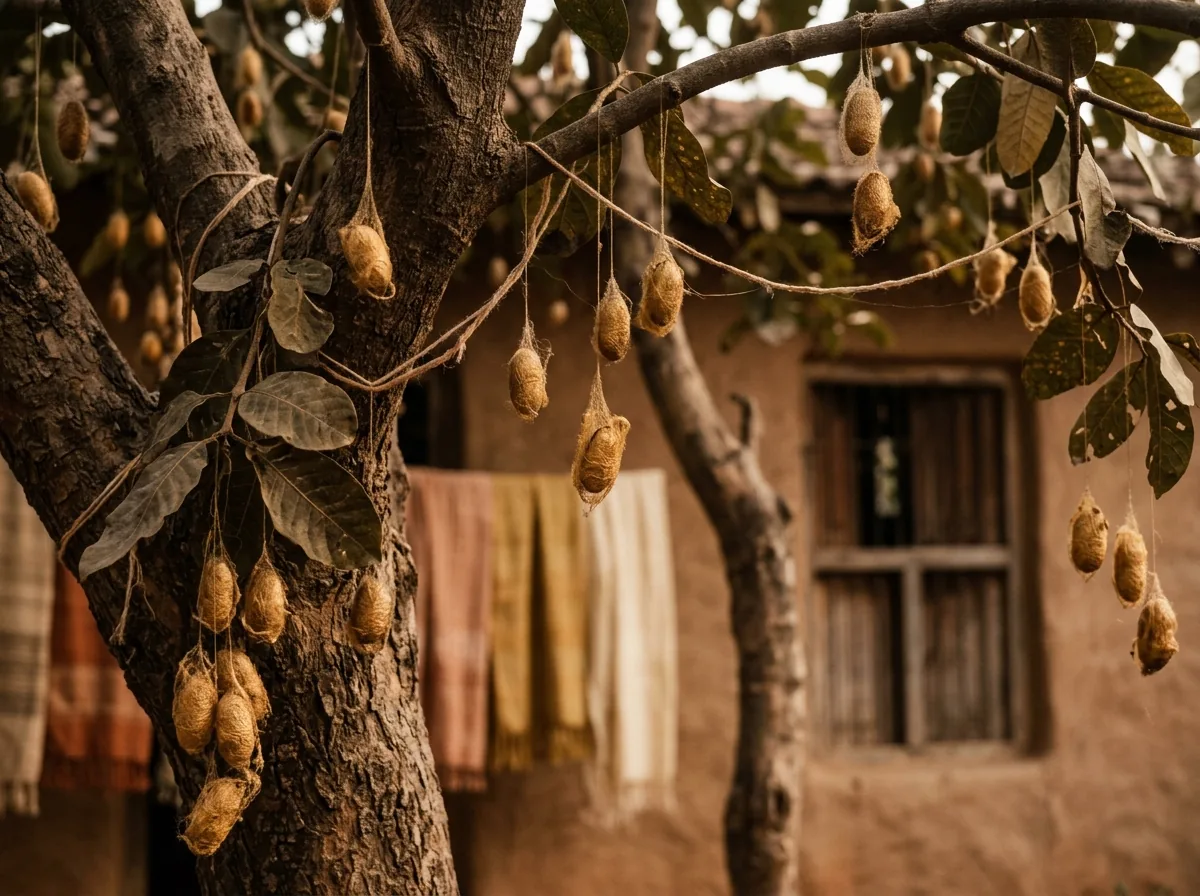
The yarn used here is often a natural-dyed cotton or a tussar silk sourced from the forests of Odisha, a reminder that ikat in this region is embedded in a larger ecology, one that includes the mulberry and non-mulberry silkworm traditions of the tribal heartland.
The Binding and the Dyeing: A Technical Poetry
To appreciate ikat fully, one must spend some time with the process itself, because the process is where the art lives. Before a single thread meets the loom, weeks of preparatory work have already shaped the final cloth.
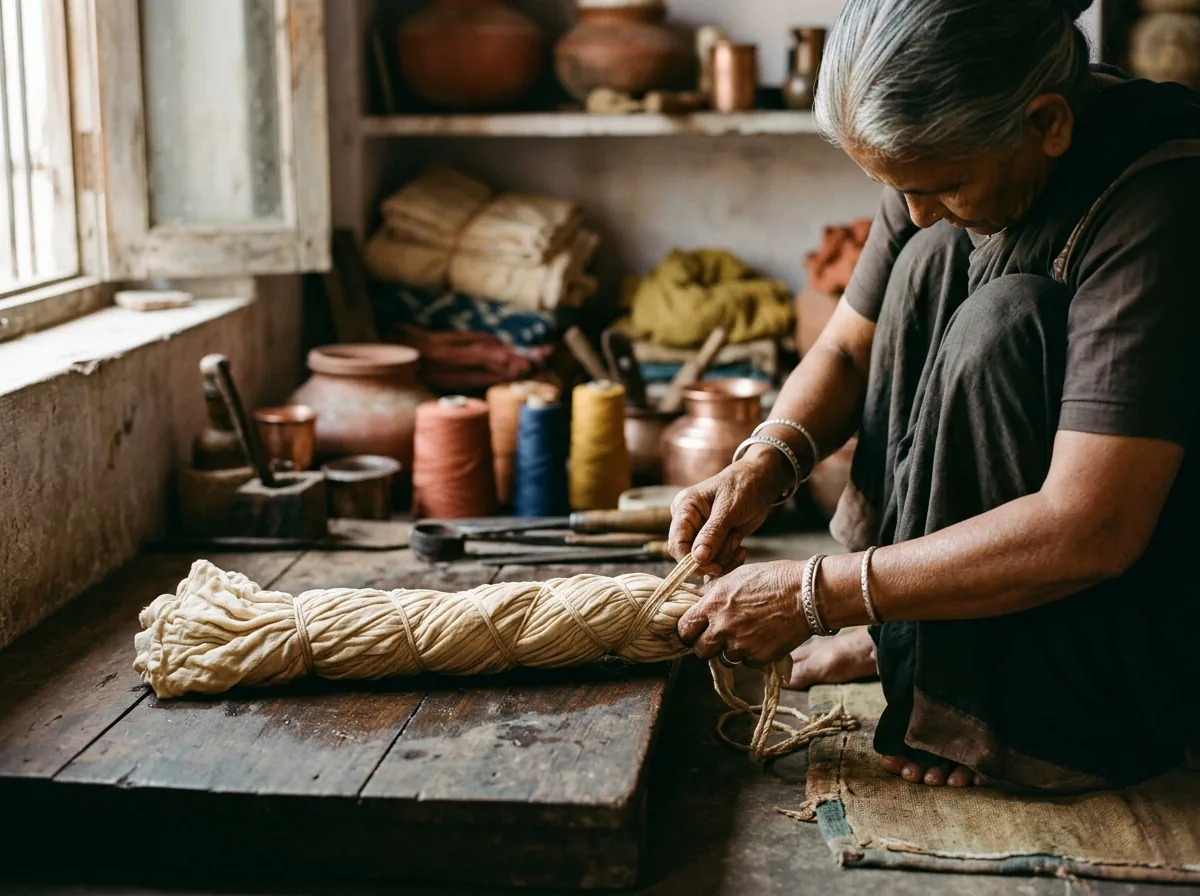
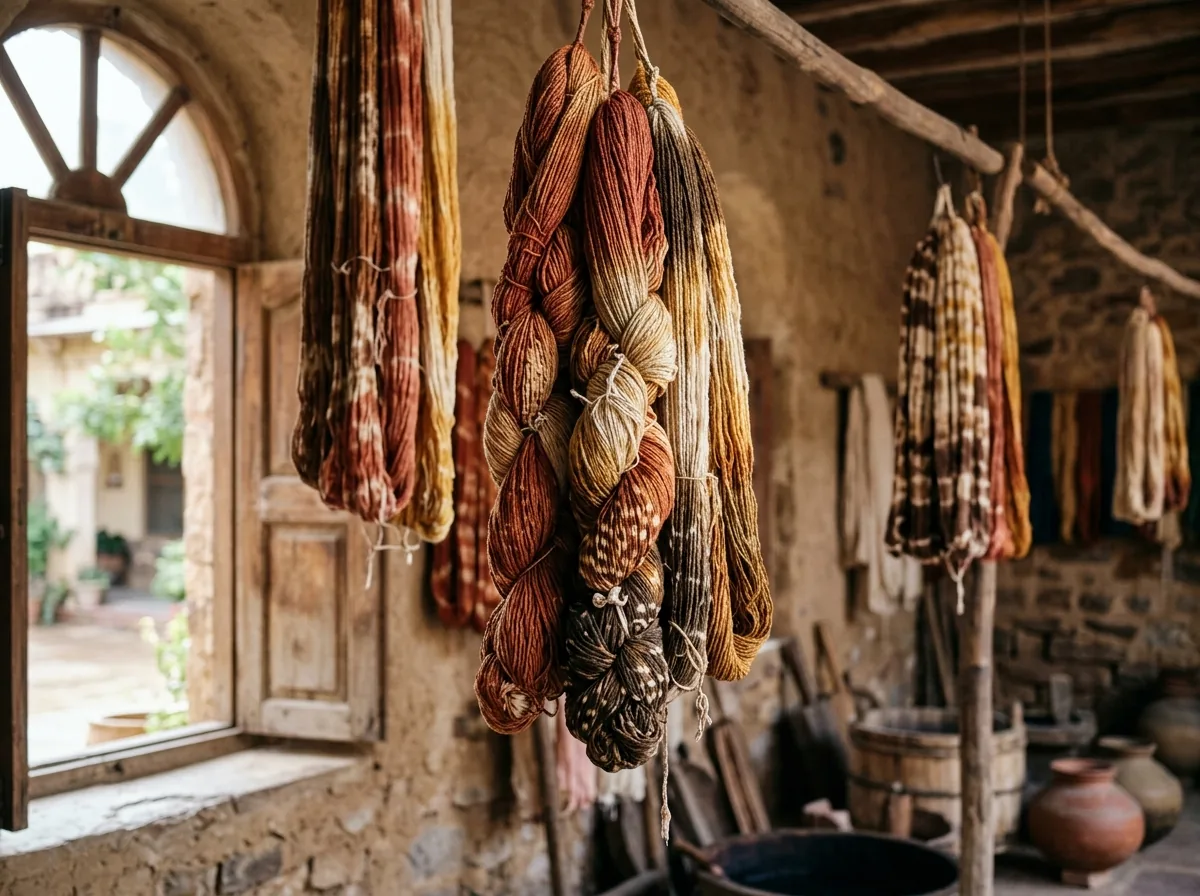
The yarn, whether cotton or silk, is first wound onto a frame in calculated lengths corresponding to the finished measurements of the cloth. The master craftsperson, working from either a drawn template or a memorised design, then identifies and marks which sections of each bundle must resist the dye, and these sections are bound tightly with strips of plastic or, in older practice, with banana fibre or palm leaf. The bound yarn is submerged in the first dye bath. After drying, some bindings are removed, others are added, and the yarn enters a second bath. This process repeats across as many dye cycles as the design requires.
The extraordinary difficulty is this: the binding must be placed with absolute precision, because the error does not announce itself until the weaving begins. There is no erasing, no correcting mid-process. The dyer-weaver must carry the finished pattern in the mind through every stage of preparation, trusting that the arithmetic of resist placement will resolve, eventually, into the image anticipated. This is why the craft is sometimes called the blind weave. The pattern is invisible until the moment of revelation on the loom.
It is also why ikat cloth has a characteristic soft-edged quality, a gentle blurring at the boundaries of each colour field. This is not imperfection. It is evidence of process, the visual record of yarn that was bound and unbound and re-bound by human hands. The slight feathering at the edge of a Pochampally chevron or a Sambalpuri chakra is the signature of the technique itself.
Wearing the Woven Mind
There is something asked of the wearer of an ikat garment that is not asked by other cloths. A block-printed fabric invites admiration of its surface. An embroidered piece displays its labour visibly, stitch by stitch. But ikat requires that the eye look into the cloth rather than merely at it, following the geometry inward, noticing where one colour negotiates its boundary with another, recognising the intelligence encoded in the repeat.
This is clothing as conversation. The Sambalpuri saree worn to a wedding in Odisha carries the weight of community recognition, an implicit acknowledgement that the wearer understands what the motifs mean and respects the hands that produced them. The Pochampally dupatta draped over a contemporary silhouette in a Delhi drawing room makes a different kind of statement: that the wearer values the rigour of the handloom over the legibility of fast fashion, that beauty and process are not separate categories.
For members of the Indian diaspora, ikat often functions as cultural memory made wearable. The geometric vocabulary of Pochampally or the sacred motifs of Sambalpuri can carry a person back to a particular festival, a grandmother's cupboard, a ceremonial occasion remembered through the texture of cloth. This is not nostalgia in the diminishing sense. It is continuity, the experience of being held by something that precedes you and will outlast you.
The best ikat pieces age magnificently. The natural dyes common to both traditions, indigo, pomegranate, lac, turmeric-based yellows, deepen rather than fade, developing a patina that makes the cloth richer at ten years than at one.
A Living Thread
The weaving communities of Pochampally and Sambalpur, of Bargarh and Boudh and Sonepur, are navigating the same pressures that face all handloom traditions in the present moment: the competition of power-loom imitation, the unpredictability of raw material costs, the migration of younger family members toward urban employment. Geographical Indication protections help in principle, though enforcement remains uneven. Designer collaborations have brought new visibility to both traditions, sometimes thoughtfully, sometimes less so.
What endures is the knowledge itself, held in the bodies and memories of weavers who learned by watching and doing, who can calculate resist placement without a calculator, who understand colour as a sequence of decisions made under uncertainty. This knowledge is not archival. It is living, which means it is also vulnerable, and also capable of renewal.
Ikat asks us to consider that the most sophisticated things are sometimes the least legible on the surface. That constraint, the binding of thread, the resistance to dye, is the condition of creativity rather than its obstacle. That what the eye cannot yet see is sometimes exactly what the hand already knows.