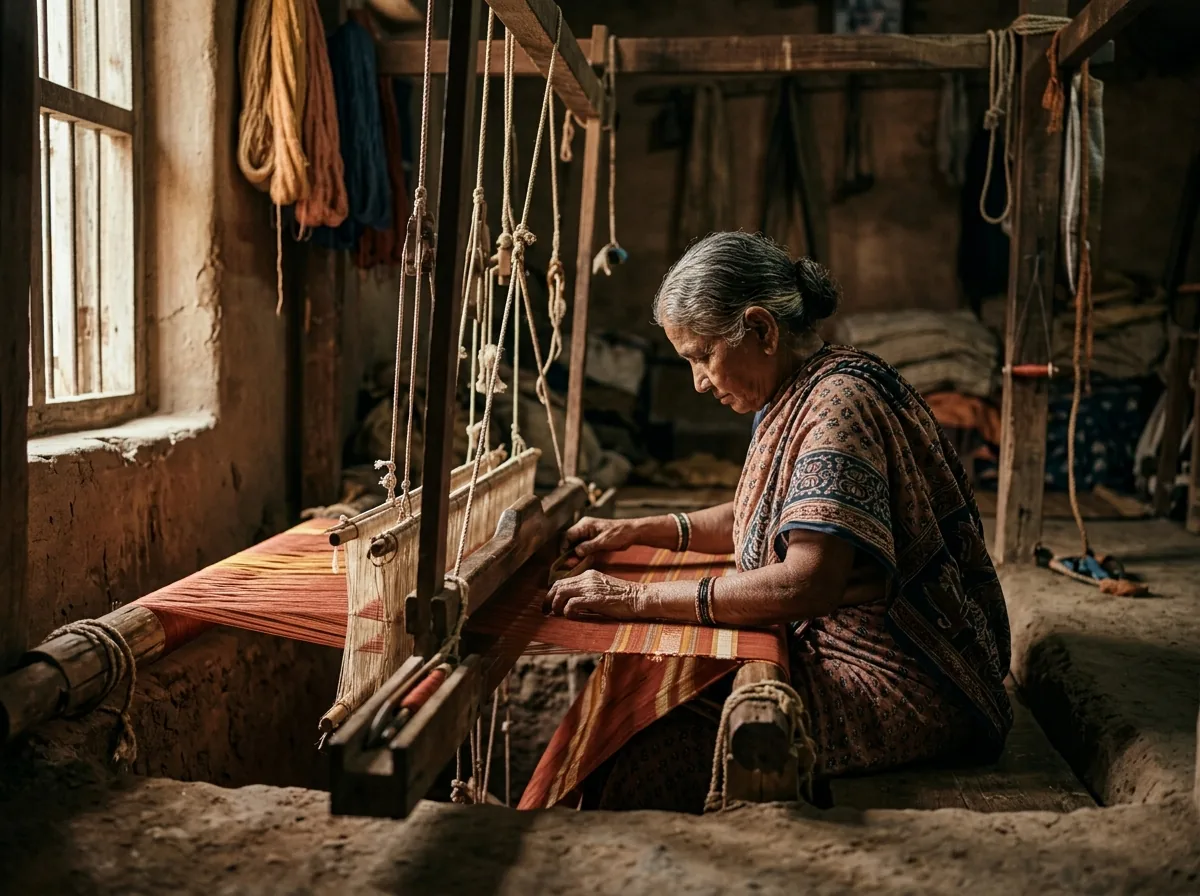
The loom does not sleep. It only waits for the hands that remember.
A City That Weaves Its Own Sky
Varanasi does not belong entirely to the living. It is a city held in trust by the dead, the divine, and the devoted, and somewhere within that ancient compact, the weavers found their place. For centuries, the Muslim weaver communities of Banaras, known as the Ansari or Momin, have produced textiles of such concentrated beauty that the cloth itself seems to argue against the passage of time.
To speak of a Banarasi sari is to invoke something more than a garment. It is to acknowledge a city's obsession with light: how it falls on the Ganga at dawn, how it catches in the gold of a zari border, how it transforms silk into something closer to architecture than fabric. The weavers of Varanasi understood light not as an accident but as a material to be worked, folded into the warp and weft until the textile seemed to glow from somewhere within itself.
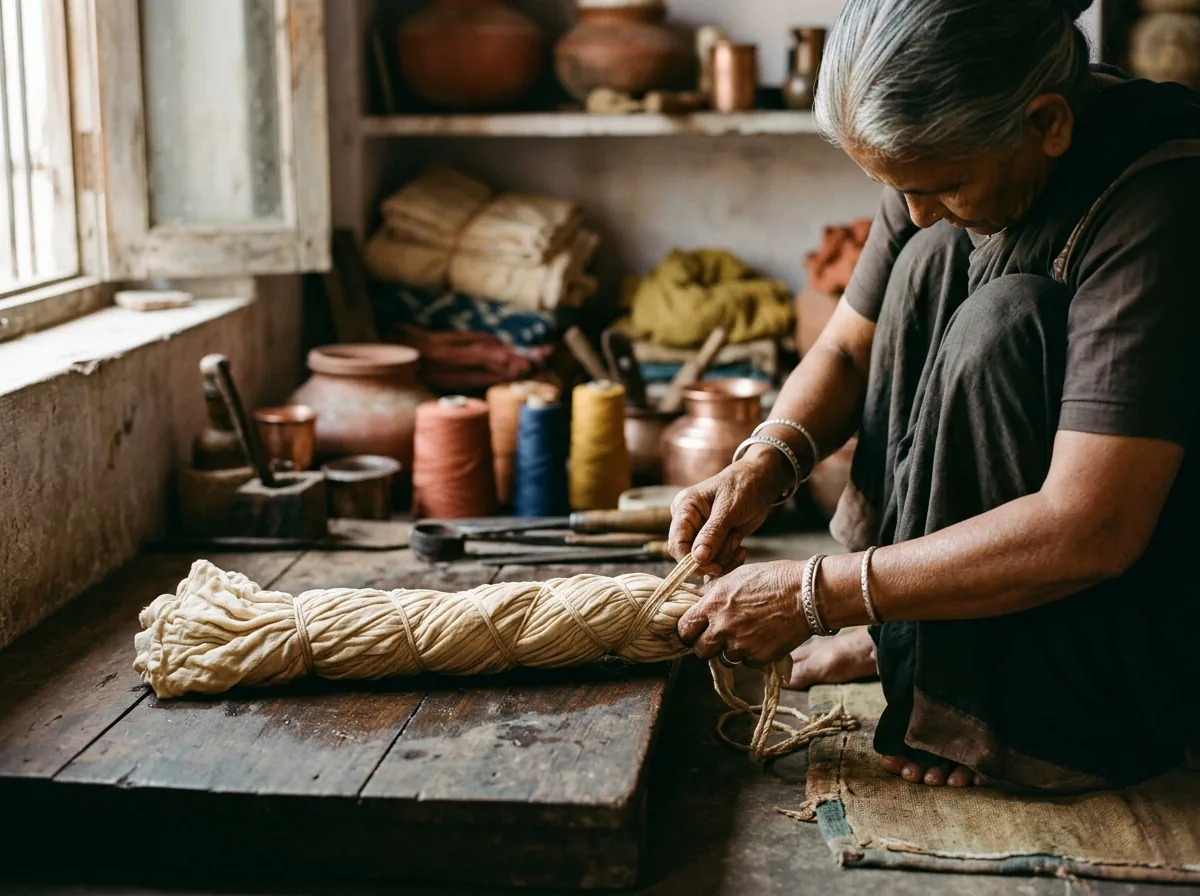
The karkhanas, the weaving workshops that cluster through the old city's lanes, particularly in neighbourhoods like Madanpura, Lallapura, and Alaipura, have been the quiet engines of this tradition. These are not romantic spaces in any picturesque sense. They are working rooms, often low-ceilinged and dense with the rhythmic percussion of pit looms, where several generations of a family may share the labour of a single commission. The tradition is oral, physical, passed through watching and doing rather than through any formal pedagogy. A child in a karkhana learns to read the naksha, the design card, before he learns to read a textbook.
The Mughal Thread and Its Long Afterlife
The debt that Banarasi weaving owes to the Mughal court is neither simple nor sentimental. When the emperors of the Mughal period established their patronage networks across the subcontinent, they brought with them Persian aesthetic vocabularies: the arabesque, the flowering vine, the dense symmetry of the jali screen translated into textile form. Artisans from Persia, Central Asia, and the established weaving towns of Fatehpur Sikri and later Agra contributed to what would become a shared design language, one that the Ansari weavers of Varanasi absorbed, transformed, and made entirely their own.
The motifs that persist across Banarasi weaves today carry the residue of this history in their very names. The kairi, the mango or paisley form, arrived via the Persian boteh and settled so completely into the Banarasi vocabulary that it no longer feels borrowed. The jangla pattern, a dense floral lattice that covers the body of the sari in a continuous field, recalls the manuscript illuminations of the Mughal atelier. The shikargah, the hunting scene woven across a sari's breadth, represents an entire court's leisure translated into silk.
What makes this lineage remarkable is not mere imitation. The Banarasi weavers did not preserve Mughal motifs as museum objects. They subjected them to continuous editing, compression, and elaboration across generations, so that a contemporary kaduwa weave, where motifs are woven individually on separate shuttles for maximum definition, contains within it centuries of aesthetic argument. The motif has been questioned, refined, and reaffirmed so many times that it now belongs to a different civilisation entirely, one rooted not in imperial patronage but in the karkhana itself.
Silk, Zari, and the Grammar of Weave Structures
Banarasi textiles are not a single fabric but a family of distinct weave traditions, each with its own technical demands and its own visual register. Understanding these categories is not pedantry; it is the beginning of genuine appreciation.
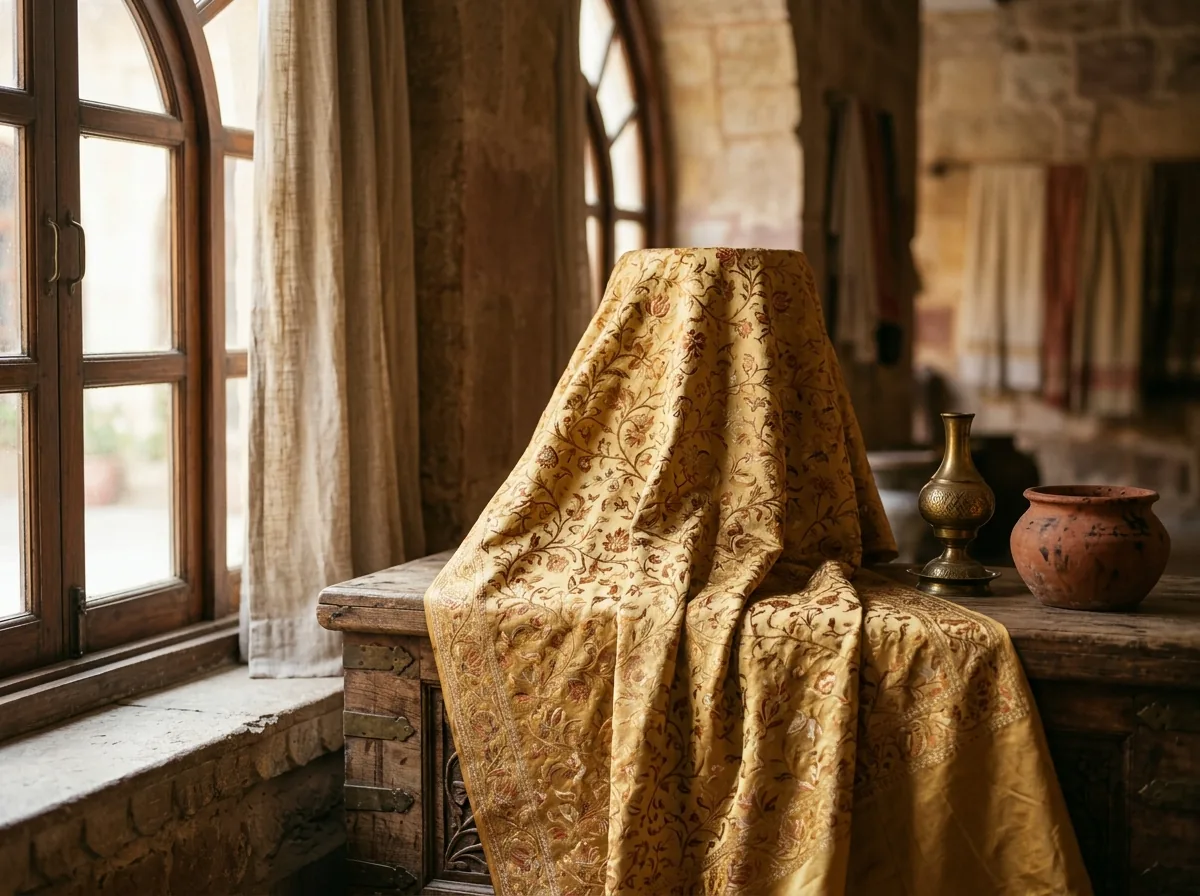
The katan silk sari uses a pure silk warp and weft with no embellishment in the base fabric, allowing the zari and the motif work to assert themselves against a ground of quiet lustre. The organza-based kora sari, lighter and more transparent, carries its zari work with a different kind of restraint, the motifs floating on a surface that seems barely to exist. The shattir and the tissue weaves, where zari runs through the ground itself, create fabrics that appear almost metallic in certain light, recalling the kinkhab brocades that were once exclusive to imperial commissions.
Then there is the tanchoi, a technique that arrived in Surat during the nineteenth century via Chinese weavers from Shanghai and was subsequently absorbed into the Banarasi repertoire: its characteristic is a satin-weave ground with the pattern woven in without any floating threads on the reverse, giving the cloth a clean, reversible finish. The cutwork, or jamdani-adjacent technique sometimes employed in Banarasi weaving, creates patterns by cutting out portions of the supplementary weft, producing a subtle relief.
Zari itself warrants separate attention. The real zari, silver wire wound with gold-coloured silk or coated with real gold, comes traditionally from Surat in Gujarat. The distinction between real zari and the more affordable metallic yarn matters not only to the collector but to the drape, the weight, and the long-term life of the fabric.
The Karkhana Today: Continuity and Contraction
The contemporary karkhana exists under pressures that no amount of cultural affection alone can resolve. The power loom, which arrived in and around Varanasi in significant numbers through the latter half of the twentieth century, altered the economics of handweaving in ways that are still being negotiated. Areas like Bajardiha and the broader Banaras-Mirzapur corridor now contain facilities capable of producing sari volumes that a karkhana of skilled hand-weavers could not match in price or speed.
The Ansari weaver families who have stayed with the handloom often describe a landscape in which the middle of the market has collapsed. The customer for a modestly priced handwoven sari has largely moved to power-loom approximations; the customer for the finest kaduwa or cutwork tissue pieces remains, but the margin between the two has thinned in ways that make succession within families uncertain. Young men who might have taken their place at the pit loom are, in growing numbers, choosing other trades.
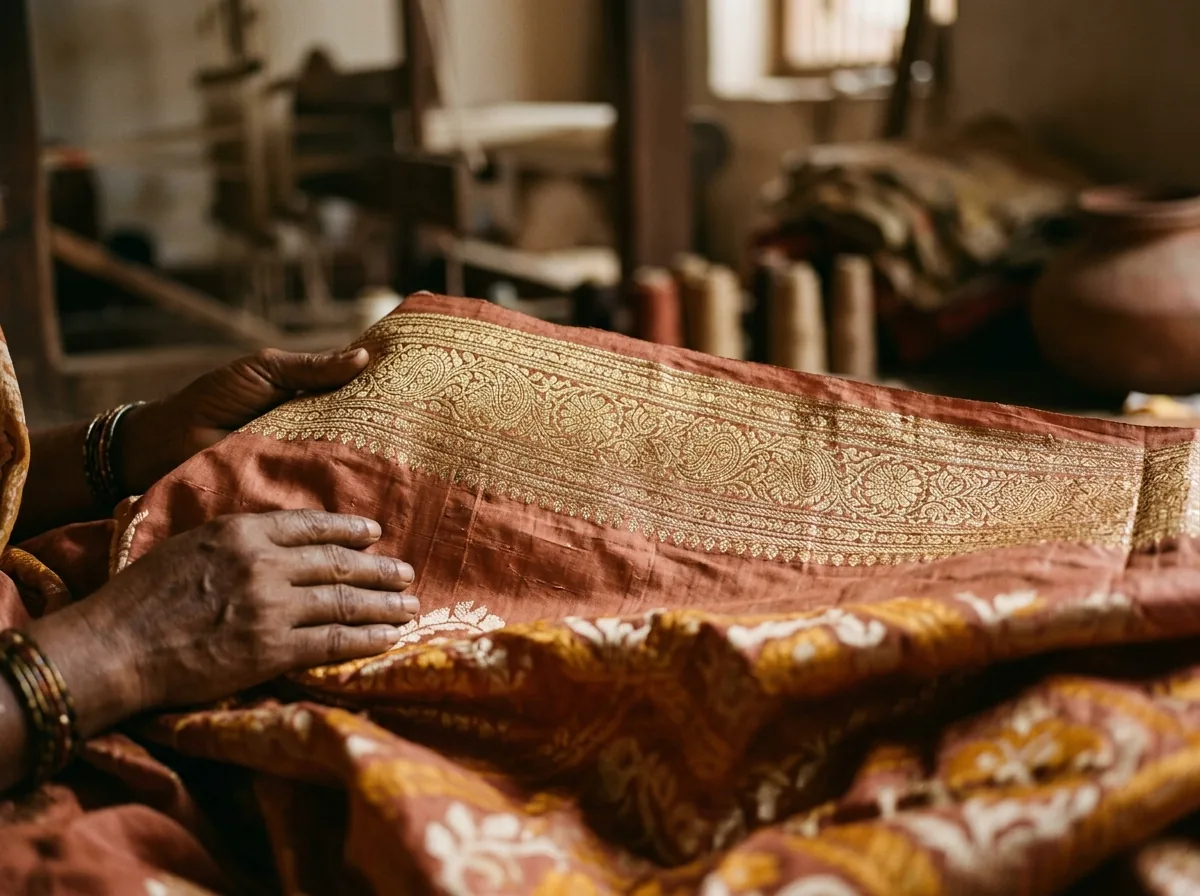
Government schemes, including GI tag protections for Banarasi silk that came into force in 2009, have attempted to create formal distinctions between handwoven and machine-produced cloth. The Geographical Indication status in principle restricts the use of the Banarasi name to genuine handwoven silk from the designated region, covering Varanasi, Chandauli, Jaunpur, Mirzapur, and parts of Azamgarh and Sant Ravidas Nagar districts. In practice, enforcement is uneven. The collector or the careful buyer still needs to know what to look for: the slight irregularity of hand-knotted zari, the way the reverse of a kaduwa piece shows its own grammar, the particular weight of real silk against the palm.
What the Motif Remembers
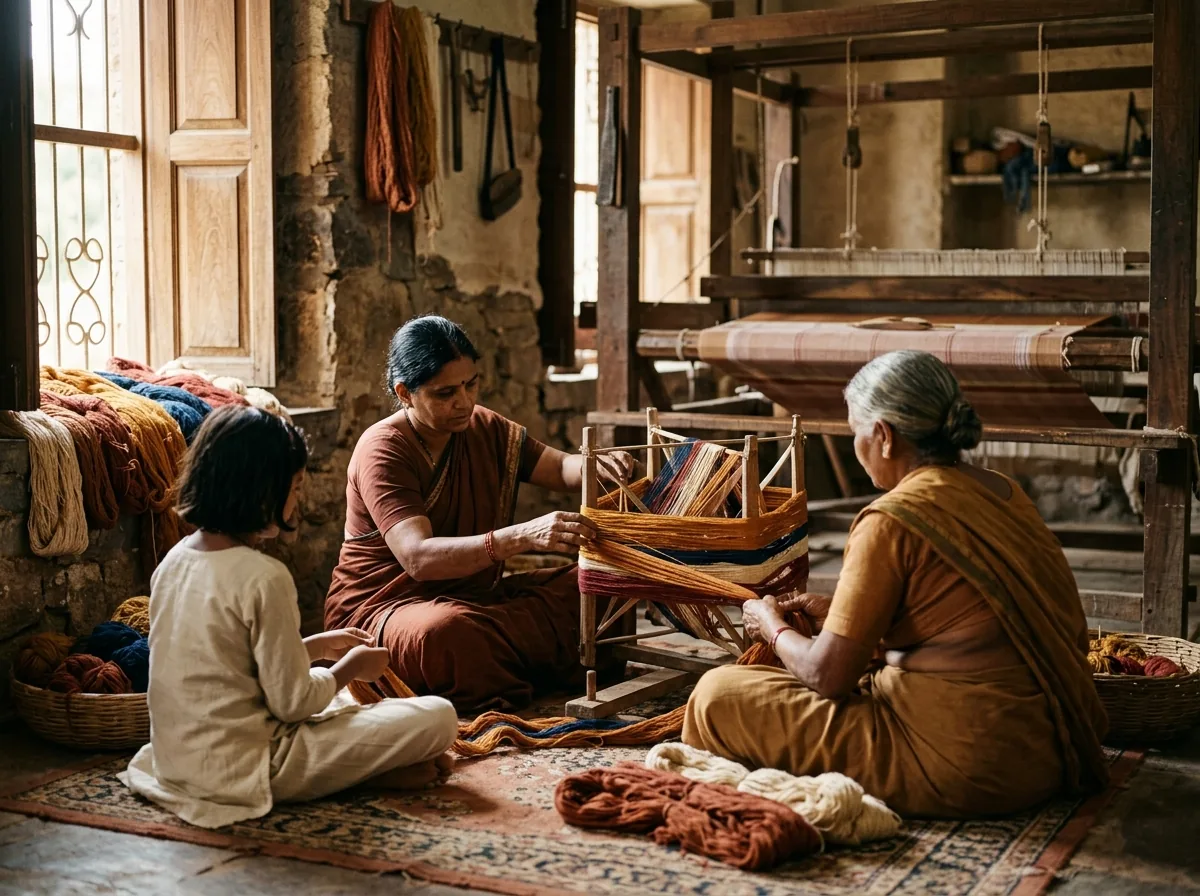
There is a kind of knowledge stored in pattern that resists verbal transmission. When an Ansari master weaver in Madanpura plots a new naksha, selecting from the archive of motifs that his family has accumulated across generations, he is making decisions that are simultaneously aesthetic, technical, and historical. He knows which floral forms respond well to a particular gauge of zari. He knows which geometric grounds allow the eye to rest between areas of density. He is, in a sense, editing a text that has been in continuous revision for four hundred years.
This is what distinguishes Banarasi weaving from surface decoration. The motif in a kaduwa brocade is not applied to the fabric: it is the fabric, constituted in the same act of weaving, inseparable from the ground that carries it. The distinction matters because it means that every design choice has structural consequence. A motif that is too dense collapses the weave. A border that is too wide distorts the drape. The weaver must think simultaneously in two registers: the visual and the structural, and it is the discipline of holding both in mind at once that defines the craft's highest practice.
The Cloth That Outlasts Its Occasion
A fine Banarasi sari, if it is cared for with even moderate attention, does not age in the way most textiles do. The silk mellows; the zari, if it is the real article, develops a depth that new metal cannot replicate. Families who have kept such pieces across three or four generations report that the cloth seems to gather significance with time, the way certain objects do when they have been present at enough of the moments that mattered.
This quality of duration is, perhaps, the most honest argument for the handwoven Banarasi. It is not that the machine-made version is without beauty, or without a place in a thoughtful wardrobe. It is that the handwoven piece participates in a different economy of time. It was made slowly, by hands trained over a lifetime, drawing on a visual language assembled over centuries, in a city that has been weaving since before the word textile had a history worth recording. To wear it is not a performance of heritage. It is simply to be, for a moment, part of something that is still in the process of becoming.