In the blue hour before dawn, the block meets the cloth and the river holds its breath.
The Villages That Carry the Craft
There is a particular quality of light in Kutch in the early morning, when the salt flats are still cool and the air carries the mineral scent of the Rann. It is in this light that the Khatri community of Ajrakhpur and Dhamadka have, for centuries, laid out their freshly printed cloth on the earth to dry, turning the landscape itself into a gallery of geometry. These two villages, separated by only a few kilometres of Gujarat's western terrain, are the twin heartlands of Ajrakh block printing, a tradition so exacting in its demands that it has been compared, not without reason, to a form of devotion.
Dhamadka was the elder settlement, its workshops humming with the rhythm of wooden blocks long before partition reshaped the map of the subcontinent. After the earthquake of 2001 devastated much of Kutch, several families relocated and rebuilt in Ajrakhpur, a village established specifically to house the displaced artisans. What could have been an ending became instead a continuation. The craft did not fracture. It migrated, and then it deepened.
The Khatri community identifies itself through this work. The word "Ajrakh" is believed to derive from "azrak," the Arabic for blue, though scholars debate the etymology with quiet enthusiasm. What is beyond debate is the cloth itself: a field of deep indigo and madder red, patterned with stars, medallions, and interlocking grids that speak a visual language older than any dictionary. To wear Ajrakh is to carry a piece of this landscape, and the people who shaped it, against your skin.
A Ritual in Twenty-One Stages
The number is not metaphorical. The traditional process of Ajrakh printing involves twenty-one distinct stages, each one essential, none negotiable. It begins long before a block ever meets cloth, in the preparation of fabric and the patient assembly of natural dye materials, and it ends only after the cloth has passed through the river multiple times, each immersion deepening and fixing the colours in ways that synthetic shortcuts simply cannot replicate.
The cloth, typically fine cotton, is first washed and treated with a solution of soda ash and castor oil, a process called saaj. This opens the fibres and prepares them to receive what follows. The fabric is then treated with myrobalan, the tannin-rich extract of haritaki fruit, which acts as a mordant, binding future dye molecules to the weave. At this stage the cloth is a pale, unremarkable cream. Nothing in its appearance suggests the richness to come.
Next comes the resist. A mixture of lime and gum arabic is block-printed onto the cloth in precise patterns, masking areas that must remain white. This is the first exercise in negative space, the first act of preservation rather than addition. The block itself is carved from sheesham wood, its surface a map of the motif it will repeat across yards of fabric. A single block, pressed into a tray of resist paste and then stamped with controlled force onto the cloth, must land true. The register, as printers say, must hold. A fractional misalignment compounds across a full length of cloth and cannot be undone.
The stages proceed through mud resist, alum mordanting, drying, and repeat resist application, each layer building toward a final reveal that the artisan carries in his mind throughout.
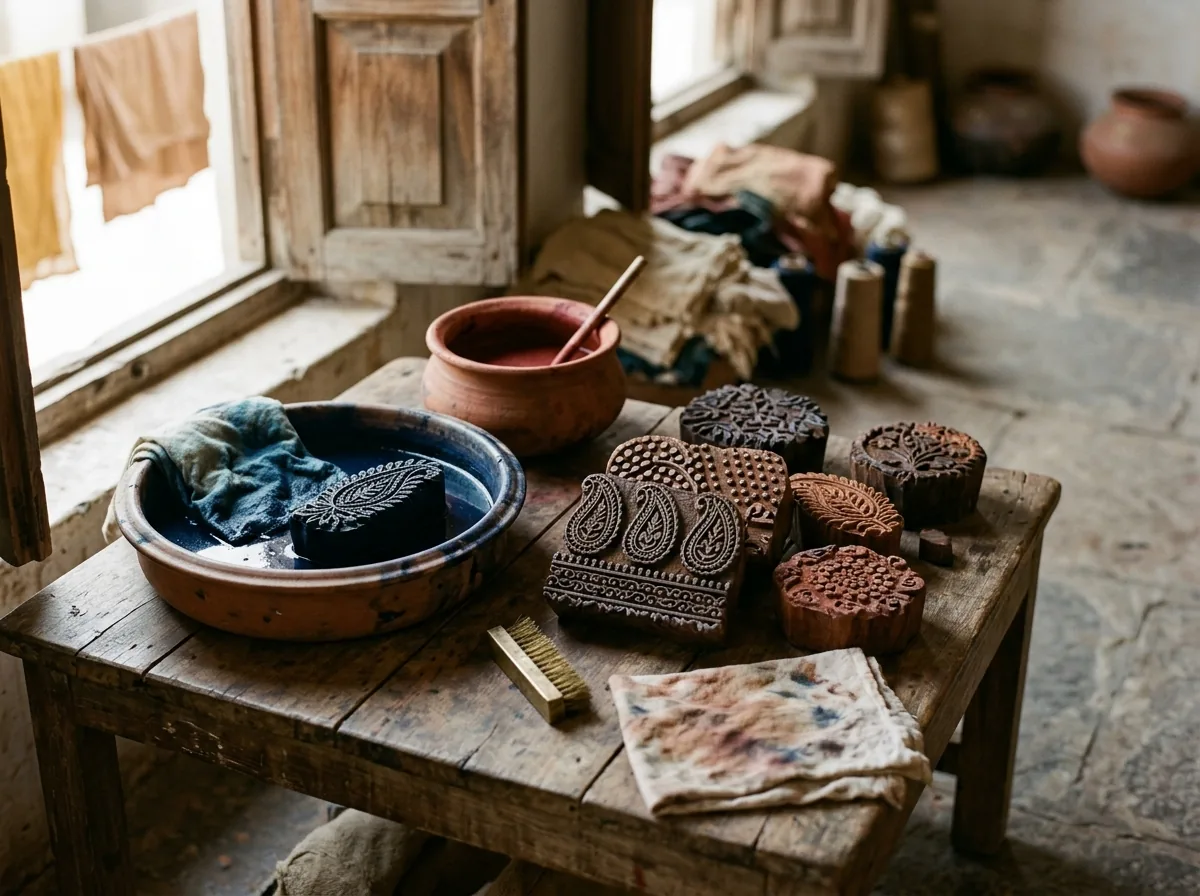
The Grammar of Natural Dyes
Indigo is a living substance. It arrives as a powder or paste, prepared from the leaves of Indigofera tinctoria, and it requires a vat that is carefully maintained at the right temperature and pH, fed with reducing agents that create the conditions for dye to bond with fibre. When cloth is lifted from an indigo vat it emerges green, and only on exposure to air does it turn, oxidising into the deep, dependable blue that has defined Ajrakh for generations. This transformation, observed a thousand times, never quite loses its quality of surprise.
Madder root, sourced from Rubia tinctorum and its Indian relatives, provides the terracotta and crimson tones that sit beside indigo in the classic Ajrakh palette. The mordant applied to the cloth determines the precise shade: alum produces red; iron shifts the same dye toward black or dark grey. The Khatri artisans understand this chemistry not as abstraction but as lived knowledge, calibrated through seasons and generations of practice.
Pomegranate rind, harda (haritaki), alizarin, and iron-rich water from the Dhamadka riverbed have all played their roles in the Ajrakh palette at different points in its history. The river water of the region, carrying particular mineral compositions, was considered integral to the quality of the final colour. After the 2001 earthquake, when many families moved to Ajrakhpur, they discovered that the local water yielded slightly different results, and adjusted their processes accordingly. This responsiveness to place is not an accident. It is the essence of a craft tradition that has never tried to insulate itself from its environment.
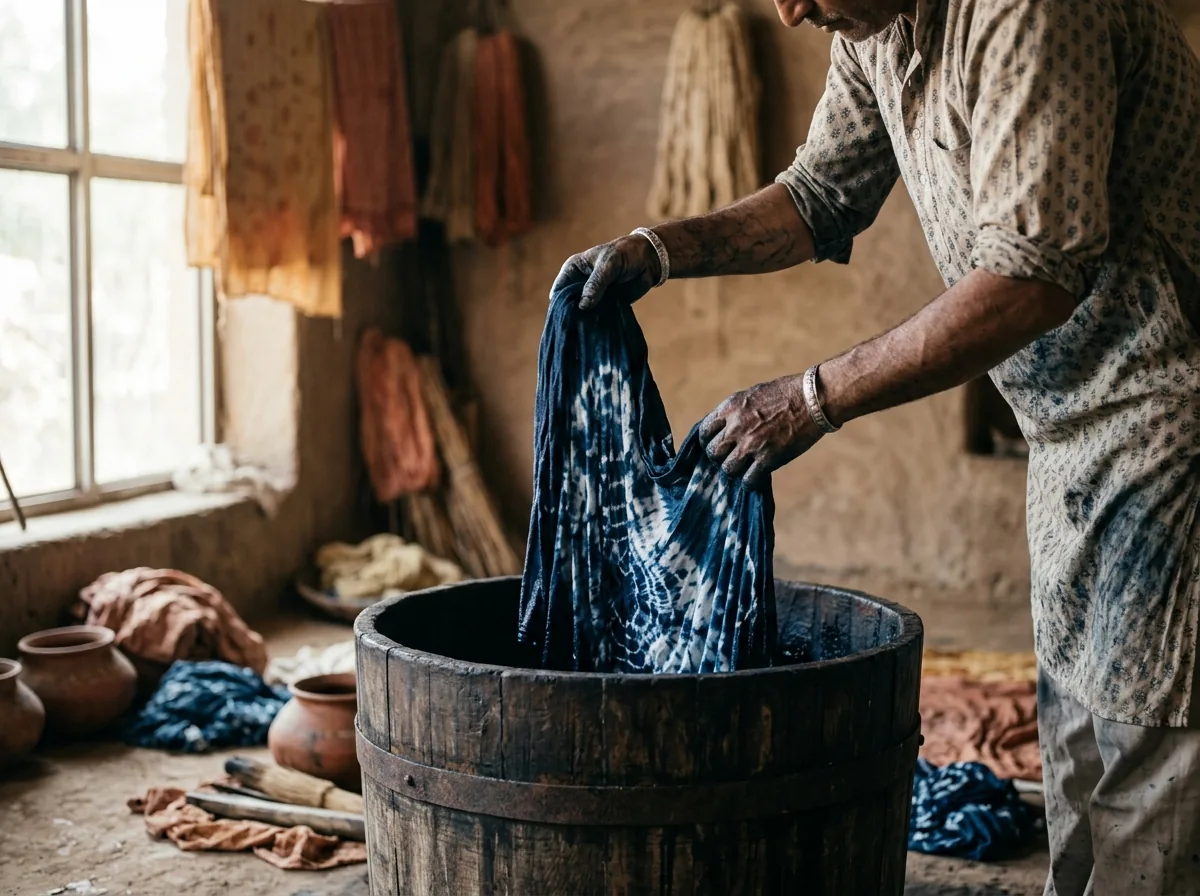
Block and Body: The Physical Discipline of Printing
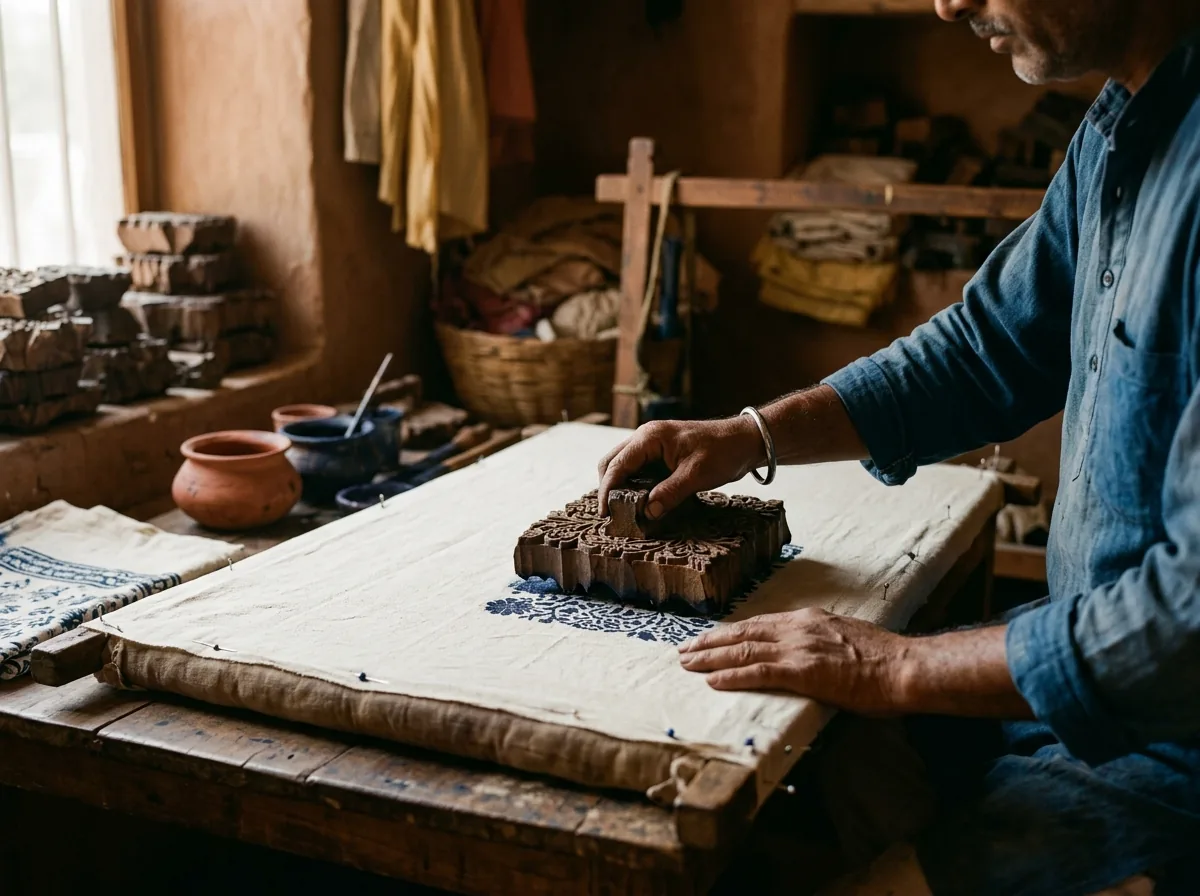
To watch an experienced Khatri artisan print Ajrakh is to understand that the craft lives in the body as much as in the mind. The block is gripped firmly but not rigidly, angled slightly to ensure even ink distribution, then brought down onto the cloth with a single, unhesitating press. The artisan's body weight moves through the motion. There is no second attempt. Lifting and repositioning a block that has already made partial contact leaves a ghost impression, a doubling that marks the cloth as imprecise.
Accurate registration across the full length of a cloth, often six metres or more, requires the printer to maintain a consistent rhythm and spatial memory. The pattern repeat must align at every junction. On complex two-sided Ajrakh, where both faces of the cloth are printed so that the design shows equally from either surface, the challenge multiplies. The blocks must match across the thickness of the fabric.
The artisan works on a long padded table, the cloth stretched flat and pinned at intervals. The paste trays sit at one end. The wooden blocks are stored in a particular order, each one a record of hundreds of hours of a craftsman's carving. Motifs include the eight-pointed star, the arabesque scroll, the fine-line geometric grid, and the floral medallion. These forms recur across Islamic geometric tradition and appear in Ajrakh in configurations that suggest long-distance cultural conversation, across trade routes and centuries.
The printing of a single saree-length piece of cloth, done correctly, takes a full day. The preparation that precedes it takes several days more.
Time, Washing, and the River's Role
No stage of Ajrakh is passive, but there is something particular in the act of washing. After the resist and dye stages have been completed, the cloth is taken to running water and washed thoroughly, loosening the spent resist and rinsing away surface dye. This is where excess falls away and what remains is what was truly fixed. The river, historically the Dhamadka, acted as a collaborator in this process, its particular mineral content softening and brightening the colours in ways that standing water does not replicate.
The washing stages are interspersed throughout the twenty-one steps, not reserved for the end. Each immersion is a checkpoint, an opportunity to assess what the cloth holds and to decide what comes next. It is also, in a more contemplative sense, a form of editing. The craft has no room for sentiment about any individual stage. If the colour has not fixed, the process must be corrected before continuing.
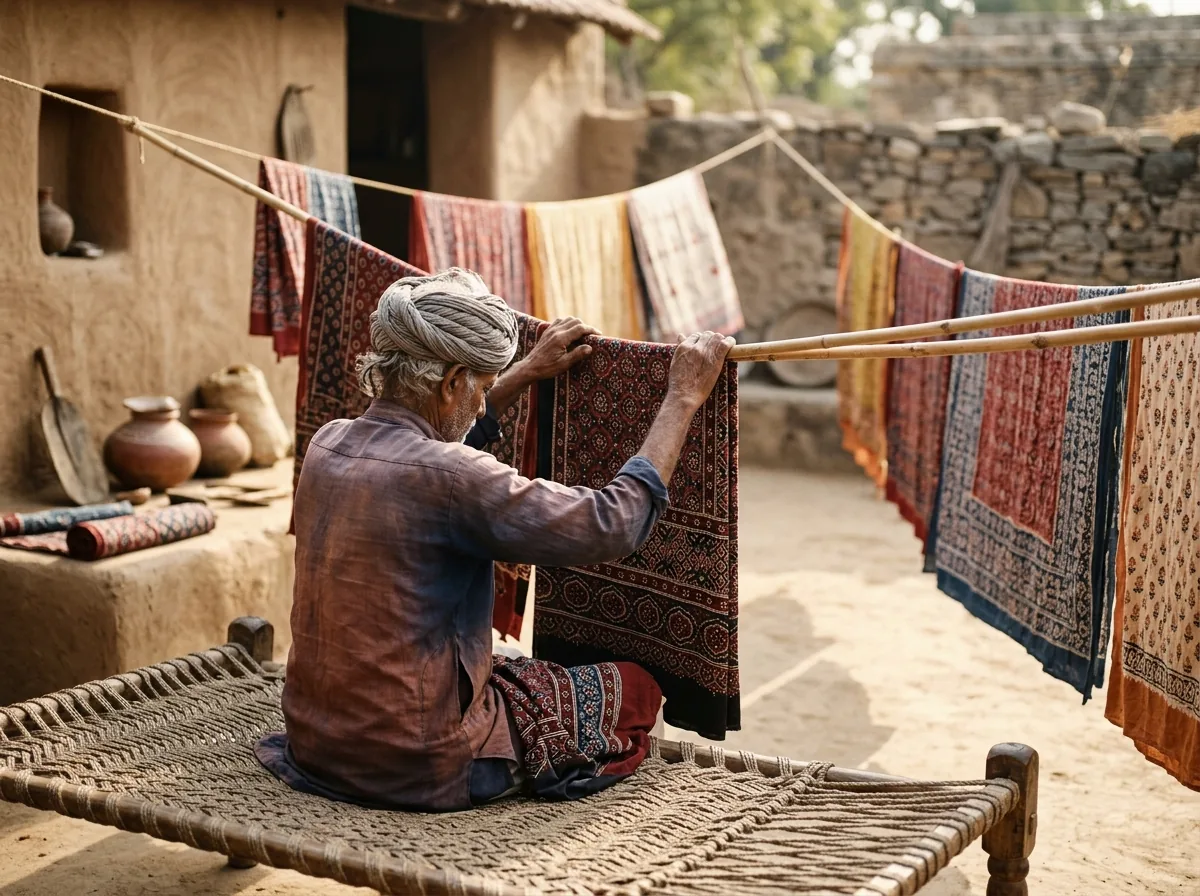
After the final wash, the cloth is stretched and dried on the earth or on racks in the open air. In Ajrakhpur, this sight is one of the defining images of the village: long lengths of patterned red and blue cotton laid flat on the pale ground, or hung between wooden poles in the sun, the geometry repeating across the landscape until it seems the cloth is not drying but growing, extending itself outward toward the Rann.
This final drying is also an act of public declaration. The cloth that emerges is complete, and it carries in its fibres the full record of what was done to make it.
What the Cloth Remembers
Ajrakh does not belong to a single moment in history. Its motifs have been found on fragments excavated from Mohenjo-daro, placing them at the outermost reaches of traceable South Asian material culture. They appear in the garments of Sindhi and Kutchi communities across the subcontinent and in the diaspora, worn at ceremonies, traded along the old caravan routes that connected Kutch to Persia, East Africa, and the ports of the Arabian Sea.
The Khatri families who carry this tradition today navigate between deep continuity and genuine change. New markets have encouraged experimentation with silk and wool as base fabrics. Some artisans have introduced additional natural dye colours, expanding beyond the classic red and blue into saffron, green, and grey. These innovations sit alongside the unchanged core of the practice: the twenty-one stages, the natural dye chemistry, the wooden block, the river.
What Ajrakh offers to the person who wears it is not merely a beautiful textile. It is participation in an argument, quiet but persistent, for the value of slowness, of material intelligence, of craft knowledge carried in the hands across generations. The cloth has already been through fire and water, through resist and revelation. It arrives having already survived something. That quality does not wash out.